
European turtle dove
Streptopelia turtur
Description
How to identify
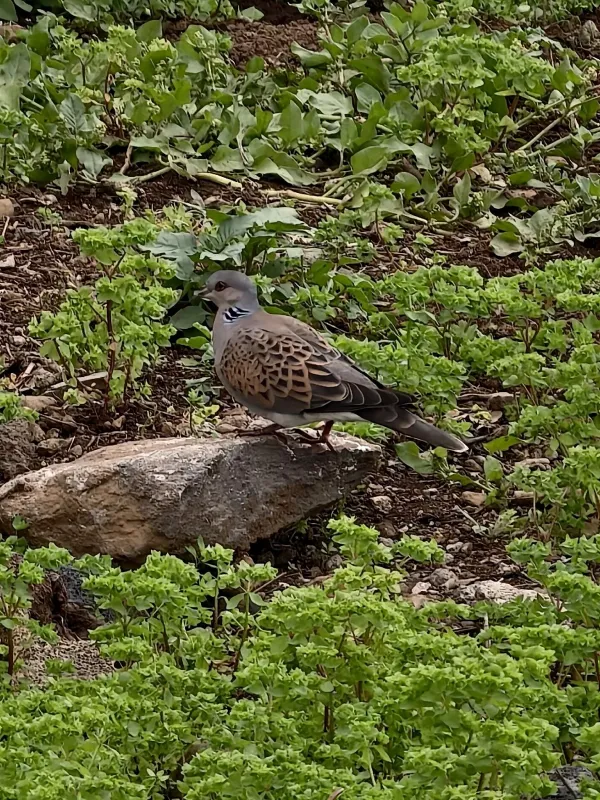
The European turtle dove (Streptopelia turtur) is a member of the Columbidae family. It is a migratory bird known for its slender build and distinctive scalloped wing patterns.
Adults are easily identified by the dark patch on the side of the neck, accented with white stripes. They are smaller and more graceful than common feral pigeons.
These birds prefer to nest in trees and thickets located near open agricultural lands. Their nesting behavior allows them to utilize edges of fields as primary foraging grounds.
The biological cycle of the turtle dove is closely linked to the availability of seeds. They typically breed twice per season, which increases their foraging pressure on crops during peak summer months.
Unlike some other birds, they are quite cautious. When foraging, they move in small flocks and are highly alert to human presence, making them difficult to approach once they have settled on a field.
What it damages
The European turtle dove primarily targets cereal crops, including wheat, barley, millet, and sunflowers. They feed on the grain during the milk and soft dough stages.
Damage is most severe at the edges of fields adjacent to woodland or shrubbery. The birds efficiently strip the grain from the stalks, leading to significant yield losses.
Beyond direct grain consumption, the weight of the flock can cause stems to lodge or break. This mechanical damage hinders harvesting and increases the amount of grain left on the soil.
Damaged heads are more susceptible to secondary fungal infections. This reduces the overall quality of the grain, making it unsuitable for certain industrial purposes.
For smaller agricultural plots, the damage can be substantial as these birds can quickly clear the heads from a large proportion of the available crop surface.
When it appears
The period of highest risk occurs from June to the end of August, coinciding with the grain ripening phase. As summer progresses, the birds' foraging activity increases.
After arriving from their wintering grounds in May, the birds establish nests. As their young mature and join the feeding flocks, the pressure on nearby agricultural crops reaches its peak.
In late August, as the harvest begins and grain becomes less available, the turtle doves prepare for their southward migration, causing the feeding pressure to decline.
Seasonal weather conditions can exacerbate damage. In dry years, natural food sources become scarce, forcing the birds to rely more heavily on agricultural crops for their survival.
Monitoring the fields during the early summer is essential. Detecting early flock activity allows farmers to deploy deterrents before the birds become habitual visitors to the site.
Signs of infestation
Identifying the presence of turtle doves involves observing groups of birds near field edges at dawn or dusk. They are easily startled and will fly off at the first sign of disturbance.
A primary sign of infestation is the presence of partially or fully threshed heads. You will notice significant portions of the crop empty of grain while the surrounding husk remains.
Bird droppings found on the ground and on the stalks are clear evidence that a large flock has been feeding on the spot for an extended period.
The accumulation of chaff and plant debris directly underneath the feeding zone is a strong indicator of intense, concentrated feeding activity by the flock.
Patches of flattened or broken stems along the periphery of the field indicate high-traffic zones where the birds consistently congregate during their feeding cycles.
Control measures
Protecting grain crops requires a multi-layered approach involving visual and auditory deterrents. Dynamic scarecrows resembling predatory birds like hawks or falcons are often effective.
Bioacoustic deterrents, which simulate predator calls or bird distress signals, help maintain a protective buffer zone around the crop and discourage the doves from landing.
Good agricultural practices, such as clearing weed-heavy bushes and thickets near field borders, reduce the availability of resting and observation points for the birds.
Timely harvesting remains the most effective management strategy. By removing the crop quickly once it reaches maturity, the food source is eliminated, forcing the birds to migrate elsewhere.
- Deploying moving predatory bird silhouettes.
- Using propane cannons for timed auditory deterrence.
- Installing reflective tape and flashing elements at field edges.
- Maintaining field perimeters to limit nesting proximity.
Taxonomy
- Latin name
- Streptopelia turtur
- Family
- Columbidae
- EPPO code
- STPETU
Discussion
No discussions yet — be the first.