
Red-eyed dove
Streptopelia semitorquata
Description
How to identify
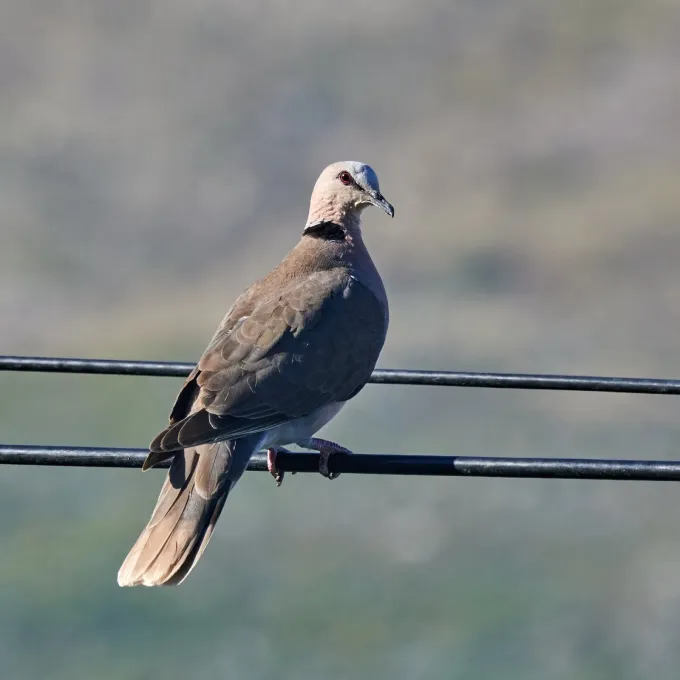
The red-eyed dove (Streptopelia semitorquata) is a member of the Columbidae family. It is a large, robust dove species easily identified by the distinct red skin patch around its eyes.
Adult birds typically reach lengths of 30 to 35 cm. They feature a dark, half-collar on the back of their necks and a plumage dominated by earthy brown and grey tones.
They are highly gregarious birds, often found in large flocks, especially when food resources are abundant, such as in cultivated fields and grain storage areas.
Known for their adaptability, these birds thrive in proximity to human settlements and agricultural zones, which has established them as persistent pests in many regions.
The species vocalizes with a deep, rhythmic cooing sound, which often serves as a key indicator of the presence of a flock in the vicinity of a crop field.
What it damages
This species is considered a major agricultural pest for grain crops, including maize, sorghum, wheat, and millet, as well as various leguminous crops.
The most severe damage occurs during the sowing phase, where birds excavate newly planted seeds from the soil, leading to significant gaps in crop emergence.
During the ripening stages, red-eyed doves feed on maturing grains, directly reducing yield volume and damaging the structural integrity of maize cobs and wheat heads.
By damaging the husks of maize, these birds expose the grain to moisture and subsequent fungal growth, which can lead to further secondary losses in quality.
Small-scale farms and vegetable gardens are particularly vulnerable, as the birds often target high-value crops for both food and supplemental water intake during dry periods.
When it appears
The birds are active throughout the growing season, with peak damage occurring during the planting window and the final ripening phase before harvest.
Because the species is largely non-migratory and maintains high populations year-round, farmers must remain vigilant regardless of the specific time of year.
Reproductive periods can be extended in favourable climates, meaning that new generations constantly replenish the flock size, sustaining persistent pressure on crops.
Drought conditions significantly influence their movement, forcing flocks to concentrate near irrigated farmlands and orchard zones in search of moisture.
Their activity patterns are largely diurnally driven, with birds feeding intensely in the early morning and late afternoon hours on the edges of fields.
Signs of infestation
Obvious signs of infestation include patchy crop growth, where seeds have been uprooted, leaving behind small holes in the soil surface.
Evidence of feeding on mature crops includes broken maize husks, missing kernels, and shattered wheat heads, often found littered on the ground underneath nearby trees.
Large amounts of droppings on fences, power lines, and tree branches surrounding a field are strong indicators that the area is being used as a staging or resting site.
Frequent visual sightings of large groups of doves taking flight from a field when disturbed are a clear warning that the crop is being targeted.
The rhythmic, loud cooing heard consistently around dawn and dusk indicates that a nesting or resting colony is nearby, threatening your nearby plantations.
Control measures
Acoustic deterrents, such as gas cannons or recorded alarm calls of predators, are effective in discouraging flocks from establishing feeding patterns in a field.
Visual aids like reflective tape and realistic raptor decoys can provide short-term relief, though their effectiveness requires frequent repositioning to avoid bird habituation.
Improving agronomic practices, such as increasing the depth of seed planting, can help protect grains from surface-feeding by birds during the critical germination period.
Using bird-repellent chemical seed treatments can make the seeds unpalatable, reducing the rate of consumption during the initial sowing stages.
- Regular monitoring of field margins for bird activity.
- Removing nearby roosting trees or dense vegetation near crops.
- Coordinating with neighboring farms to apply uniform control measures.
Taxonomy
- Latin name
- Streptopelia semitorquata
- Family
- Columbidae
- EPPO code
- STPESM
Discussion
No discussions yet — be the first.