
Oriental turtle dove
Streptopelia orientalis
Description
How to identify
The Oriental turtle dove is a member of the Columbidae family, distinguished by its larger size and characteristic plumage compared to other dove species.
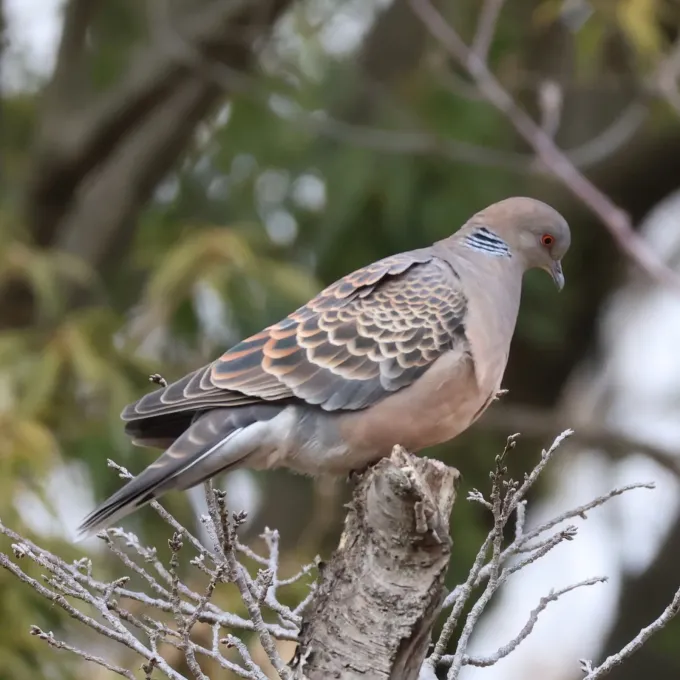
The bird reaches approximately 30 cm in length, featuring brownish-grey feathers with distinct rufous or ochre edges, creating a scaled appearance on its wings.
A diagnostic feature is a black patch on the side of the neck, accented by white or pale blue stripes, which is easily visible when observing them closely.
These birds are typically found in open areas near woodlands or hedgerows, providing them with safe nesting sites and cover after foraging on agricultural fields.
Their song is a rhythmic, low-pitched cooing sound that serves as an acoustic marker, helping farmers identify their presence near crop fields during early hours.
What it damages
The Oriental turtle dove causes significant agricultural damage by feeding on grain crops, particularly during the maturation and harvest stages.
Wheat, barley, millet, and buckwheat are primary targets, as the birds congregate in large flocks to feed directly on ripening grain heads.
Beyond the grain consumption, the birds cause physical damage by trampling seedlings and crushing stems, which negatively impacts plant stand density.
Damage is often most severe at the edges of fields bordering trees, where the birds have quick access to escape routes if disturbed by predators or human activity.
In regions with high population densities, the economic impact is felt through substantial yield reductions and the necessity of reseeding patches where birds consumed the grain.
When it appears
The pest activity of the Oriental turtle dove begins in the spring, as they can feed on freshly sown seeds if they are not buried at sufficient depth.
During the summer, the threat peaks as crops enter the milk-wax and full ripening phases, making the grain highly attractive for the birds' diet.
Frequent flocking activity is observed throughout the maturation period, requiring constant monitoring by agricultural managers to prevent large-scale crop losses.
Autumn migration periods may lead to localized increases in dove numbers, potentially impacting late-harvested fields or fields where significant grain spillage has occurred.
The birds demonstrate a consistent daily rhythm, with two primary feeding peaks — once in the early morning and once just before dusk.
Signs of infestation
Signs of infestation include visible patches of flattened, trampled crops where large flocks have gathered to forage for an extended period.
Empty glumes and broken chaff found on the ground or within the grain heads are clear evidence of birds extracting the grains.
Accumulation of droppings at the field margins, particularly under favorite perching trees or electrical wires, indicates high bird density.
- Flattened and trampled crop patches.
- Empty grain husks and broken stalks.
- Presence of feathers near field borders.
- Accumulated bird droppings in resting areas.
The auditory signs, such as constant cooing coming from nearby trees and the loud sound of wings during take-off, are reliable indicators of active feeding.
Control measures
Effective control of the Oriental turtle dove relies on non-lethal deterrent strategies that aim to discourage the birds from visiting crop fields.
Bioacoustic devices, which play recordings of predator calls, are highly effective at scaring flocks away from large agricultural land plots.
Visual deterrents, including predator silhouettes, spinning reflective tape, or motion-activated devices, provide a temporary but useful barrier for protecting high-risk zones.
Good agricultural practices, such as ensuring precise sowing depth and conducting harvest operations with minimal grain spillage, effectively reduce the available food source.
Where bird pressure is extreme, implementing field rotations or using physical barriers on small-scale crops can help preserve the yield for the farmers.
Taxonomy
- Latin name
- Streptopelia orientalis
- Family
- Columbidae
- EPPO code
- STPEOR
Discussion
No discussions yet — be the first.