
Twin-toothed soldier fly
Stratiomys furcata
Description
How to identify
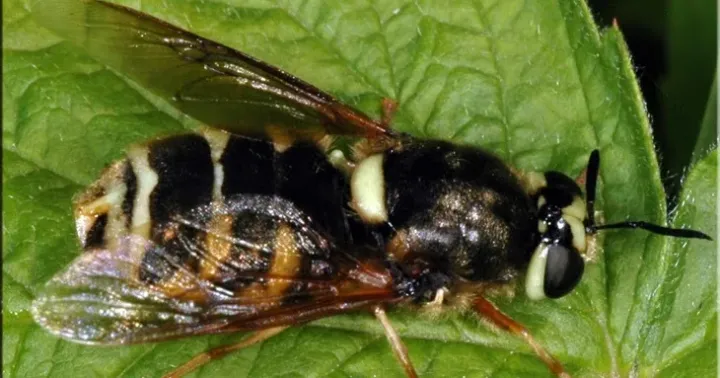
The twin-toothed soldier fly belongs to the Stratiomyidae family within the order Diptera. Adults are characterized by their relatively large size and distinctive, often bright yellow or white markings on the abdomen, mimicking wasps.
The larvae possess an elongated, flattened body structure covered in a tough, wrinkled cuticle. They feature a specialized breathing apparatus at the posterior end, which enables them to reside in semi-aquatic or saturated environments.
Their head is small and retractable, facilitating movement through dense decaying organic matter. This morphological adaptation allows the larvae to thrive in high-moisture, nutrient-rich habitats such as decaying compost.
Adult flies are frequently observed on flowers, feeding on nectar and pollen. Their flight pattern is typically slow and deliberate, and they rest with their wings folded flat over their abdomens, which serves as a key identification feature.
The life cycle follows complete metamorphosis: egg, larva, pupa, and adult. The pupal stage is protected by the final larval skin, known as a puparium, which provides essential environmental insulation.
What it damages
The twin-toothed soldier fly (Stratiomys furcata) is not considered a pest of agricultural crops. It is a saprophagous insect, meaning its diet consists primarily of decaying organic material.
The larvae inhabit moist areas, including compost heaps, manure piles, or water-saturated soil. They do not consume live plant tissues, roots, or fruits of healthy crops, thus posing no direct threat to agriculture.
These insects play a beneficial role in the ecosystem by acting as decomposers, accelerating the breakdown of organic matter and returning nutrients to the soil profile.
Their presence on a farm or garden is usually an indicator of abundant organic resources rather than an infestation that requires pest control measures.
In summary, there is no economic damage associated with this species; therefore, it should be categorized as an ecologically useful insect rather than a pest.
When it appears
Adult activity of the twin-toothed soldier fly is primarily observed during the summer months, typically spanning from June to August, coinciding with peak floral availability.
The larvae undergo a prolonged developmental phase, often overwintering in protected, moist environments such as deep leaf litter or the top layers of humus-rich soil.
With the arrival of stable spring warmth, the physiological processes of the larvae accelerate, leading to the formation of pupae and the subsequent emergence of the adult flies.
The population density and distribution are heavily influenced by the availability of nectar sources for adults and suitable decomposing organic substrates for larval development.
Generational shifts are temperature-dependent, with warmer summers potentially allowing for more successful survival rates of the larval population.
Control measures
Since the twin-toothed soldier fly is not an agricultural pest, no chemical or biological control programs are necessary or recommended.
For those seeking to reduce the presence of these insects near residential or gardening areas, focus should be on proper sanitation, such as removing stagnant organic waste and managing compost heaps effectively.
Improving field or garden drainage is an efficient way to reduce the high-moisture conditions that female flies find attractive for oviposition.
Compost should be kept covered or managed in a way that minimizes surface moisture, effectively limiting the recruitment of larvae in unwanted locations.
The application of insecticides is strictly discouraged, as it disrupts the beneficial decomposer community and harms the overall biological balance of the soil ecosystem.
Taxonomy
- Latin name
- Stratiomys furcata
- Order
- Diptera (flies)
- Family
- Stratiomyidae
- EPPO code
- SRMSFU
Discussion
No discussions yet — be the first.