
Black soldier fly
Hermetia
Description
How to identify
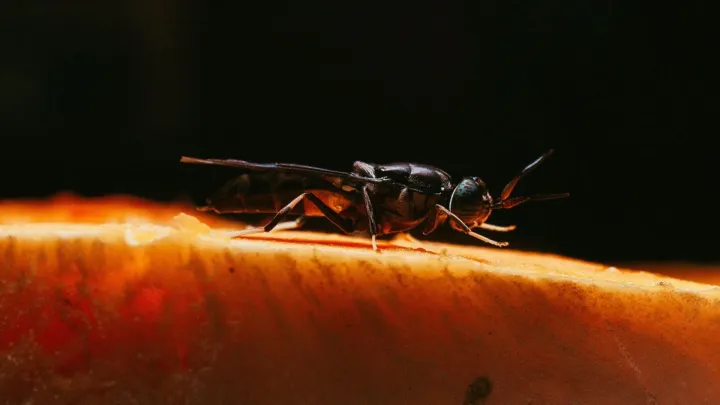
The Black soldier fly (Hermetia illucens) is a member of the order Diptera and the Stratiomyidae family. Adults typically reach lengths of 15 to 20 mm and possess a distinct black body, sometimes with translucent abdominal segments.
The life cycle consists of four distinct stages: egg, larva, pupa, and adult. Adult flies are non-feeding and focus exclusively on mating and laying eggs in organic matter.
Larvae are characterized by a flattened, segmented body with a tough, leathery exoskeleton. They are highly efficient processors of decaying organic waste, thriving in moist environments.
Development is highly temperature-dependent, with optimal growth occurring between 25°C and 30°C. In such conditions, the generation time can be as short as 40 days.
While often farmed for waste management, in uncontrolled environments, they can rapidly establish large populations if favorable substrate conditions are present.
What it damages
Black soldier fly larvae are saprophages, meaning they primarily feed on decaying organic material. They are not considered primary agricultural pests in healthy, well-maintained crops.
Damage occurs primarily when larvae infiltrate agricultural facilities. They may contaminate stored produce by introducing moisture and facilitating bacterial or fungal decay.
In greenhouses, if organic fertilizers are not properly treated, larvae may populate the soil, potentially disturbing the root zones of young or stressed plants.
Their presence can be an indicator of poor sanitation, as they thrive on decomposing plant debris, which indirectly creates an environment conducive to other opportunistic pathogens.
Large populations of larvae can physically disturb the growth medium, altering its chemical composition and making it unsuitable for sensitive vegetable or ornamental crops.
Control measures
Sanitation is the most effective management strategy. Eliminating standing pools of decaying organic waste effectively removes the breeding sites for the fly.
Proper composting techniques, including thermal processing, are essential to ensure that larvae or eggs are not introduced into the greenhouse through organic fertilizers.
Physical barriers such as fine-mesh screens on greenhouse vents and doors prevent adult flies from entering and laying eggs in sensitive areas.
Monitoring for signs of larvae in the substrate allows for early intervention, such as localized removal of organic matter or humidity control measures.
Biological control agents, specifically those targeting dipteran larvae in soil, can be employed if chemical pesticides are not desired or contraindicated.
Taxonomy
- Latin name
- Hermetia
- Order
- Diptera (flies)
- Family
- Stratiomyidae
- EPPO code
- HERESP
Discussion
No discussions yet — be the first.