
Soldier fly
Stratiomys
Description
How to identify
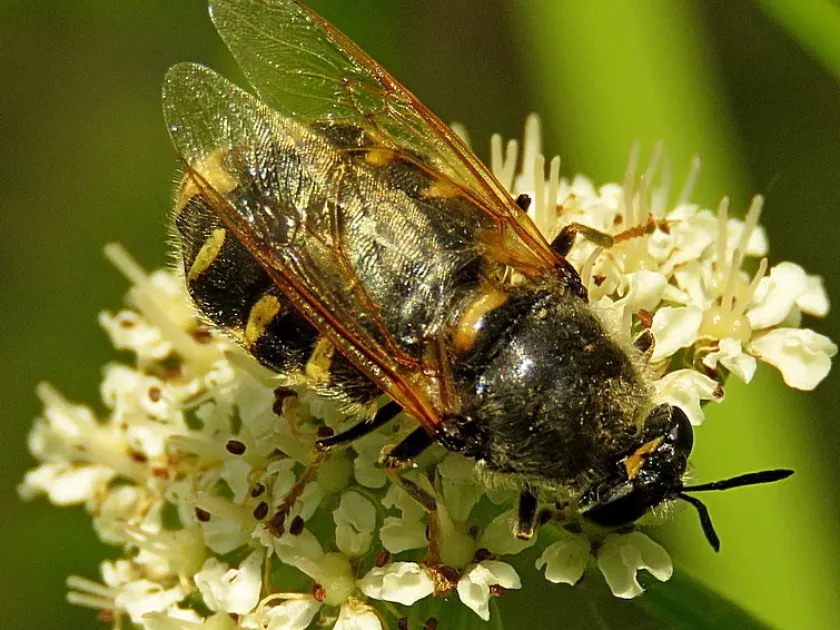
Soldier flies (family Stratiomyidae) are a diverse group of flies that often feature distinctive metallic or bright colors, including yellow, green, and black stripes. Adults typically have a broad, flattened abdomen, which is a common diagnostic feature.
The head of the adult fly is equipped with large, prominent eyes. The wing venation is unique, with the heavy veins clustered towards the leading edge of the wing, making them relatively easy to identify for trained observers.
Their larvae are very different from the adults. They possess a long, flattened, and somewhat rigid body. The cuticle is often tough and may have a textured appearance due to calcium deposits.
A notable feature of the larvae is the specialized respiratory structure at the posterior end, which appears as a crown of feathery hairs, allowing them to breathe air while submerged in damp or aquatic environments.
In general, soldier flies are not categorized as primary agricultural pests because they lack the mouthparts or behavioral adaptations to consume healthy, living plant tissue.
What it damages
Soldier flies are rarely considered pests in horticultural settings. They are saprophagous, meaning their larvae feed primarily on decaying organic matter, such as compost, manure, and rotting vegetation.
By consuming decaying organic material, they play a vital role in nutrient cycling, effectively composting waste and turning it into rich soil amendments.
Direct damage to plants is essentially nonexistent unless there is significant root rot or other decay processes already occurring in the root zone. In such cases, the larvae may be found feeding on the necrotic tissue, which is often mistaken for them causing the rot.
Gardeners should view their presence as an indicator of rich organic activity rather than a sign of a pest infestation requiring immediate intervention.
Their impact on crop health is largely neutral or even positive due to their role in accelerating the decomposition process in compost heaps.
When it appears
Adult soldier flies are typically active during the warmer months, usually appearing from late spring through mid-summer when temperatures favor their flight and reproduction.
The larvae develop throughout the warm season, continuously feeding on moist, decaying organic substrates. Their numbers tend to peak when there is an abundance of food sources available.
Overwintering occurs at the larval stage, with the insects seeking refuge deep within organic matter, compost piles, or deep in the soil where they are protected from freezing temperatures.
In the spring, as temperatures rise, the larvae complete their development and pupate, eventually emerging as adults to start the next generation.
In controlled environments like greenhouses, soldier fly populations can persist year-round if there are consistent moisture sources and organic debris for them to occupy.
Signs of infestation
The most common sign of soldier flies is the presence of their distinct, flat, and somewhat "leathery" looking larvae in damp compost or garden debris.
Adults are frequently observed on flowers or in the vicinity of organic waste, where they feed on nectar and seek out egg-laying sites.
You may notice a rapid rate of decomposition in your compost bin, which is often accelerated by a high concentration of these larvae working through the waste.
If you find insects inside containers with decaying plant material, it is likely that soldier flies have identified the rotting area as a suitable breeding ground.
They do not leave behind characteristic bites or holes on healthy leaves, which distinguishes them from typical foliage-feeding pests.
Control measures
Because soldier flies are generally considered beneficial decomposers rather than pests, targeted chemical control is typically unnecessary and not recommended.
If their presence becomes a nuisance, the best management practice is to maintain proper hygiene and sanitation in the garden and compost areas.
Preventing excessive moisture and stagnant conditions in compost heaps will naturally reduce the attractiveness of the area for egg-laying adults.
Regular aeration of compost bins or piles helps keep the environment less favorable for larval development and encourages faster decomposition through other microbial paths.
- Manage soil and compost moisture levels.
- Ensure adequate drainage in garden beds.
- Practice regular maintenance and aeration of compost.
Taxonomy
- Latin name
- Stratiomys
- Order
- Diptera (flies)
- Family
- Stratiomyidae
- EPPO code
- SRMSSP
Discussion
No discussions yet — be the first.