
Stenophylax permistus
Stenophylax permistus
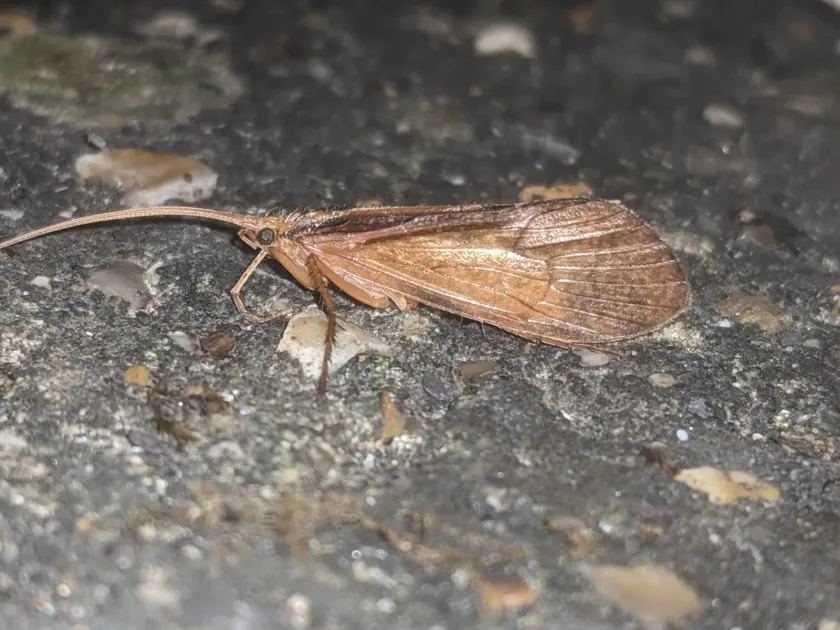
Description
How to identify
Stenophylax permistus belongs to the order Trichoptera (caddisflies) and the family Limnephilidae. Adult individuals are nocturnal insects that resemble moths, often resting with their wings folded over their bodies in a roof-like shape.
The body of the adult is covered in dense hairs, a distinctive trait of this order. The forewings reach 20–25 mm in length, and their coloration typically ranges from grayish-brown to ochre with dark speckles.
Although larvae are aquatic, adults can be found near agricultural fields, especially during periods of migration triggered by rainfall and specific humidity levels.
Precise identification of this species requires microscopic analysis of wing venation, as it visually resembles many other members of the Limnephilidae family found in temperate climates.
The adult insect has well-developed palps and long antennae, which are essential for navigating in the dark while searching for suitable daytime shelters.
What it damages
While the larvae of Stenophylax permistus are aquatic, the adults can cause indirect damage to agricultural crops by colonizing the edges of fields during their daytime rest.
During mass flight periods, these insects gather on grain crops, vegetables, and fruit orchards, using the lush vegetation as a sanctuary during the day.
The primary danger lies in the alteration of the microclimate within the plant canopy upon intense colonization, alongside the risk of transporting pathogens on their bodies in humid conditions.
In certain instances, mechanical damage to young leaves or tender shoots may occur if the population density near water bodies becomes critically high.
The most significant damage is reported on fields adjacent to natural ponds, marshes, or other standing water bodies that serve as the main breeding grounds for this species.
When it appears
The life cycle of this species is closely linked to water temperature changes. Mass emergence of adults from water bodies typically occurs in late summer and autumn.
Adults exhibit distinct imaginal diapause, allowing them to survive unfavorable conditions by hiding in dense vegetation, under stones, or in soil crevices.
Reproduction occurs in the spring when insects migrate back to water bodies to lay eggs in the riparian zone or directly into the water.
The frequency of the pest's presence on agricultural fields depends directly on air humidity and rainfall levels throughout the summer and autumn.
In hot and arid years, the number of individuals migrating to fields decreases significantly as they seek out cooler, more humid environments elsewhere.
Signs of infestation
A primary sign of this pest's presence is the discovery of large numbers of adult insects on the underside of plant leaves during the morning hours.
The presence of specific frass on leaf surfaces or other signs of activity indicates that the area is being used as a daytime resting site.
When shaking plants colonized by these pests, a mass flight occurs, visually resembling a swarm of small, erratic insects taking off simultaneously.
In dry weather, the pests penetrate deeper into dense vegetation; therefore, monitoring should focus on the lower parts of the stems where humidity is maintained.
Tissue damage typically lacks a specific pattern; however, weakened plants become more susceptible to secondary fungal infections following contact with the insects.
Control measures
Effective protection against Stenophylax permistus is based on creating conditions that are unfavorable for the presence of adults on crop fields.
Regular mowing of weeds around field boundaries is recommended to remove the natural daytime hiding places of the pest.
Using light traps near water bodies can significantly reduce the number of adults migrating to crops during the night.
The use of insecticides is justified only upon reaching the economic injury level, particularly during years of abnormal population outbreaks.
Preventive measures should include crop rotation planning to ensure that the most sensitive crops are situated at a sufficient distance from water sources.
Taxonomy
- Latin name
- Stenophylax permistus
- Family
- Limnephilidae
- EPPO code
- STHXPE
Discussion
No discussions yet — be the first.