
Ecclisopteryx guttulata
Ecclisopteryx guttulata
Description
How to identify
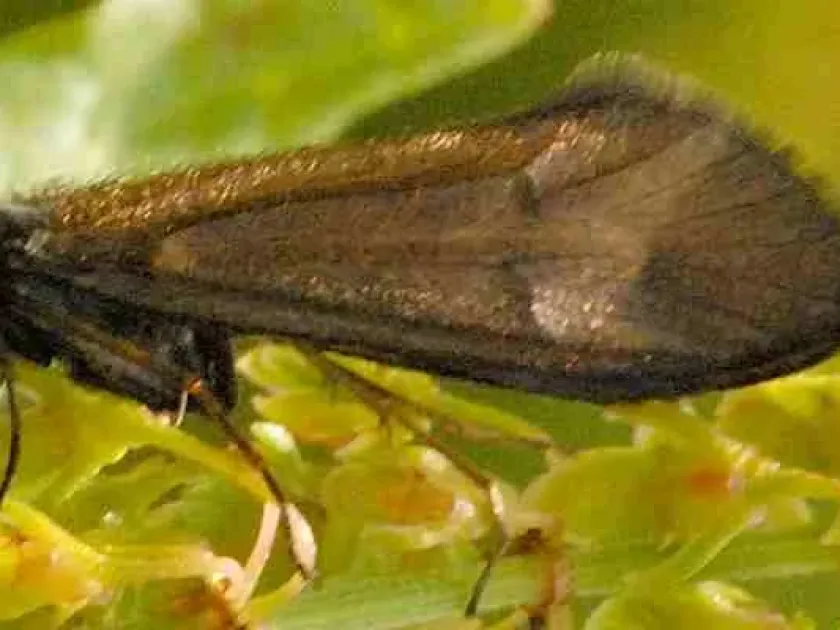
Ecclisopteryx guttulata belongs to the order Trichoptera, commonly known as caddisflies, and the family Limnephilidae. Adult insects are characterized by their moth-like appearance with brown, spotted wings that have intricate venation patterns.
The larval stage is aquatic and highly distinct due to the construction of portable cases. These cases are crafted from organic debris, sand grains, or small pebbles, bound together with silk produced by the larvae.
Morphologically, adults are cryptic, blending into the bark and foliage of riparian trees. They possess long, thread-like antennae and a specialized mouthpart structure primarily adapted for fluid feeding.
Identification often requires careful examination of male genitalia and wing patterns to distinguish this species from other members of the Limnephilidae family.
As biological indicators of water quality, their presence is often associated with well-oxygenated, flowing water systems which influence their local distribution and population density.
What it damages
The primary damage occurs in agricultural areas situated adjacent to streams or irrigation ponds. Larvae primarily consume aquatic vegetation but can shift to crop seedlings if they are submerged or located at the water's edge.
Feeding damage involves irregular holes and missing leaf tissue, which can stress young plants and delay their establishment in moist soil conditions.
Adult insects do not cause mechanical damage to crops as their dietary needs are met through nectar or fluid intake, which does not involve plant tissue destruction.
Most significant impacts are reported in nurseries or greenhouses using open water systems where larval population spikes can lead to local plant stress.
While not a major agricultural pest, their ability to thrive in wet conditions makes them a concern in specific lowland agricultural environments.
When it appears
Adult activity peaks during the late spring and early summer months, typically between May and June, when mating flights occur near water sources.
The larval phase is significantly longer, lasting throughout most of the year as they grow and develop within their protective cases, undergoing several molting stages.
Temperature fluctuations in water bodies are critical factors; warmer springs typically lead to earlier emergence of adults and faster progression of the life cycle.
Eggs are deposited into the water, and the subsequent larvae immediately begin their case-building process to ensure survival against predators and environmental factors.
Heavy rainfall and flooding events can facilitate the dispersal of larvae, potentially moving them from water bodies into crop rows during high-water seasons.
Signs of infestation
The most visible sign of infestation is the discovery of larval cases attached to submerged stalks or plant roots near the water line.
Evidence of feeding includes notches or holes on leaves of plants located in or directly next to the water, often accompanied by the presence of case debris.
Mass attraction of adult caddisflies to artificial light sources near fields indicates a robust breeding population in the surrounding water bodies.
Wilting of seedlings in poorly drained areas can sometimes be linked to larval feeding on the tender stems or roots near the soil surface.
The presence of fine silken webbing on plant stems near water serves as an additional diagnostic feature of caddisfly activity.
Control measures
Cultural control is the most effective approach, focusing on clearing excess riparian vegetation that provides breeding sites for the species.
Optimizing irrigation and drainage systems to prevent long-term water stagnation reduces the habitat suitability for larval survival.
Light traps are effective for monitoring and reducing adult populations, thereby preventing the females from laying eggs in irrigation channels.
Chemical control should be avoided in water-adjacent areas due to the high risk of environmental contamination and negative impacts on aquatic biodiversity.
- Clearing drainage canals of excessive debris.
- Managing riparian buffer zones to discourage breeding.
- Monitoring adult flight periods for early detection.
Taxonomy
- Latin name
- Ecclisopteryx guttulata
- Family
- Limnephilidae
- EPPO code
- ECCLGU
Discussion
No discussions yet — be the first.