
Anabolia
Anabolia
Description
How to identify
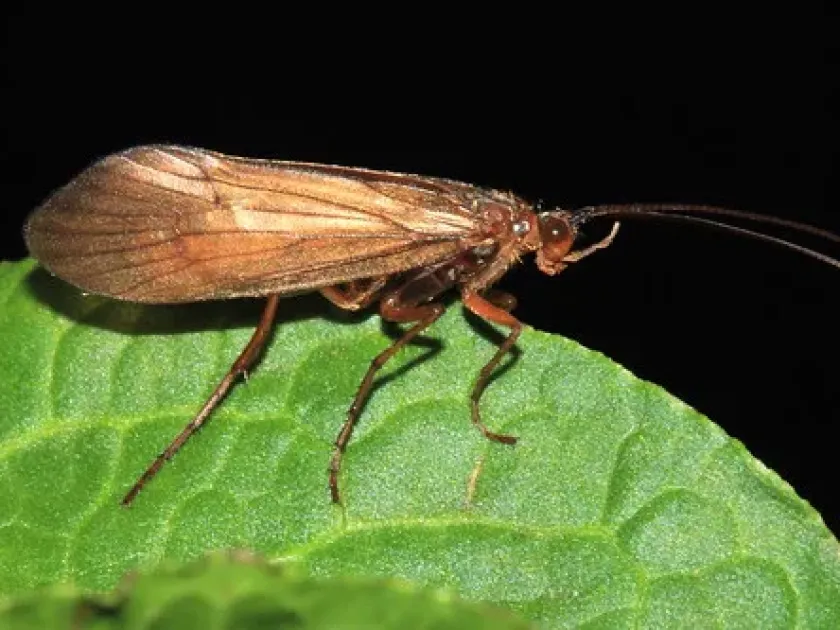
Anabolia is a genus of insects in the order Trichoptera (caddisflies), belonging to the family Limnephilidae. The adult forms are nocturnal insects with wings covered in fine hairs, giving them an appearance similar to small moths.
The larvae are well-known inhabitants of freshwater ecosystems. They construct protective cases, often referred to as "caddis cases," using materials like plant fragments, sand grains, or small stones, bound together with silk.
The head and thoracic segments of the larvae are heavily sclerotized and dark in color, providing protection as they move along the substrate. The abdomen is soft, equipped with tracheal gills for respiration underwater.
Identification at the species level relies on the morphology of the larval case and the venation patterns of the adult wings. Microscopic analysis of the genital structures is often necessary for precise classification.
Unlike many other caddisfly genera, Anabolia larvae are highly adaptable to stagnant or slow-moving water, making them common in agricultural irrigation systems and artificial ponds.
What it damages
The economic impact of Anabolia is most significant in aquaculture and agricultural systems growing aquatic plants such as rice, lotus, or various hydrophytes.
These larvae are polyphagous, consuming both detritus and living tissues of aquatic plants, effectively grazing on young shoots and foliage.
Under high population density, larval feeding can lead to severe crop thinning and significant yield loss within aquatic vegetation zones.
Damage manifests as skeletonized leaf blades or the complete severing of stems near the base, which often results in the mortality of young aquatic plants.
Beyond direct damage, their presence creates competition for food resources in fish ponds and may disturb the vegetation necessary for fish spawning sites.
When it appears
The lifecycle of Anabolia includes complete metamorphosis: egg, larva, pupa, and imago. Adults are typically active during the summer months, which is when mating and dispersal occur.
Eggs are deposited directly into water or onto emergent vegetation. Larvae continue to develop throughout the autumn and winter, feeding actively even in cold water conditions.
Peak damage generally occurs in the spring, as aquatic vegetation begins its rapid growth phase and the larvae reach their final, most voracious instars.
Pupation occurs within the larval case, which is securely attached to substrates like submerged rocks or plant stems prior to the transition into the adult stage.
There is typically one generation per year, a biological adaptation suited to the temperate climates where these insects are most prevalent.
Signs of infestation
The presence of Anabolia can be identified by the movement of their characteristic cases on the pond bottom, often mistaken for floating organic debris or small twigs.
Feeding signs include irregularly chewed leaf margins and perforated foliage, which are diagnostic of the larval chewing mouthparts.
Adult caddisflies are attracted to light, so their presence can be monitored by observing those flying around artificial light sources near water bodies in the evening.
Heavy infestations are accompanied by a visible accumulation of small granular frass near the feeding sites on aquatic plants.
In severe cases, entire colonies of larvae may be found clustered on the underside of floating lily pads or other broad-leaved aquatic crops.
Control measures
Management strategies focus on agrotechnical practices that disrupt the insect's lifecycle within artificial water bodies.
Periodic draining and drying of ponds or irrigation channels is an highly effective method, as the larvae are susceptible to desiccation.
Mechanical removal of excessive aquatic vegetation reduces the available food sources and limits the surface area for case attachment.
Biological control methods include stocking ponds with fish species that naturally predate on caddisfly larvae, helping to keep populations below economic injury levels.
Chemical control is rarely utilized due to environmental regulations regarding water quality; therefore, monitoring and population suppression are the preferred approaches.
Taxonomy
- Latin name
- Anabolia
- Family
- Limnephilidae
- EPPO code
- ANBOSP
Discussion
No discussions yet — be the first.