

Description
How to identify
The sorghum midge (Stenodiplosis sorghicola) is a small dipteran insect belonging to the Cecidomyiidae family. It is recognized as one of the most destructive pests for sorghum crops globally.
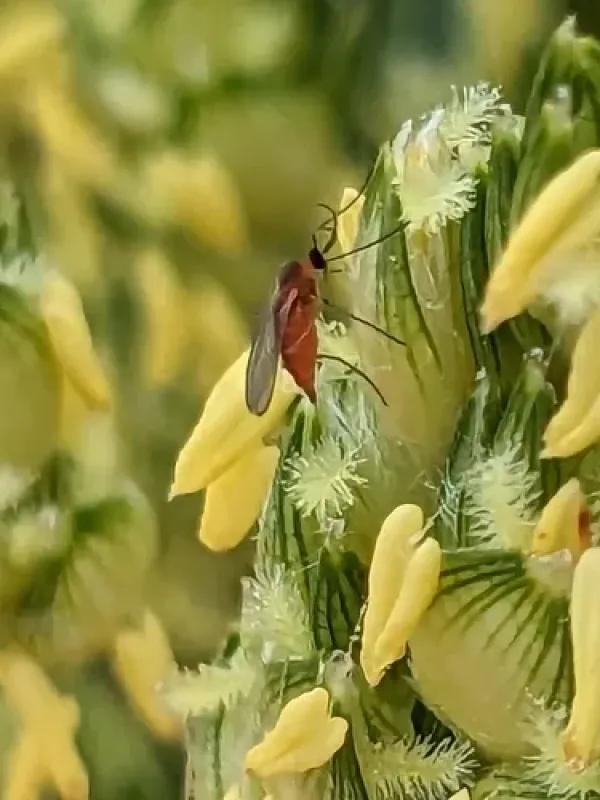
Adult midges are about 1.5–2 mm long, characterized by a vibrant orange-red abdomen and a dark head, which makes them stand out despite their small size.
The wings are clear and have a simple venation pattern. These insects are fragile and rely heavily on stable environmental conditions to survive and reproduce.
The larvae are small, spindle-shaped, and usually orange or pinkish. They reside entirely within the floral structures of the sorghum plant, feeding on the developing seed.
Due to a short lifecycle, which can take less than three weeks under optimal conditions, the sorghum midge can produce multiple generations during the growing season.
What it damages
The primary host of this pest is sorghum, with damage occurring exclusively during the flowering stage when the ovaries are receptive to eggs.
The larvae feed on the internal components of the developing seed. By consuming the nutrient-rich tissues, they prevent the seed from maturing properly.
The result is a "blasted" grain, where the husk remains, but the interior is hollow. This leads to a severe reduction in yield and grain quality.
Economic damage is often significant because the infestation is not easily detected until the crop is harvested and yields are found to be much lower than expected.
In addition to sorghum, the pest can survive on certain wild grasses, which act as alternative hosts and reservoirs for population survival between seasons.
When it appears
The adult midge emerges in early spring, typically synchronized with the appearance of the first sorghum blooms in the region.
Adults are most active during the morning and evening hours when humidity is higher. They have a short lifespan, usually lasting only a few days, during which the female focuses on laying eggs.
The presence of the pest in the field is strictly tied to the flowering window of the sorghum plants. Once the flowering ends, the midge population declines.
Overwintering occurs in the larval stage, protected inside the infested seeds left on the ground or in volunteer sorghum plants.
The emergence of the spring generation depends on cumulative heat units and the availability of host plants for immediate colonization.
Signs of infestation
The most visible sign of an infestation is the presence of empty or "blasted" grains that fail to fill out as the rest of the head matures.
Exuviae, the discarded pupal cases, are often seen protruding from the glumes, serving as a reliable indicator that the midge has completed its development.
Heads infested with the midge may appear lighter in weight and have a slight discoloration in the affected spikelets compared to healthy ones.
Close inspection of the flower heads during early morning hours may reveal the presence of adult flies hovering around the blooming florets.
Significant infestations often show a lack of grain development in large patches of the field, resulting in a noticeably lower test weight of the harvested crop.
Control measures
Effective management begins with deep plowing of stubble to bury plant debris, which physically prevents adult midges from emerging in the spring.
Crop rotation is crucial to break the pest cycle. Avoid planting sorghum on the same field or adjacent fields for consecutive years to minimize colonization risks.
Using hybrids with uniform and short flowering periods helps reduce the time the crop is susceptible to egg-laying by the midge.
Chemical control involves applying insecticides during the peak of adult activity, right at the onset of the bloom, to target females before they lay eggs.
- Remove volunteer sorghum and wild grasses near fields.
- Monitor adult flight using yellow sticky traps.
- Select resistant sorghum hybrids where available.
- Apply systemic or contact insecticides during the flowering stage.
Content graph
Connections · Sorghum midge
Most often together:
Marketplace
Products · 4


Biology
Taxonomy
- Latin name
- Stenodiplosis sorghicola
- Order
- Diptera (flies)
- Family
- Cecidomyiidae
- EPPO code
- CONTSO
Community
Discussion
No discussions yet — be the first.