

Description
How to identify
The wheat blossom midge (Contarinia tritici) is a small dipteran insect belonging to the family Cecidomyiidae. Adult midges are very small, measuring about 2-3 mm, with a yellowish-orange body.
Females are equipped with a long, retractable ovipositor, which they use to insert eggs into the spikelets of wheat during the flowering stage of the crop.
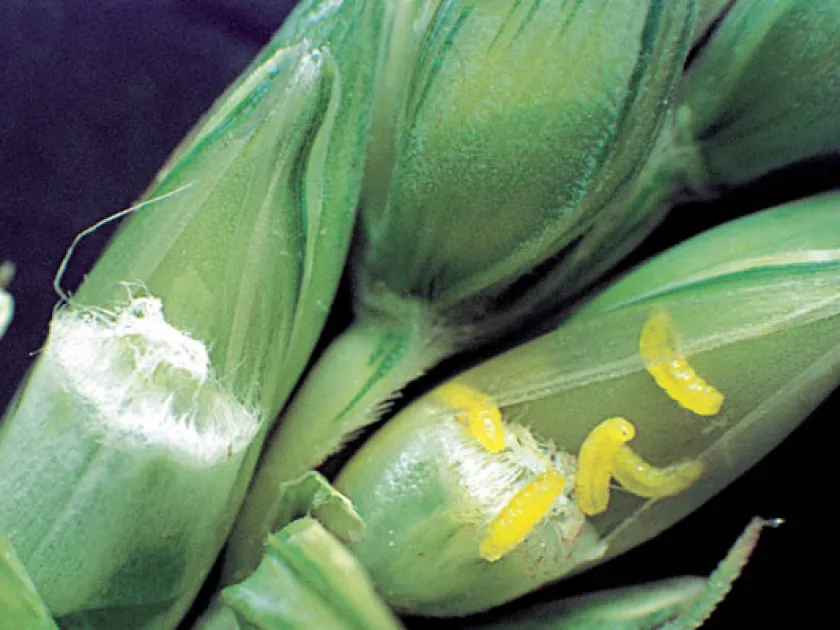
Larvae are spindle-shaped and lack legs. They typically undergo a color change from colorless to a vivid lemon-yellow or orange as they mature and feed inside the host plant.
The lifecycle of the wheat blossom midge is synchronized with the phenology of wheat. The insects overwinter as larvae in the soil within protective cocoons, often at depths of 10-15 cm.
They can remain in a state of diapause for several years, which allows the population to survive even in years when wheat is not cultivated in the field.
What it damages
The wheat blossom midge primarily targets wheat, including both soft and hard varieties. It can also infest other cereals like rye and barley, as well as some wild grass species.
Damage is caused exclusively by the larvae. Once they hatch, they migrate into the spikelets and begin feeding on the developing grain and the ovary of the plant.
Feeding by the larvae leads to grain shriveling, deformation, and significant loss of weight. In cases of high infestation, the grain can be completely destroyed.
Beyond direct yield loss, the feeding activity often creates openings that facilitate the entry of fungal pathogens, further reducing the overall grain quality and yield.
Economic damage is most severe when the adult flight period coincides precisely with the susceptible wheat flowering stage, especially under humid weather conditions.
When it appears
Adult emergence typically begins in late spring or early summer, triggered by soil temperatures rising above 12-15°C and sufficient soil moisture.
After mating, females lay eggs in clusters within the developing florets. Incubation lasts for approximately one week, depending on ambient temperature and humidity.
Larvae feed inside the head for about two to three weeks. Once development is complete, they usually exit the spikelets during rainfall and drop to the ground to overwinter.
While there is generally one generation per year, the ability of larvae to persist in diapause for multiple seasons makes them a persistent threat to agricultural production.
The pest thrives in calm, humid, and warm conditions, especially during the evening hours when adult activity is at its peak.
Signs of infestation
The presence of adult midges can be detected during the flowering period by observing the wheat heads in the evening when they are actively flying.
Closer examination of the wheat heads will reveal the presence of small, orange-colored larvae tucked inside the spikelet glumes.
Visual symptoms on the plant include distorted grain or empty spikelets, which can lead to a mottled or "empty" appearance of the wheat head at maturity.
A reduction in the thousand-kernel weight is a clear quantitative indicator of an infestation, as damaged grain fails to reach its full development.
Sticky traps or sweep netting can be used by agronomists to monitor adult population levels and determine the necessity for insecticide intervention.
Control measures
Effective crop management starts with strict crop rotation, ensuring that wheat is not planted in the same field in consecutive years to disrupt the midge's lifecycle.
Deep plowing after harvest can bury larvae, preventing them from emerging the following season and significantly reducing the population pressure.
Selecting resistant wheat cultivars, particularly those with tight spikelet glumes, makes it more difficult for females to insert their ovipositors and lay eggs.
Chemical control is possible through the application of approved insecticides during the peak of adult emergence but before egg-laying occurs.
- Monitor fields closely during the susceptible heading and flowering stages to time potential insecticide applications.
- Maintain weed-free field margins to eliminate secondary hosts for the midge.
- Encourage natural biological control by protecting parasitic wasps and predatory insects that feed on midge larvae.
Content graph
Connections · Wheat blossom midge
Most often together:
Marketplace
Products · 1
Biology
Taxonomy
- Latin name
- Contarinia tritici
- Order
- Diptera (flies)
- Family
- Cecidomyiidae
- EPPO code
- CONTTR
Community
Discussion
No discussions yet — be the first.