
Stagmomantis mantis
Stagmomantis
Description
How to identify
The Stagmomantis genus belongs to the order Mantodea and the family Mantidae. These are relatively large insects characterized by an elongated body structure typical of most mantids.
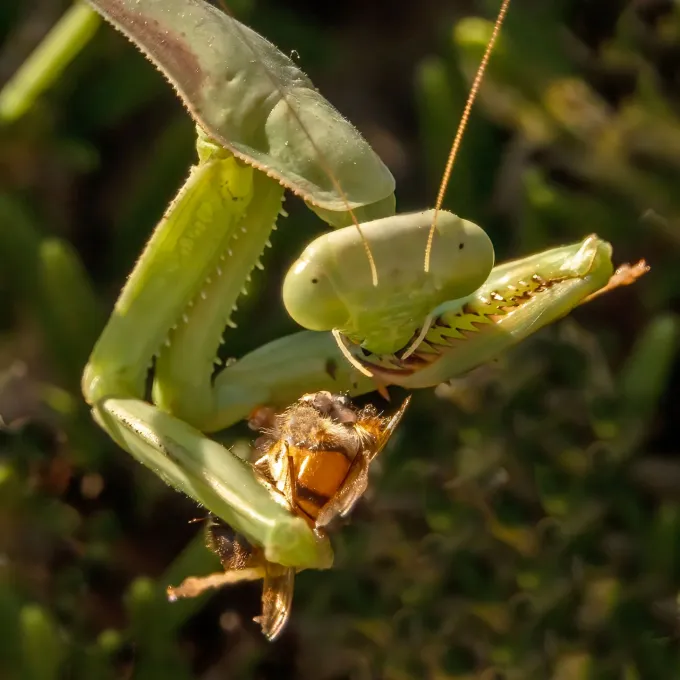
A distinctive feature of these insects is their well-developed raptorial forelegs, which are specifically adapted for capturing and holding prey. Their coloration ranges from green to brown, providing effective camouflage against foliage and twigs.
The head of the mantis is highly mobile, allowing it to survey its surroundings with a wide field of vision. Large compound eyes provide excellent visual acuity, essential for hunting moving insects.
Mature adults typically reach 5–7 centimeters in length. Females are generally larger and more robust than males, possessing an enlarged abdomen for egg production before oviposition.
Most Stagmomantis species possess well-developed wings, enabling adults to fly significant distances in search of food sources or suitable habitats for mating and reproduction.
What it damages
It is important to recognize that Stagmomantis mantids are primarily predators, not phytophagous pests. They do not feed directly on plant tissues and thus do not cause direct damage to crops.
The potential negative impact arises from their predatory nature, as they may consume beneficial insects such as ladybugs, lacewings, and parasitic wasps that naturally suppress common plant pests.
In some agricultural scenarios, a high density of mantids can disrupt the local ecological balance, reducing the efficiency of natural pest control agents like aphids and mites.
While not direct consumers of foliage, they may incidentally cause mechanical damage to tender shoots when females attach their oothecae (egg cases) to stems, sometimes leading to localized wilting or deformation.
Consequently, classifying Stagmomantis as a pest is controversial, and they are generally viewed as "unwanted visitors" rather than primary threats in biological farming systems.
When it appears
The life cycle of the mantis begins with the deposition of eggs into an ootheca, which the female attaches to twigs or other stable surfaces in the autumn. The insect overwinters in this stage.
In the spring, as temperatures rise, nymphs emerge from the egg cases. These nymphs resemble miniature, wingless versions of the adult mantids.
Throughout the summer, nymphs feed actively on small insects, undergoing several molting stages while gradually increasing in size and developing their reproductive organs.
By mid-summer or early autumn, the majority of the population reaches the adult (imago) stage, becoming most visible within garden environments and agricultural fields.
After mating, males typically expire, and females proceed to lay eggs, marking the end of the life cycle as temperatures drop with the approach of winter.
Signs of infestation
The primary indicator of a Stagmomantis presence is the discovery of their characteristic frothy oothecae, which harden into firm, brown, structural capsules found on shrub branches.
Observing the insects themselves resting among the foliage of ornamental or fruit plants confirms their hunting activity. They are also frequently attracted to light sources during evening hours.
An indirect sign may include the sudden local decline of beneficial pollinators or small predators in areas where mantid populations have become particularly dense.
Physical evidence on plants, such as abrasions or superficial incisions where egg cases were attached, can indicate that the plant was used as a nursery substrate.
In rare instances, discarded chitinous exoskeletons of prey insects found on leaves suggest that a mantis has established a successful hunting post in that vicinity.
Control measures
In the vast majority of garden settings, specific control measures against mantids are unnecessary, as they rarely reach population levels that cause significant economic damage.
If management is required, the most effective approach is the manual removal and disposal of oothecae during the winter or early spring when they are clearly visible on dormant branches.
The use of broad-spectrum insecticides is strongly discouraged, as these chemicals eliminate both pests and beneficial predators, ultimately leading to greater ecological instability.
Regular pruning of excessive shrubbery and dead wood can help limit the availability of suitable nesting sites, thereby naturally reducing the population density in the following season.
Maintaining high levels of biodiversity in the garden helps foster an environment where mantid populations are naturally regulated by birds and other higher-order predators.
Taxonomy
- Latin name
- Stagmomantis
- Family
- Mantidae
- EPPO code
- STAMSP
Discussion
No discussions yet — be the first.