
European mantis
Mantis religiosa
Description
How to identify
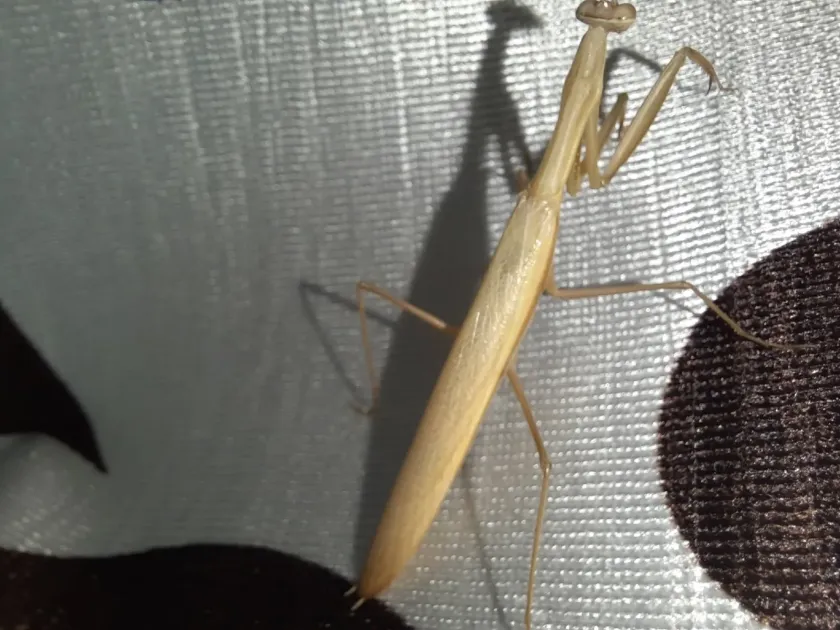
The European mantis (Mantis religiosa) is a large predatory insect belonging to the family Mantidae. It is characterized by its elongated body, triangular head, and highly specialized raptorial forelegs.
Adults typically measure between 45 and 75 mm in length. Their coloration ranges from bright green to brown, providing an effective camouflage against stems and leaves, making them difficult to spot in fields.
The insect possesses large compound eyes that grant it a wide field of vision. It is known for its ability to rotate its head almost 180 degrees, allowing it to track moving prey with precision.
The life cycle involves incomplete metamorphosis. Females lay their eggs in protective structures called oothecae, which are usually attached to sturdy vegetation and are capable of surviving cold winter temperatures.
Nymphs emerge in late spring or early summer. They resemble miniature adults and immediately begin hunting small insects, steadily growing through several molting stages until reaching maturity.
What it damages
The main agricultural concern associated with the European mantis is its indiscriminate predation on beneficial insects, particularly bees, bumblebees, and lacewings that pollinate crops.
In greenhouse settings, the presence of these mantids can significantly reduce fruit yield by decimation of the pollinator population required for proper flowering and fertilization.
By consuming predatory insects like ladybugs, the mantis can disrupt natural pest control, potentially leading to outbreaks of aphids and other sap-sucking pests in the garden.
While they do not consume plant tissue, the female's egg-laying behavior can cause physical damage to delicate stems, and the adhesive material used to bind oothecae can inhibit plant growth.
The presence of a high population density of mantids can destabilize the local ecosystem, favoring pest survival by eliminating the natural predators of those pests.
When it appears
Nymph emergence typically occurs in May or June, once the environmental temperature stays consistently high enough for development.
Adult mantids are most active during the peak of summer and early autumn, which is when they undergo mating rituals and search for suitable egg-laying sites.
In late autumn, before the onset of the first frost, adult mantids die off after ensuring the survival of their offspring within the durable oothecae.
The overwintering phase is strictly restricted to the egg stage. The ootheca serves as a highly resistant casing that protects the developing embryos from desiccation and freezing.
Seasonal population fluctuations are directly influenced by the availability of prey and the survival rate of eggs through the winter months.
Control measures
The most effective strategy for managing mantis numbers is the manual removal of oothecae during the dormant winter months when the foliage is thin and the egg cases are visible.
For protected cultivation, installing fine-mesh screens on ventilation windows and doors is crucial to prevent adult mantids from entering and preying on introduced pollinators.
Maintaining clear boundaries around agricultural fields by removing excessive weeds and dry brush eliminates potential nesting sites for the next generation of mantids.
Chemical control is rarely justified and generally discouraged due to the non-selective nature of insecticides, which would harm beneficial species more than the mantis itself.
- Inspect vegetation for egg cases.
- Manual collection and destruction of oothecae.
- Use of exclusion netting in greenhouses.
Taxonomy
- Latin name
- Mantis religiosa
- Family
- Mantidae
- EPPO code
- MANTRE
Discussion
No discussions yet — be the first.