
Ameles decolor
Ameles decolor
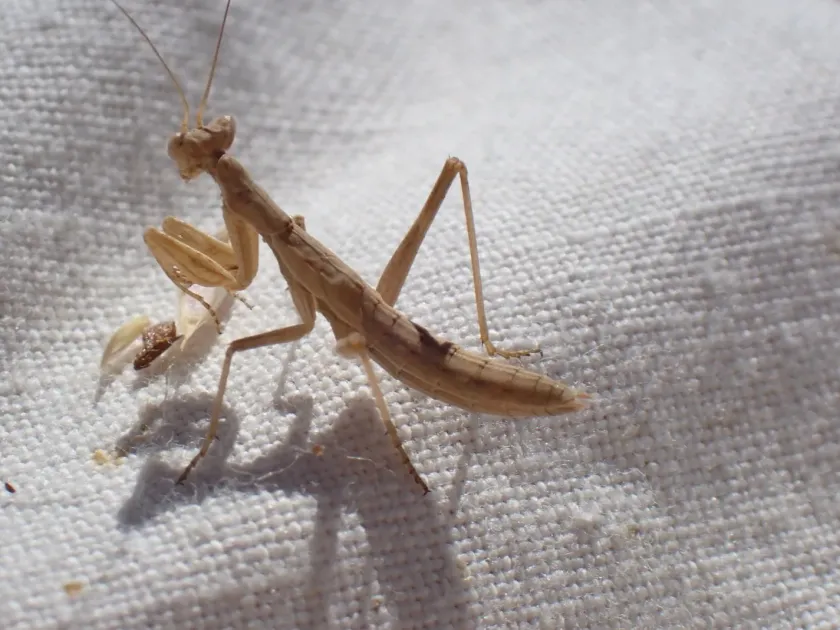
Description
How to identify
Ameles decolor is a species of praying mantis belonging to the order Mantodea and the family Mantidae. These insects are characterized by their elongated bodies, specialized raptorial forelegs, and triangular, highly mobile heads.
The adults are relatively small, typically measuring between 20 and 30 mm in length. Their coloration ranges from grayish-brown to green, providing excellent camouflage against dry vegetation, which is their preferred habitat.
The nymphs appear as smaller versions of the adults. Throughout their development, they undergo several molts, increasing in size and progressively developing their hunting skills by preying on smaller insects.
Sexual dimorphism is evident in this species: females often have reduced, non-functional wings, while males are generally more slender and capable of sustained flight to locate mates.
They are primarily found in arid and semi-arid environments, favoring sunny areas with sparse vegetation where their camouflage is most effective for hunting and protection from larger predators.
What it damages
Ameles decolor is primarily a predator, not a herbivore. Therefore, it does not directly damage crops by feeding on leaves, stems, or fruits, making it a neutral or potentially beneficial presence in most agricultural fields.
Potential concerns arise only if the population density becomes unusually high, potentially impacting populations of beneficial pollinators like bees or other predatory insects that serve as natural biocontrol agents.
In most ecosystems, they act as a natural check on various smaller insect populations, including some that might be considered minor pests in garden settings, thus contributing to the balance of the local ecosystem.
They are not classified as agricultural pests, and their presence does not lead to economic loss for farmers or gardeners. They do not transmit plant diseases or cause mechanical damage to plant tissues.
From an agronomic perspective, managing the population of Ameles decolor is generally unnecessary, as they are not a threat to standard crop production practices.
When it appears
The life cycle of Ameles decolor is strictly tied to the warmth of the season. Adults are most frequently observed during the summer months, specifically from July through early autumn when temperatures are at their peak.
The species overwinters in the egg stage, enclosed within an ootheca (egg case). These oothecae are firmly attached to sturdy substrates such as rocks or woody stems, ensuring survival through the winter months.
Hatching occurs in late spring as the ambient temperature rises. Nymphs begin their growth phase throughout the early summer, gradually progressing through various instars to reach maturity.
Mating occurs towards the end of the summer. Shortly after reproduction, the females deposit their oothecae to secure the next generation before the onset of cold weather.
Because they are a univoltine species, observing their population dynamics is most practical during the heat of summer, which is the primary window for their activity.
Control measures
There are no established control protocols for Ameles decolor because it is not considered a crop-damaging pest. The application of insecticides specifically for this species is highly discouraged.
Standard horticultural practices, such as maintaining weed-free fields and proper soil cultivation, naturally limit the available habitats for oothecae, keeping their numbers in check without chemical intervention.
Maintaining biological diversity is the most effective approach to managing any insect population. A balanced ecosystem will naturally regulate the number of mantids through competition and predation.
If a reduction in their numbers is required due to concerns about pollinators, physical removal is sufficient, but this is rarely necessary in professional or domestic agriculture.
- Avoid the use of broad-spectrum insecticides.
- Implement general field sanitation practices.
- Encourage natural predators and biodiversity.
Taxonomy
- Latin name
- Ameles decolor
- Family
- Mantidae
- EPPO code
- AMLEDE
Discussion
No discussions yet — be the first.