
Red-underwing skipper
Spialia sertorius
Description
How to identify
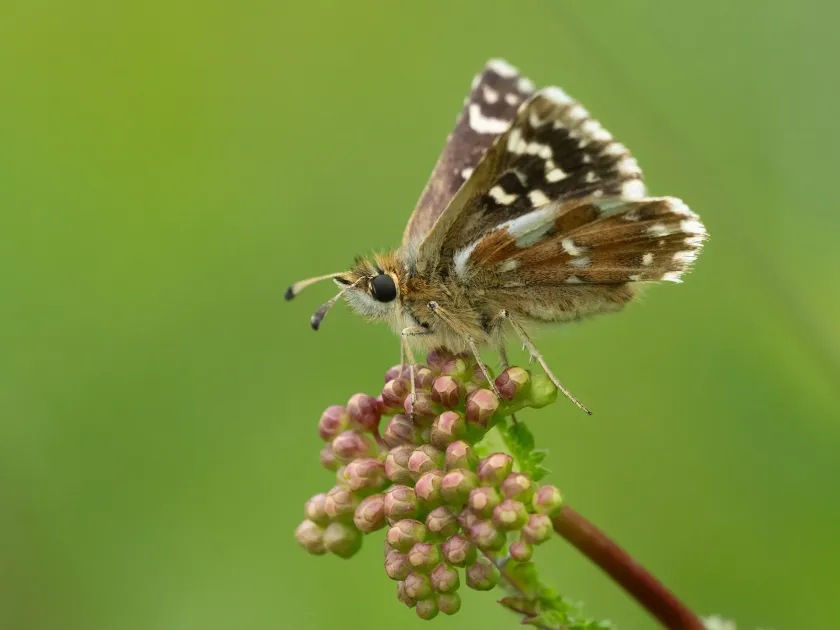
The red-underwing skipper (Spialia sertorius) is a butterfly belonging to the Hesperiidae family. Adult individuals have a wingspan ranging from 20 to 26 mm.
The wings exhibit a dark brown to nearly black coloration with distinct white spots arranged in a characteristic pattern. The underside of the hindwings displays a reddish-brown or ochre hue, which is a key identification feature.
The body is robust and covered with dense hairs, giving the insect a sturdy appearance. The head is broad with large eyes positioned on the sides, typical for the Hesperiidae family.
The larvae (caterpillars) are pale, greenish, or brownish with a dark dorsal stripe. Their bodies are covered in fine setae, and the head is usually darker than the rest of the body.
Systematically, this species belongs to the order Lepidoptera, the family Hesperiidae, and the genus Spialia.
What it damages
This pest primarily affects plants of the Rosaceae family. The main host plants are species of the Sanguisorba genus, particularly the great burnet (Sanguisorba officinalis).
Although the red-underwing skipper is not considered a mass pest in commercial agriculture, its larvae may feed on the foliage of wild and ornamental Rosaceae species.
Damage is caused by the caterpillars, which actively consume the leaf blade, starting from the edges or creating irregular holes in the central part of the leaf.
During periods of high population density, significant skeletonization of leaves can occur, reducing the plant's photosynthetic capacity and overall biomass.
Damage to young shoots can lead to the deformation of the leaf apparatus and overall stunting of plant growth.
When it appears
In temperate climates, the red-underwing skipper typically undergoes one or two generations per season, depending on the regional temperature conditions.
The adult flight period generally occurs from May to August. In warmer years, the activity of butterflies may begin as early as late April.
The species overwinters as a caterpillar in the final or penultimate larval stage, residing in hibernacula made of rolled leaves or leaf litter at the base of the host plant.
In the spring, the caterpillars complete their development and pupate. Pupation takes several weeks, followed by the emergence of the next generation of adults.
Pupation often takes place within a silk cocoon constructed by the caterpillar among the leaves of the host plant, securely fastened with silk threads.
Signs of infestation
The first sign of infestation is the presence of characteristic "shelters" created by rolled leaves bound together with silken threads.
The leaf blades appear partially consumed along the margins, often with large, uneven holes visible between the leaf veins.
When inspecting the underside of leaves or inside the rolled leaf shelters, one can often spot the caterpillars, which tend to hide or drop to the ground when disturbed.
The presence of frass, appearing as small, dark granular droppings on leaves below the feeding sites, serves as an additional indicator of infestation.
During the flowering season, adults may be observed visiting flowers of host plants for nectar, which often precedes egg-laying activity.
Control measures
Control measures are primarily preventive, as the species rarely reaches an economic threshold requiring intensive intervention.
- Mechanical removal and destruction of rolled leaves containing caterpillars during early development stages.
- Timely removal of weeds that might serve as intermediate or alternative host plants.
- Use of biological pesticides based on Bacillus thuringiensis if the pest population threatens ornamental garden plantings.
- Application of broad-spectrum insecticides only during mass outbreaks, strictly adhering to pre-harvest intervals.
- Promotion of natural predators such as predatory bugs and parasitic wasps to help maintain population balance.
Taxonomy
- Latin name
- Spialia sertorius
- Order
- Lepidoptera (butterflies)
- Family
- Hesperiidae
- EPPO code
- SILASE
Discussion
No discussions yet — be the first.