
Privet hawk-moth
Sphinx ligustri
Description
How to identify
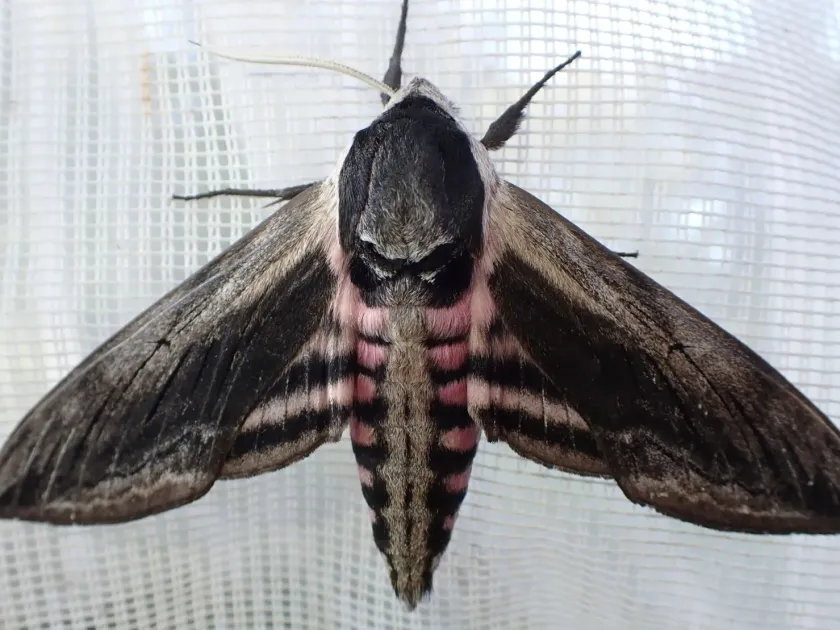
The Privet hawk-moth (Sphinx ligustri) belongs to the family Sphingidae. It is one of the largest moths in Europe, with a wingspan reaching up to 120 mm. The adults are known for their distinctive pink and black striped abdomen.
The larvae, or caterpillars, are large, measuring up to 100 mm. They are bright green with purple and white diagonal side stripes and possess a characteristic horn at the posterior end of the body.
The pupae are dark brown, robust, and reside in the soil at a depth of up to 10 cm. They remain in the soil throughout the winter, marking the dormant stage of the species.
This species is nocturnal, with adults active primarily from dusk. They are powerful fliers capable of moving across large areas to find suitable host plants for oviposition.
The life cycle consists of a single annual generation in most regions, with adults appearing in late spring to begin the reproductive process for the next season.
What it damages
The larvae are specialized feeders on shrubs, with a strong preference for Privet (Ligustrum) and Lilac (Syringa). They also frequently infest Ash (Fraxinus) and Viburnum.
Though less common, they can also feed on fruit trees, including apple and pear. Feeding activity involves consuming large amounts of leaf tissue very rapidly.
Significant defoliation is the primary form of damage. While healthy mature shrubs can usually withstand loss, young saplings may suffer growth retardation.
In ornamental gardens, the aesthetic damage is usually the main concern. Entire branches can be stripped of leaves, which may weaken the plant’s vigor significantly.
Economic damage is typically localized rather than widespread, as the species rarely occurs in high densities across large commercial orchards or plantations.
When it appears
Adult moths are on the wing from May to July. During this timeframe, they engage in mating and laying eggs on the underside of leaves of preferred host plants.
Caterpillars emerge throughout the summer months. The larval stage is active from June until early September, during which time they grow rapidly.
Pupation occurs in the soil by late September. The caterpillars descend from their host plants and burrow into the ground to build a subterranean pupal chamber.
The summer period, specifically July and August, is when the feeding damage is most intensive as the caterpillars enter their final, largest instars.
Monitoring the flight of adults at night using light traps can provide an indication of potential infestation risk for the following summer season.
Signs of infestation
The presence of the Privet hawk-moth is indicated by missing leaf sections or complete defoliation of branches on target shrubs like Lilac or Privet.
Large, dark, cylindrical frass (droppings) left on the ground under the plant canopy is a clear indicator that a large larva is feeding above.
Caterpillars are often found in a rigid, curved posture on stems during the day, where they remain motionless to camouflage themselves against the branches.
Their size alone makes them hard to miss during a visual inspection. Their bright stripes distinguish them from other common garden caterpillar species.
- Edges of leaves are eaten away;
- Large frass visible on the ground;
- Sudden appearance of bare twigs;
- Large caterpillars found on host plants.
Control measures
Manual collection is the most effective and safe method for small gardens. Removing caterpillars by hand is easy due to their size and visibility.
For larger infestations, biological control using Bacillus thuringiensis is highly recommended as it is effective against larvae while remaining safe for the environment.
Digging up the soil around the base of host plants in late autumn can destroy overwintering pupae, thereby reducing the population size for the next season.
Chemical pesticides should be reserved for severe cases where the health of rare or valuable ornamental specimens is at immediate risk from defoliation.
Proper maintenance of plant health helps reduce the likelihood of heavy infestations, as healthy plants are better able to recover from occasional feeding damage.
Taxonomy
- Latin name
- Sphinx ligustri
- Order
- Lepidoptera (butterflies)
- Family
- Sphingidae
- EPPO code
- SPHXLI
Discussion
No discussions yet — be the first.