
Death's-head hawkmoth
Acherontia atropos
Description
How to identify
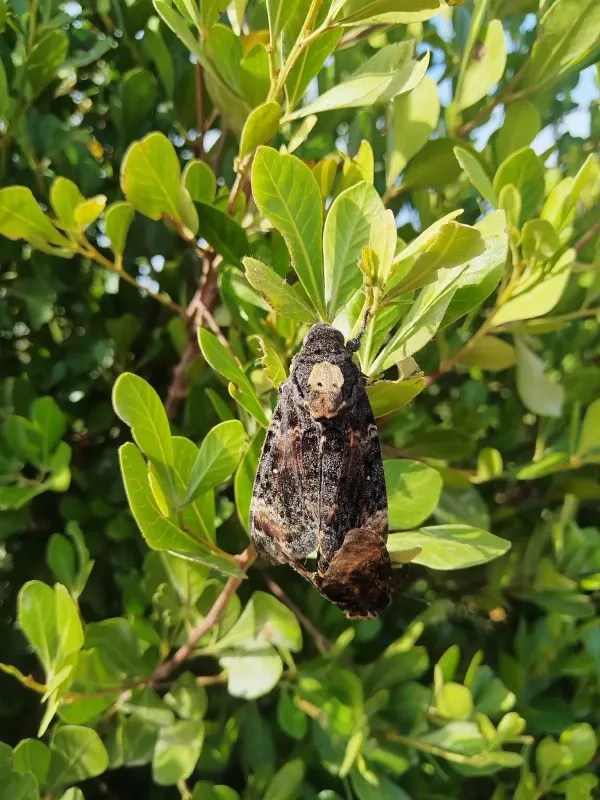
The Death's-head hawkmoth (Acherontia atropos) is a large moth belonging to the family Sphingidae. It is named after the distinctive skull-like pattern on its thorax.
The adult moth has a wingspan of up to 13 centimeters. The forewings are dark with brown and grey patterns, which provide excellent camouflage in natural environments.
The caterpillar of this species is quite large, reaching up to 15 centimeters in length. It can be bright yellow, green, or brown, featuring a characteristic horn-like tail.
The pupa is smooth and dark brown in color. The pupal stage typically occurs underground, usually at a depth of 15 to 20 centimeters below the surface.
This species is a migrant, so the population levels vary significantly between seasons depending on the climate and wind patterns during the migration period.
What it damages
The caterpillars primarily feed on plants from the Solanaceae family. They can cause significant damage to potatoes, tomatoes, eggplants, and peppers.
Besides agricultural crops, the larvae can feed on foliage from various other families, including Oleaceae, Bignoniaceae, and Verbenaceae.
While adult moths are known to enter beehives to feed on honey, the primary concern for agronomists is the leaf consumption by the caterpillars.
Extensive feeding leads to severe defoliation, which weakens the plant's structural integrity and significantly reduces overall yield potential.
Given the massive size of the larvae, a few individuals can strip a vegetable plant of its foliage in a surprisingly short amount of time.
When it appears
The adult flight period typically occurs from late spring through summer, as moths migrate from warmer climates into northern regions.
Egg-laying usually takes place at night. Females deposit their eggs individually on the undersides of host plant leaves to ensure food access for the larvae.
Caterpillars are most active during the summer months, specifically June, July, and August, when they undergo several developmental stages.
In temperate climates, the species rarely produces more than one generation because the pupae often struggle to survive the harsh winter temperatures.
Pupation generally concludes by late summer or early autumn, with the insects entering the soil to overwinter or eventually dying if the frost is severe.
Signs of infestation
The most obvious sign of infestation is the presence of the large, fleshy caterpillars feeding openly on the leaves of host crops.
Damage is characterized by large, ragged holes in leaves, as the larvae consume the leaf tissue rapidly, leaving only the primary veins intact.
Large dark droppings (frass) under the plants are a clear indicator that a large caterpillar has been feeding in the immediate vicinity.
During the twilight hours, adults may be seen flying around the garden, which often precedes an outbreak of caterpillars on solanaceous crops.
Because these larvae are so large, the impact on the vegetation is very noticeable and can progress from minor spotting to total defoliation very quickly.
Control measures
Hand-picking the caterpillars is the most effective and eco-friendly control method for small gardens or limited infestations.
Deep autumn plowing or tilling helps expose the pupae to birds and harsh weather conditions, significantly reducing the population for the next season.
If an infestation becomes severe, biological insecticides containing Bacillus thuringiensis can be used as they specifically target caterpillar larvae.
Chemical control with broad-spectrum insecticides should be used as a last resort, always ensuring compliance with harvest safety intervals.
Maintaining a clean garden by removing weeds from the Solanaceae family helps reduce the likelihood of moths selecting the site for egg-laying.
Taxonomy
- Latin name
- Acherontia atropos
- Order
- Lepidoptera (butterflies)
- Family
- Sphingidae
- EPPO code
- ACHEAT
Discussion
No discussions yet — be the first.