
Acherontia lachesis
Acherontia lachesis
Description
How to identify
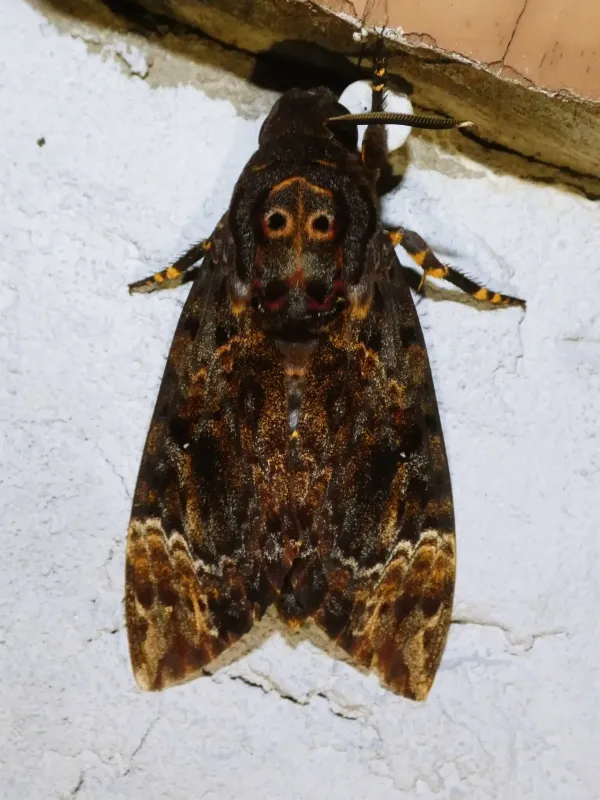
Acherontia lachesis, commonly known as the Great Death's Head Hawkmoth, belongs to the Sphingidae family within the order Lepidoptera. It is famous for the skull-like pattern on its thorax.
Adult moths are quite large, with a wingspan reaching up to 13 centimeters. Their forewings feature intricate dark patterns, while the hindwings are vibrant yellow with two distinct black transverse bands.
The larvae are robust, growing up to 15 centimeters long. They display a wide range of colors, including green, yellow, or brown, and are decorated with diagonal stripes along their sides.
A distinct horn on the posterior end of the larva is a key identification feature. This horn is covered in small granules and is a standard morphological trait for this specific hawkmoth species.
The pupae are mahogany brown, smooth, and typically found in underground chambers. This subterranean life stage is crucial for their survival through unfavorable weather conditions.
What it damages
The primary damage is caused by the larval stage. With their strong mandibles, the caterpillars consume large amounts of foliage, which can lead to rapid defoliation of host plants.
Common host plants include various Solanaceae crops, such as potatoes, tomatoes, eggplants, and peppers. In some regions, they may also feed on plants from other botanical families.
Large-scale consumption of leaf tissue by these larvae significantly weakens the plants, reducing their ability to photosynthesize and ultimately leading to lower fruit or tuber production.
When infestation levels are high, the caterpillars can strip a plant bare, leaving only the stem and main veins, which stresses the plant and makes it prone to secondary pest or disease attacks.
While mass outbreaks of Acherontia lachesis are relatively rare compared to other agricultural pests, their size means that even a few individuals can cause visible, localized damage.
When it appears
The life cycle of this species typically involves multiple generations per year, depending on the climatic conditions of their habitat and their migratory patterns across different zones.
Adult moths are primarily nocturnal and crepuscular. They are capable of long-distance flights, which enables them to spread to new agricultural areas to find suitable hosts for oviposition.
The most active period for larvae is during the warm summer months, when temperatures promote rapid metabolism and quick transition through the larval instars to pupation.
The insect overwinters as a pupa, burrowing deep into the soil. This depth protects the pupae from temperature fluctuations and prevents them from drying out or freezing during winter.
The emergence of the new generation usually coincides with the peak vegetative growth phase of crops, ensuring that the larvae have an abundant food supply immediately upon hatching.
Signs of infestation
The most reliable sign of an infestation is the presence of large, cylindrical frass (droppings) on the soil surface directly beneath the affected plant canopy.
Visual inspections often reveal significant loss of leaf area, with caterpillars frequently eating large, jagged holes in leaves or entirely consuming the leaf blade while leaving the midrib.
Despite their size, the larvae can be surprisingly difficult to spot due to their excellent camouflage, which helps them blend in with the leaves and stems of the host plant.
Gardeners should look for stunted or damaged plants, especially in patches where leaf growth has suddenly stalled compared to the rest of the field or garden bed.
- Large holes or missing leaf tissue.
- Presence of large, dark larval frass on the ground.
- Partially eaten or stripped stems.
- Reduced overall vigor of the host plant.
Control measures
Hand-picking is the most effective and eco-friendly control method for small-scale gardens. Because of their large size, the larvae are easy to locate and remove manually.
Tilling the soil at the end of the season is highly effective at destroying the underground pupal chambers, which reduces the population size for the following year.
Biological control using Bacillus thuringiensis (Bt) sprays can successfully manage the larval population without harming beneficial pollinators or natural predators in the environment.
Chemical control should be reserved for high-infestation cases where other methods have failed. Always ensure that the chosen insecticide is approved for the specific crop and follow pre-harvest intervals.
Maintaining a weed-free environment and removing wild solanaceous plants near the fields can significantly reduce the attractiveness of the area to egg-laying female moths.
Taxonomy
- Latin name
- Acherontia lachesis
- Order
- Lepidoptera (butterflies)
- Family
- Sphingidae
- EPPO code
- ACHELA
Discussion
No discussions yet — be the first.