
Death's head hawkmoth
Acherontia styx
Description
How to identify
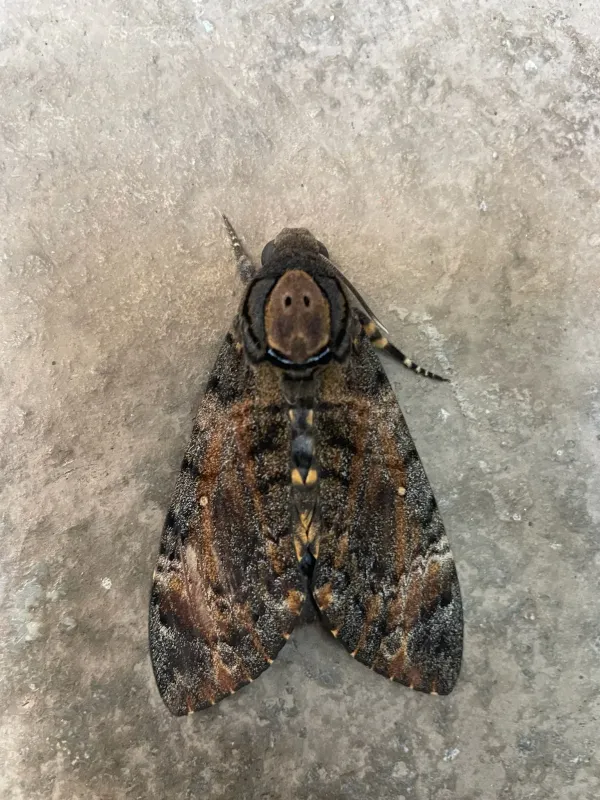
The Death's head hawkmoth (Acherontia styx) is a large moth belonging to the Sphingidae family. It is widely recognized by the distinct skull-like pattern on the thorax, which serves as a unique identification marker for this species.
Adult moths are robust with a wingspan of approximately 10 to 12 cm. Their forewings typically exhibit a mottled dark brown and black pattern with yellow transverse bands, providing effective camouflage against tree bark and foliage.
The larvae, or caterpillars, are substantial, reaching lengths of up to 12 cm. They display polymorphism, appearing in various shades of green, yellow, or brown, and are characterized by a prominent horn on the posterior segment of the body.
The lifecycle includes four stages: egg, larva, pupa, and adult. The species typically overwinters as a pupa, buried deep within the soil in a self-constructed chamber, which protects it from adverse environmental conditions.
As crepuscular or nocturnal insects, adults are frequently attracted to artificial lights. They possess a remarkable ability to emit squeaking sounds when threatened, a behavioral defense mechanism rarely seen in other moth species.
What it damages
The damage is caused primarily by the larval stage. These caterpillars are voracious feeders capable of consuming large volumes of leaf tissue in a very short amount of time, leading to significant defoliation of the host plant.
The primary hosts for Acherontia styx are plants in the Solanaceae family. Economically important crops such as potatoes, tomatoes, eggplants, and peppers are at the highest risk of infestation by this pest.
Severe defoliation negatively impacts the plant's photosynthetic capacity, resulting in stunted growth and a considerable decrease in overall crop yield. In extreme cases, the stress can make plants more susceptible to secondary diseases.
Beyond leaf consumption, the caterpillars may also feed on developing fruits and stems, causing physical injury that leads to fruit rot or stem breakage, thereby reducing the commercial quality of the harvest.
While often appearing in lower densities compared to other agricultural pests, the sheer size of the caterpillars means that even a small population can cause localized devastation in garden plots or specialized vegetable farms.
When it appears
Adult moth activity typically begins in late spring or early summer, following the emergence of adults from overwintering pupae. The peak flight period usually occurs during the height of the summer months.
Caterpillars are most abundant during the mid-to-late growing season, coinciding with the peak vegetative growth and fruit-setting stages of solanaceous crops. This is the period when vigilance is most critical for crop safety.
The duration of the lifecycle depends heavily on environmental temperature and humidity. In tropical or temperate climates with long summers, multiple generations can occur, extending the threat window through the autumn harvest.
As temperatures begin to drop, mature caterpillars bury themselves into the soil to pupate. This transition is a key biological response that ensures the survival of the species through the winter months.
Agronomists should implement monitoring programs from early June, focusing on visual inspections of the underside of leaves for eggs and small larvae, which are much easier to control than fully grown caterpillars.
Signs of infestation
The first indicator of an infestation is the presence of large, irregular notches along the leaf margins. As the caterpillars grow, they consume entire leaves, often leaving only the midribs intact.
Significant amounts of frass (caterpillar droppings) found on the soil surface beneath the plants are a definitive sign of active feeding. These pellets are large and easily spotted by trained field staff.
Stems may show signs of girdling or localized grazing. This damage can cause the plant to wilt or break under its own weight, especially if the infestation coincides with fruit development.
Close inspection of the underside of leaves may reveal individual eggs. These eggs are usually small, spherical to oval, and possess a pale greenish or yellowish hue that blends well with the plant tissue.
On fruiting crops, evidence of damage often includes deep excavations into the flesh of the fruit, which often serve as infection sites for various molds and bacterial rot pathogens.
Control measures
Hand-picking is the most practical and recommended control method for small-scale operations. Because of their large size, the larvae are easily visible, and manual removal is highly effective in preventing further damage.
Biological control agents, specifically products based on Bacillus thuringiensis (Bt), are highly effective against younger larval stages. These treatments are environmentally friendly and have minimal impact on beneficial insect populations.
Cultural practices, such as deep autumn plowing, are essential for destroying overwintering pupae. By disturbing the soil, the pupal chambers are broken, exposing the insects to predators and lethal freezing temperatures during winter.
In cases of severe infestation, chemical insecticides may be necessary. It is crucial to choose products registered for the specific crop and to strictly adhere to pre-harvest intervals to ensure consumer safety.
Managing alternate host plants, particularly wild solanaceous weeds around field borders, is a vital preventative measure. Removing these weeds reduces the availability of secondary food sources and disrupts the pest's lifecycle.
Taxonomy
- Latin name
- Acherontia styx
- Order
- Lepidoptera (butterflies)
- Family
- Sphingidae
- EPPO code
- ACHESO
Discussion
No discussions yet — be the first.