
Convolvulus hawk-moth
Agrius convolvuli
Description
How to identify
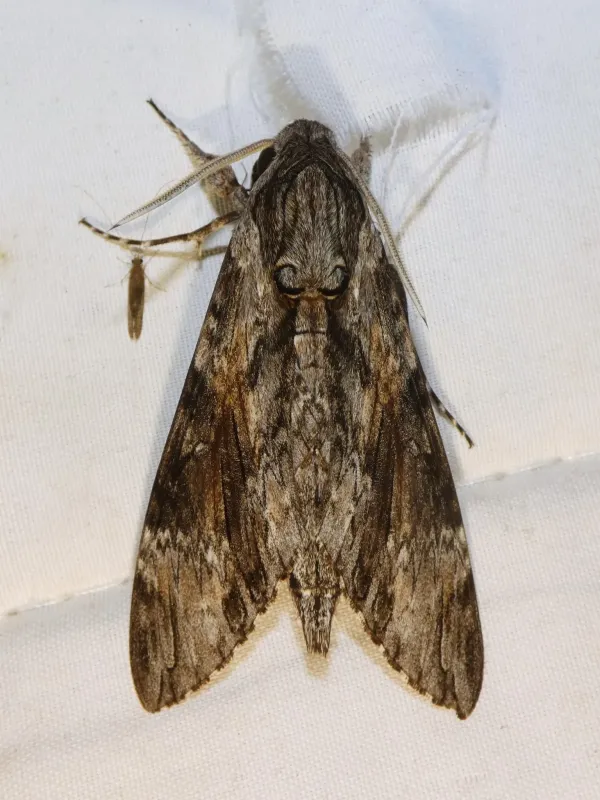
The Convolvulus hawk-moth (Agrius convolvuli) is a large moth belonging to the family Sphingidae. With a wingspan of up to 120 mm, it is known for its grey patterned forewings and strong flying ability during the night.
The larvae are impressive in size, reaching up to 10 cm in length. They display a wide range of colors from green to brown and are easily distinguished by a small, curved horn located at the posterior end of their body.
What it damages
This species primarily feeds on plants in the Convolvulaceae family. In agricultural settings, it is a significant pest known for targeting specific horticultural crops that share a botanical relationship with the wild field bindweed.
Sweet potato plantations are the most frequent victims of Agrius convolvuli outbreaks. The larvae possess a voracious appetite and can consume entire leaves, significantly reducing the photosynthetic capacity of the plants and impacting tuber development.
When it appears
This moth is a known migrant, traveling from warmer regions to temperate zones during the summer months. Adults usually arrive in early summer to lay eggs on the leaves of host plants.
The caterpillar stage typically occurs from July to September. During this period, larvae feed extensively, predominantly at night, while adults remain active in the dusk, feeding on nectar from tubular flowers.
Signs of infestation
The most obvious sign of an infestation is rapid defoliation of the host plant. Large, irregular holes appear in the foliage as larvae progress from the edges of leaves towards the center, often leaving only the main stems behind.
Evidence of larval presence is also indicated by large, dark frass pellets accumulating on the ground beneath the infested plants. Regular inspection of the foliage during the evening can reveal the presence of large, well-camouflaged caterpillars.
Control measures
Cultural control is the most effective approach, focusing on the rigorous removal of field bindweed from fields and garden edges to eliminate the primary food source for early generations.
Tillage and soil cultivation are recommended to disrupt the pupation cycle, as the pupae overwinter underground. In severe infestation cases, targeted application of microbial pesticides or systemic insecticides may be necessary to protect the yield.
Taxonomy
- Latin name
- Agrius convolvuli
- Order
- Lepidoptera (butterflies)
- Family
- Sphingidae
- EPPO code
- HERSCO
Discussion
No discussions yet — be the first.