
Wild Cherry Sphinx
Sphinx drupiferarum
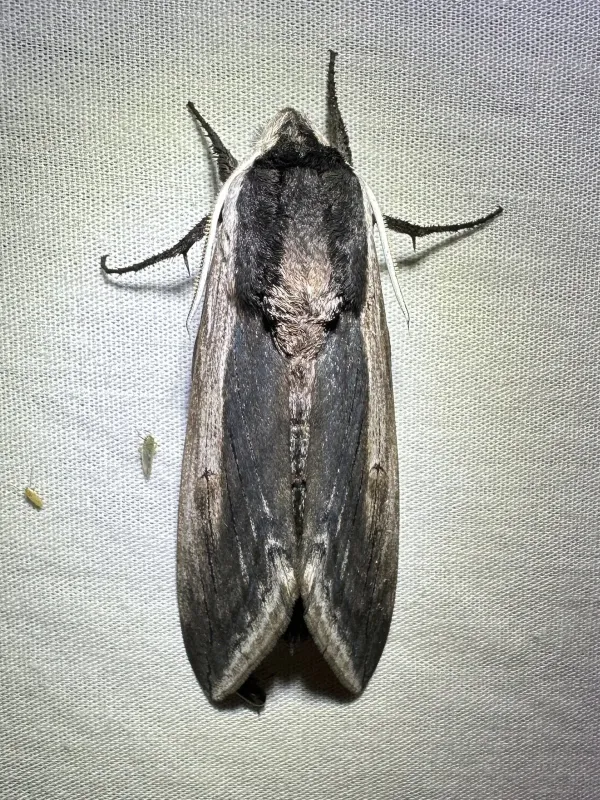
Description
How to identify
The adult Wild Cherry Sphinx is a large nocturnal moth with a wingspan ranging from 10 to 12 centimeters. Its forewings are patterned with shades of gray and brown, featuring distinct dark streaks and light borders that provide excellent camouflage against tree bark.
The larvae of this species reach impressive sizes, growing up to 8–9 centimeters in length. They are characterized by a vibrant green body with diagonal white or purple lateral stripes and a signature horn on the rear end, which is a hallmark of the Sphingidae family.
This species belongs to the order Lepidoptera and the family Sphingidae. These insects undergo complete metamorphosis, passing through egg, larval, pupal, and adult stages during their life cycle.
The pupa is typically dark brown and robust, overwintering in the soil within a specialized earthen cell a few centimeters deep. It features a distinct protrusion in the head region known as the proboscis case.
Adult moths are primarily active at dusk and during the night, feeding on flower nectar. Thanks to their powerful wing musculature, they are capable of hovering in mid-air over flowers, similar to hummingbirds.
What it damages
The primary damage is caused by the caterpillars, which possess a voracious appetite and can defoliate tree branches in a very short time. Their host range includes various members of the Rosaceae family.
The species most frequently affected by this pest include plum, apple, cherry, and crabapple trees. In home gardens, the larvae can also be found on a variety of ornamental shrubs belonging to the same botanical groups.
Young larvae begin feeding on the edges of leaves, eventually progressing to full skeletonization of the foliage. When populations are high, these insects can destroy a significant portion of a tree's canopy.
Extensive defoliation disrupts photosynthesis, which critically weakens the tree. This stress makes the plant susceptible to secondary diseases, reduces cold hardiness, and negatively impacts the development of fruit buds for the following year.
Although the pest rarely causes the death of a mature tree in a single season, chronic infestations over several years lead to a substantial decline in crop yields and overall tree vigor.
When it appears
The flight period of the adult Wild Cherry Sphinx moth begins in late spring and continues into the first half of summer. During this time, the moths mate and lay eggs singly on the underside of the leaves of host plants.
The larval development period occurs during the height of summer, specifically July and August. This is when visual signs of garden damage are most pronounced, as the larvae feed actively and gain mass rapidly.
After completing their feeding phase, the caterpillars descend to the soil to pupate. Overwintering occurs exclusively at the pupal stage, with the pupae remaining in the ground until the following warm season.
Pupation is generally completed by September, after which the metabolic processes within the pupa slow down until the arrival of spring warmth. Thus, the species typically follows a univoltine life cycle.
Favorable conditions for population growth include moderately warm summer months with sufficient precipitation, which promote active vegetative growth of host trees.
Signs of infestation
The first sign of an infestation is the presence of large, irregular holes in the leaves of fruit trees. As the larvae grow, the number and size of these feeding sites increase rapidly across the canopy.
Beneath the trees, one may find larval frass, which appears as characteristic large, dark-colored pellets. Their presence is a direct indicator of active feeding by larvae in the tree canopy directly above.
During evening or early morning inspections, the caterpillars themselves can often be spotted. Despite their large size, their cryptic coloration helps them blend in, as they often rest along the midrib of a leaf.
Sudden thinning or "bald patches" on individual branches or sections of the canopy are serious warning signals. If a tree shows significant defoliation in August, a thorough inspection is required to identify the larvae.
Due to their nocturnal habits and the secretive nature of the adult moths, sightings are rare. Therefore, pest monitoring is primarily based on detecting larval feeding damage.
Control measures
The simplest and most effective method for small orchards or home gardens is manual collection of the caterpillars. Their large size makes them relatively easy to spot during morning inspections when they are less active.
In commercial orchards or during heavy infestations, biological and chemical controls are employed. Insecticides with stomach-contact action, labeled for use on fruit crops, are effective when applied correctly.
A crucial agrotechnical practice is tilling the soil beneath the tree canopy in the autumn or early spring. This destroys the earthen pupal cells, exposing the pupae to frost or natural predators like birds.
The use of biological controls, such as products based on Bacillus thuringiensis, allows for effective caterpillar management without accumulating harmful residues in the fruit, which is highly beneficial for private growers.
Preventive measures include keeping the orchard clean, timely weeding, and attracting insectivorous birds that feed on sphinx moth larvae during their period of peak activity.
Taxonomy
- Latin name
- Sphinx drupiferarum
- Order
- Lepidoptera (butterflies)
- Family
- Sphingidae
- EPPO code
- SPHXDR
Discussion
No discussions yet — be the first.