
Arabian flathead borer
Sphenoptera arabica
Description
How to identify
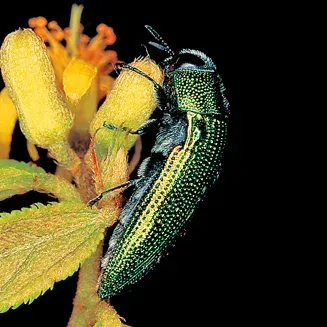
The Arabian flathead borer (Sphenoptera arabica) belongs to the order Coleoptera and the family Buprestidae. These beetles typically feature a metallic sheen, with adult specimens measuring between 10 and 15 mm in length.
The insect has an elongated, slightly flattened body shape, characteristic of the Buprestidae family. Its coloration is usually dark bronze or copper-brown, with fine punctation on the elytra.
The larvae are legless, cream-white in color, and have a noticeably expanded prothoracic segment. They are physically similar to larvae of other jewel beetle species, which makes accurate identification difficult without expert inspection.
These beetles are highly thermophilic, meaning they are most frequently found in arid regions and countries with hot climates. They are most active during daylight hours, particularly in direct, intense sunlight.
The lifecycle of this borer is closely tied to the weakening of host trees. While adult beetles feed on leaves and young shoots, the primary damage is caused by the larvae, which develop beneath the tree bark.
What it damages
The Arabian flathead borer is a destructive pest of many stone fruit crops, including apricots, peaches, plums, and almonds. Infestations in other types of fruit trees are less common and typically occur when trees are under physiological stress.
The main damage is caused by larvae that create winding tunnels within the cambium layer and the phloem of the trunk. This disrupts nutrient flow, causing the tree to slowly decline and eventually perish.
Severe infestations can lead to the total death of saplings or young trees within just a few seasons. Mature trees suffer from reduced productivity and lower resistance to winter conditions and other diseases.
The damage caused to the wood provides entry points for pathogenic fungi and bacteria, which cause secondary issues like cytosporosis or bacterial canker, significantly accelerating the tree's decay.
The pest is most dangerous in industrial orchards where agricultural practices have been neglected or during prolonged periods of drought, which weaken the trees' natural immune systems.
When it appears
The adult flight period begins in late spring when average daily temperatures reach high levels. Mass emergence of the beetles usually occurs throughout June and July.
Females lay eggs in the cracks of the bark on the trunks and large skeletal branches of trees, preferring the sun-exposed sides. A single female can produce several dozen eggs during her lifespan.
The larval development period lasts several months, during which they feed intensely on plant tissues. Larvae overwinter inside the wood, moving deeper into the trunk or remaining in the cambium zone until spring.
Pupation occurs in the spring, typically inside specially prepared chambers under the bark or in the outer layers of the wood. The development cycle of one generation can last one year, depending on the region's climate.
Favorable conditions for this pest are created during dry years, as trees experience water stress, making their bark more susceptible to egg-laying and larval colonization.
Signs of infestation
The first sign of an infestation is the appearance of small, circular holes on the bark surface, through which young beetles emerge after completing their metamorphosis.
The presence of larvae is often indicated by gumming or sap leakage on the trunk. Branch dieback or premature yellowing and leaf fall during the summer are clear signs of restricted nutrient supply due to larval activity.
Upon inspecting the trunk, one may notice patches of dead, cracked bark. When peeled back, these reveal flat, winding tunnels filled with frass, a mixture of wood dust and larval excrement.
In advanced cases, the tree canopy becomes sparse, and if the trunk is heavily damaged around its circumference, the entire tree may die due to a total failure of internal nutrient transport.
Adult beetles can also be spotted visually during their peak activity periods, as they rest on leaves or branches in sunny weather and fly between neighboring trees.
Control measures
The cornerstone of control is the implementation of proper horticultural practices. It is crucial to ensure trees receive adequate irrigation and timely fertilization, as healthy, vigorous trees are far more resistant to borer colonization.
Regular sanitary pruning is essential; dead, infested, or damaged branches must be removed and burned to eliminate larvae and pupae residing within the wood.
Chemical control measures are most effective during the active adult flight period, before egg-laying occurs. Systemic or contact-stomach insecticides approved for use in orchards should be applied according to local guidelines.
Whitewashing trunks and major branches with lime-based solutions mixed with adhesive compounds is an important preventive measure, as it discourages females from laying eggs directly onto the bark.
In cases of severe, widespread infestation, infested trees must be removed from the orchard and destroyed to prevent the pest population from spreading to healthy trees.
Taxonomy
- Latin name
- Sphenoptera arabica
- Order
- Coleoptera (beetles)
- Family
- Buprestidae
- EPPO code
- SPPTAR
Discussion
No discussions yet — be the first.