
Cicada killer wasp
Sphecius speciosus
Description
How to identify
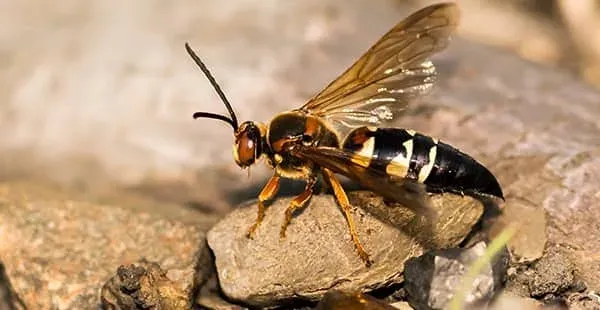
The cicada killer wasp is a large, solitary ground-nesting wasp in the family Crabronidae. Adults can grow up to 5 cm in length and feature a distinct yellow and black color pattern on their abdomen.
Females are significantly larger than males and possess a stinger. While they are not inherently aggressive toward humans, they will defend their nests if physically disturbed or threatened.
They are famous for digging deep, complex burrows in the soil. These burrows are typically marked by a small mound of soil pushed out from the entrance, often found in dry, sunny, and sparsely vegetated areas.
The life cycle involves complete metamorphosis. Larvae overwinter deep in the soil and pupate during the spring, emerging as active adults during the warm summer months.
Although they are solitary, they often nest in aggregations if the soil conditions are ideal, leading to dozens of wasps living in close proximity to one another.
What it damages
Cicada killers are not foliage pests; they do not eat plants. However, their primary damage to the landscape is caused by their extensive soil-nesting activities in gardens and lawns.
As females dig deep burrows to create nest chambers for their eggs, they displace large amounts of soil and may undermine the root systems of small shrubs, perennials, and turf grasses.
Excessive burrowing can lead to the death of young plants due to root damage and localized drying of the soil, which prevents proper water uptake by the vegetation.
The presence of large, unsightly mounds of loose soil can ruin the appearance of professional golf courses, well-manicured residential lawns, and decorative flower beds.
While the wasps themselves are beneficial in controlling cicada populations, their impact on soil structure and aesthetic value makes them a pest in managed agricultural or gardening environments.
When it appears
The activity of the cicada killer wasp is strictly linked to the summer season, coinciding with the peak emergence of annual cicadas which serve as their only food source for larvae.
Adults usually emerge from the ground in late June or early July, as soil temperatures become sufficiently high to support their reproductive cycle.
The peak period of nest-building and hunting occurs during July and August, when females are most energetic in securing prey to stock their nesting chambers.
As autumn approaches and temperatures drop, the activity of the wasps gradually diminishes until they disappear from the surface entirely.
Adult wasps typically die off by late summer or early autumn, leaving behind their offspring as prepupae hidden safely beneath the soil surface through the winter.
Signs of infestation
The most visible sign of cicada killer activity is the presence of U-shaped or rounded openings in the soil, surrounded by horseshoe-shaped mounds of excavated dirt.
Homeowners often hear the loud, buzzing flight of the wasps as they hover low over lawns or bare soil patches in search of suitable nesting sites or prey.
If there is a sudden die-back of grass or plants in specific areas of the lawn, it is often a sign that root systems have been compromised by the tunnel network beneath.
The sight of large, black and yellow insects flying around with a paralyzed cicada in their grasp is a definitive indicator of their presence in the immediate area.
Concentrations of these burrows in sunny garden beds or along patio edges are clear indicators that a colony has established itself in the vicinity of your landscape.
Control measures
The most effective long-term strategy for control is to create an environment that the wasps find unattractive for nesting, primarily through improving turf density.
Frequent watering of lawns and gardens helps keep the soil moist and firm, which prevents the wasps from easily digging their burrows and forces them to relocate.
Applying a thick layer of mulch to bare garden beds acts as a physical barrier, making it much more difficult for the females to access the soil to start their tunnels.
If a population is causing severe damage, contact-based insecticides can be applied directly into the entrance holes of the nests to eliminate the nesting female.
- Maintain thick, healthy lawn cover.
- Water dry patches of soil regularly.
- Use mulch in garden beds to cover bare soil.
- Spot-treat active burrows if necessary.
Taxonomy
- Latin name
- Sphecius speciosus
- Order
- Hymenoptera
- Family
- Crabronidae
- EPPO code
- SPHCSC
Discussion
No discussions yet — be the first.