
Sogata
Sogata
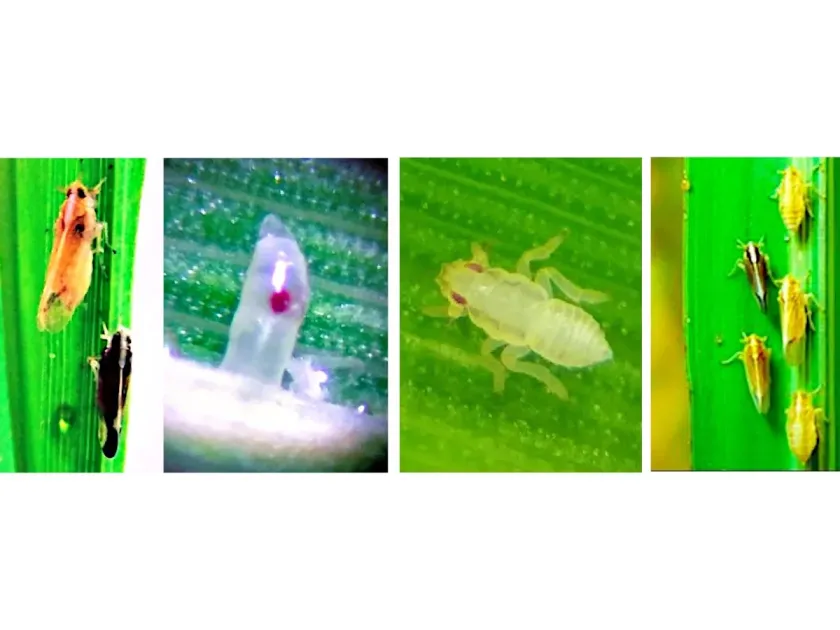
Description
How to identify
The genus Sogata belongs to the order Hemiptera and the family Delphacidae (planthoppers). These are small insects known for their jumping capabilities and their tendency to migrate over significant distances during infestation cycles.
Adult Sogata specimens typically have a slender body, measuring between 3 and 5 mm. Their coloration ranges from yellowish-brown to dark brown, and they possess transparent wings with distinct venation, often held in a tent-like fashion over the abdomen.
Nymphs resemble smaller, wingless versions of the adults. Throughout their development, they undergo several molting stages, gradually increasing in size and transitioning through various nymphal instars before reaching maturity.
These insects are primarily active during daylight hours, showing a strong preference for high-humidity environments. In rice paddies, they can rapidly establish dense populations due to the favorable microclimate provided by the dense crop canopy.
Identifying the exact species within the field can be difficult due to morphological similarities with other planthoppers; therefore, precise scientific identification often requires the examination of male genitalia under laboratory conditions.
What it damages
The primary hosts for Sogata are cereal crops, with rice being the most significant agricultural target. Additionally, they can be found on various wild grasses growing near irrigation channels and water bodies.
Both adults and nymphs feed by inserting their piercing-sucking mouthparts into plant tissues. As they feed, they extract large volumes of xylem and phloem sap, which deprives the plant of essential nutrients and disrupts its normal development.
Beyond direct mechanical damage and sap depletion, Sogata serves as a vector for various rice viral diseases. The transmission of these pathogens severely hinders plant metabolism, often leading to stunted growth and distorted tillers.
Damage is typically concentrated in the tillering nodes and young leaves, which are critical for the plant's overall productivity. Heavy infestations often result in reduced grain filling and significant yield losses at harvest time.
Mass outbreaks can cause severe lodging of the crop and widespread wilting, potentially destroying large segments of rice paddies if management measures are not implemented in a timely manner.
When it appears
The life cycle of Sogata is highly dependent on ambient temperature and humidity levels. Peak activity and rapid population growth occur during the active vegetative stages of the rice crop when environmental conditions are most favorable.
The first generation typically emerges in early summer as temperatures stabilize. In warmer climates, Sogata can complete 4 to 5 generations within a single cropping season, making it a persistent threat to rice production.
Adults are highly mobile and exhibit strong migratory behavior, moving from field to field in search of optimal feeding sites and breeding grounds, which allows them to colonize new areas very quickly.
Overwintering usually takes place at the adult or late-nymph stage in protected habitats, such as crop stubble, accumulated plant debris, or dense weeds located along the edges of water bodies.
Spring activity coincides with the warming of the soil and the germination of early-season grasses, which serve as a necessary food source before the transplanting or sowing of the main rice crop.
Signs of infestation
A visual symptom of infestation is the yellowing or browning of rice leaves. Upon close inspection of the underside of leaf blades, growers can often detect the presence of nymphs or adult insects resting in the foliage.
Infestations are frequently accompanied by the presence of honeydew—a sugary substance excreted by the insects—which promotes the growth of sooty mold (black fungal growth) on the leaves and stems of the rice plants.
Damaged plants often appear stunted and show a significant delay in reaching the booting stage. In severe cases, entire shoots may wither, become brittle, and turn a dark brown color as they succumb to the combined stress of feeding and viral infection.
- Large numbers of jumping insects visible upon disturbing the rice plants.
- Appearance of localized patches where crop growth has stalled compared to surrounding healthy areas.
- Visible sooty mold (black fungi) covering leaf surfaces as a secondary infection sign.
Increased presence of natural predators, such as lady beetles, mirid bugs, and spiders, is often a reliable indicator that a Sogata population outbreak is occurring within the field.
Control measures
Integrated Pest Management (IPM) is essential for effective control. A fundamental agricultural practice is the removal of alternative host weeds in and around the fields to eliminate overwintering sites for the pest.
Water management is another crucial tool; manipulating water levels in the rice paddies, including periodic drainage, can help disrupt the life cycle of the nymphs and limit their feeding success.
Biological control involves conserving and promoting the population of natural enemies. Encouraging predators like spiders and parasitic wasps can significantly suppress Sogata numbers, keeping them below the economic injury level.
Chemical control is advised only when populations exceed the economic threshold. Systemic insecticides, such as neonicotinoids or specific organophosphates, are typically employed to ensure long-lasting protection of the rice crop.
It is vital to rotate pesticides with different modes of action to prevent the development of insecticide resistance and to use selective application methods to minimize the impact on beneficial insects and the surrounding ecosystem.
Taxonomy
- Latin name
- Sogata
- Order
- Hemiptera (bugs, aphids, leafhoppers)
- Family
- Delphacidae
- EPPO code
- SOGASP
Discussion
No discussions yet — be the first.