
Poplar hawk-moth
Smerinthus planus
Description
How to identify
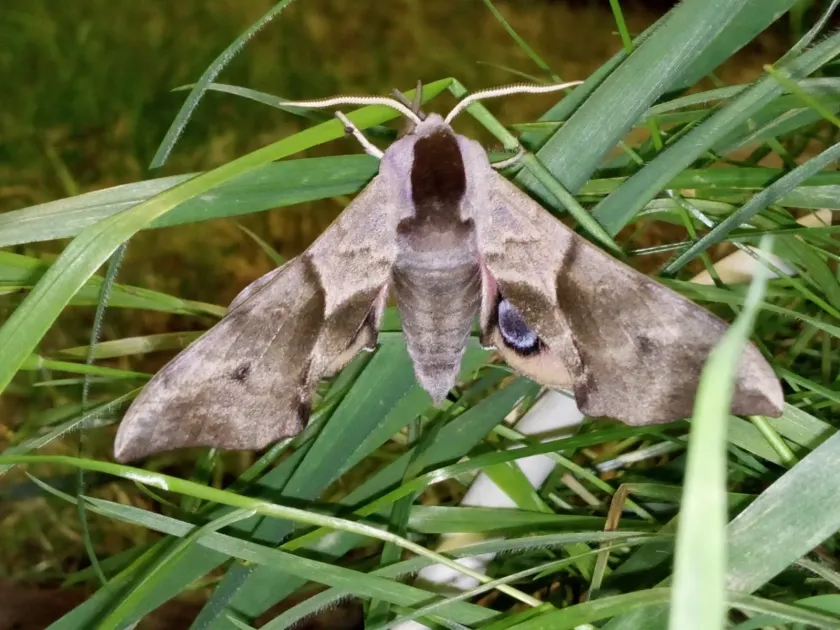
The Poplar hawk-moth (Smerinthus planus) belongs to the Sphingidae family of Lepidoptera. These moths have an impressive wingspan of 70–90 mm, making them one of the larger moth species in their region.
The forewings are patterned with shades of grey and brown, perfectly mimicking tree bark, which provides excellent camouflage while the moth rests during the day.
The hindwings are distinctively colored with a bright pink or reddish tint and feature a large, dark eyespot surrounded by a black ring, used to startle potential predators.
The larvae, or caterpillars, can grow up to 80 mm in length. They are vibrant green with diagonal white stripes and possess a characteristic horn-like protrusion on the posterior end.
The pupae are dark, matte brown, and develop within the soil or ground litter, where they undergo diapause to survive the winter season.
What it damages
The larvae feed primarily on trees from the willow family, with aspen (Populus tremula) and various poplar species being their main food sources.
Occasionally, they may feed on willows (Salix), especially if preferred hosts are unavailable or if the local population density is high.
The damage is caused by the caterpillars consuming large amounts of leaf tissue, which can lead to significant defoliation of the host tree.
Young trees and saplings are particularly vulnerable; repeated defoliation weakens them, slows their annual growth, and leaves them susceptible to secondary infestations.
Adult moths do not feed, as their mouthparts are atrophied. They exist solely for reproduction, using the energy stores accumulated during their larval stage.
When it appears
The first generation of adults emerges in late May or June, coinciding with the period of lush foliage development in their host trees.
Females lay eggs singly or in small clusters on the undersides of leaves, ensuring the larvae have immediate access to food upon hatching.
The larval stage is the most active feeding period, extending through the summer months as the caterpillars grow rapidly before entering the pupation stage.
Pupation typically occurs in the upper layers of the soil or in organic ground debris, where the insect remains throughout the colder months.
Depending on local climate conditions, the moth may produce one or two generations per year, with the final generation overwintering as a pupa.
Signs of infestation
The most visible sign of infestation is ragged, uneven edges on leaves or leaves completely eaten down to the midribs and main veins.
Accumulated frass (caterpillar droppings), which appear as large, cylindrical pellets on the ground, often reveals the presence of larvae even when they are hidden.
Caterpillars are masterfully camouflaged; finding them requires careful inspection of the foliage along the lower canopy or near the main branches.
Heavy infestations can lead to premature leaf drop, which stresses the tree and can negatively affect its vigor for the following growing season.
Adult moths are nocturnal and are strongly attracted to artificial lights, making light traps an effective way to detect their presence in the area.
Control measures
Hand-picking caterpillars is a practical and effective solution for small gardens or when dealing with individual young trees.
Biological control agents, specifically Bacillus thuringiensis sprays, are highly effective against young larvae and are considered safe for most beneficial insects.
Chemical intervention with systemic insecticides may be necessary in commercial plantations or nurseries during periods of high population density.
Cultivating or turning the soil around the base of host trees in autumn can physically destroy overwintering pupae, significantly reducing the next season's population.
Encouraging natural predators, such as insectivorous birds, is a sustainable way to keep the moth population in balance within a healthy garden ecosystem.
Taxonomy
- Latin name
- Smerinthus planus
- Order
- Lepidoptera (butterflies)
- Family
- Sphingidae
- EPPO code
- SMERPL
Discussion
No discussions yet — be the first.