
Eyed hawk-moth
Smerinthus ocellatus
Description
How to identify
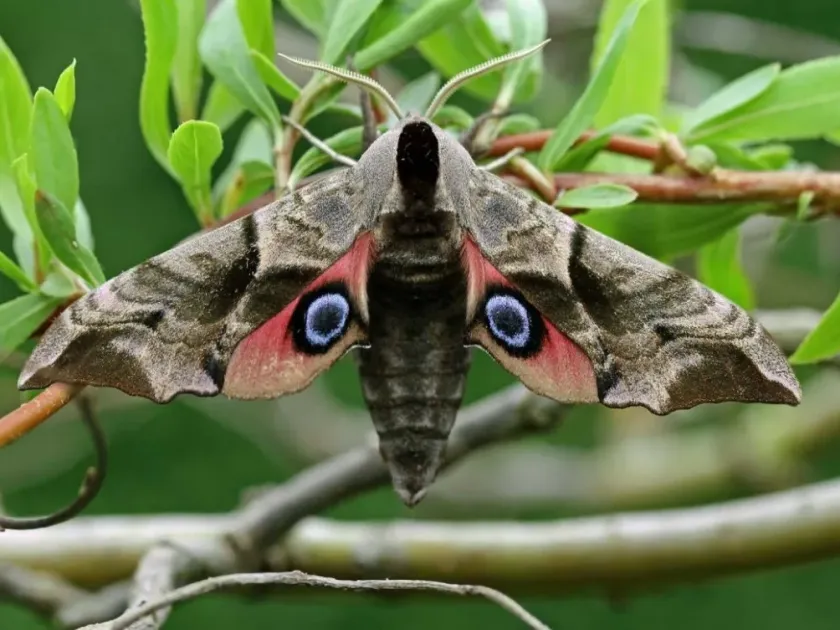
The eyed hawk-moth is a large nocturnal moth with a wingspan of up to 80 mm. Its forewings feature a cryptic grey-brown pattern, providing excellent camouflage against tree bark.
The hindwings display a prominent blue eyespot with a black border. This feature is a defensive mechanism; the moth flashes these eyespots when threatened to startle potential predators.
The larva, or caterpillar, grows up to 80 mm long and is bright green with diagonal white stripes on its sides. It is easily identified by the distinct blue-green horn on its posterior end.
Pupation occurs underground, where the dark brown, shiny pupa spends the winter. The species is closely associated with various deciduous trees and shrubs throughout the temperate zone.
Taxonomically, it belongs to the order Lepidoptera and the family Sphingidae. It is a well-known member of the hawk-moth family found across Eurasia.
What it damages
The larvae primarily feed on foliage from the Rosaceae family. They are commonly found on apple, pear, plum, and cherry trees, as well as on rowan and hawthorn bushes.
Beyond fruit trees, the moth also thrives on wild plants like willow, poplar, and alder. A high density of these wild hosts near a garden often leads to spillover infestations.
The caterpillars are voracious feeders that strip leaves from branches. This reduction in leaf area limits the tree's photosynthetic capacity, which can weaken the plant over time.
Damage is particularly critical for nursery saplings and young trees, where significant leaf loss can inhibit growth, reduce vigor, and impair the tree's ability to survive winter dormancy.
While mature trees can usually withstand light infestations, localized outbreaks in orchards or plantations can cause measurable economic stress and necessitate intervention.
When it appears
The flight period for adult moths occurs from May to July. As adults, they do not feed and spend their time mating and searching for suitable host plants for egg-laying.
Females deposit eggs singly on the undersides of host plant leaves. The embryonic development stage usually lasts for about two weeks, depending on the ambient temperature.
The larval feeding stage spans from June through August. This is the period when most visible leaf damage occurs, as the larvae grow rapidly and require high caloric intake.
By late summer, the fully grown caterpillars burrow into the soil to pupate. The insect remains in the pupal stage throughout the winter, protected from cold temperatures by the soil.
The species produces one generation per year. Gardeners can monitor adult presence using light traps or by careful inspection during the twilight hours when the moths are active.
Signs of infestation
The most evident sign is the presence of skeletonized leaves or foliage that has been completely consumed. Larvae often eat the leaf blade while leaving the thick midrib intact.
Large, dark, granular frass (droppings) found beneath the canopy is a strong indicator of caterpillar presence. Finding these droppings helps locate which specific branch is being targeted.
Caterpillars are difficult to spot due to their green coloring, which mimics the leaves. Searching the underside of the foliage, especially on branches with visible damage, is necessary.
In cases of severe infestation, damage to young shoots may occur as the larvae consume the soft bark of fresh twigs, leading to wilting or stunted growth of the affected parts.
Increased bird activity within the canopy can also suggest the presence of large caterpillars, as birds frequently prey on these sizable insects during the summer months.
Control measures
Hand-picking is the most effective and eco-friendly control method for small gardens. Their large size makes them easy to detect and remove manually during a routine inspection.
Cultivating the soil around the base of trees in autumn can help expose and destroy overwintering pupae, significantly reducing the population for the following season.
Biological insecticides containing Bacillus thuringiensis are highly effective against younger larval stages and have minimal impact on beneficial insects, such as bees and pollinators.
Chemical control with approved insecticides may be required in nursery settings if infestations are severe, provided that application follows all safety and harvest interval guidelines.
Maintaining a clean garden environment by removing excessive wild shrub growth around the perimeter can reduce the available host plants, thereby lowering the risk of infestation.
Taxonomy
- Latin name
- Smerinthus ocellatus
- Order
- Lepidoptera (butterflies)
- Family
- Sphingidae
- EPPO code
- SMEROC
Discussion
No discussions yet — be the first.