
Blinded sphinx
Smerinthus caecus
Description
How to identify
The blinded sphinx (Smerinthus caecus) belongs to the family Sphingidae (hawkmoths). It is a nocturnal insect that utilizes highly effective camouflage to remain undetected during the day.
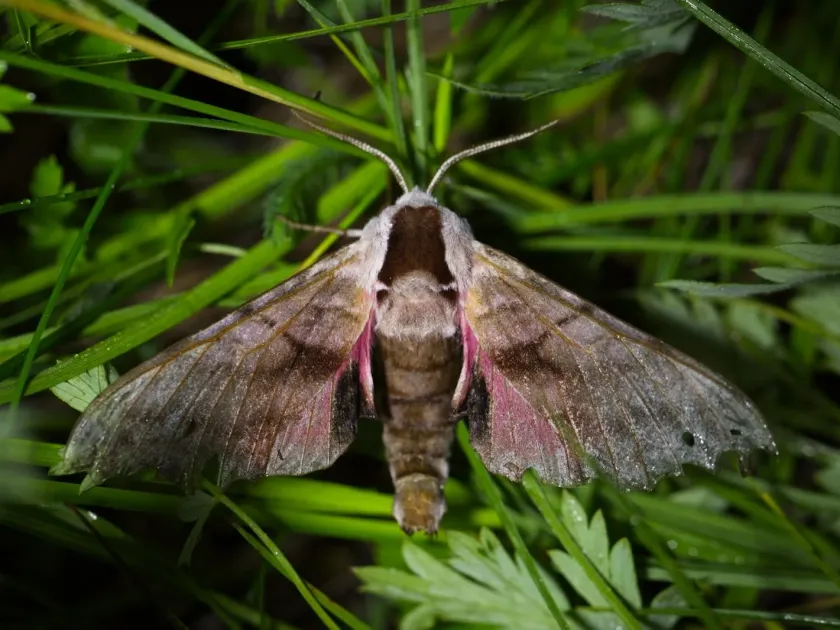
The adult moth has a wingspan of approximately 70–80 mm. Its forewings feature complex gray and brown patterns that mimic tree bark, allowing the moth to rest on trunks without being seen.
The hindwings display a bright pinkish-red color with a prominent central black spot, which resembles an eye. This marking is used as a startle display to deter predators.
The larvae are typical hawkmoth caterpillars: cylindrical, robust, and equipped with a characteristic horn on the posterior end. They are usually bright green with oblique lateral stripes.
The pupa is dark brown and robust, overwintering in the soil within a carefully constructed earthen cell, located a few centimeters below the surface near the host plant.
What it damages
The primary host plants for the larvae include trees such as willows (Salix) and poplars (Populus), though they can also be found on various Rosaceae family trees.
The caterpillars feed on foliage, consuming the leaf blades. In significant infestations, this can lead to substantial defoliation and reduced tree vigor.
Damage is typically localized, but it can affect the overall development of young nursery trees or ornamental specimens when larvae are abundant.
By consuming large amounts of leaf tissue, the larvae reduce the photosynthetic capacity of the tree, potentially affecting seasonal growth rates.
Adult moths do not cause damage to plants as they feed on nectar or do not feed at all, focusing their activity entirely on reproduction.
When it appears
The flight period for adults typically occurs from late May to mid-July. During this time, mating occurs and eggs are laid on the underside of host plant leaves.
Embryonic development usually takes about 10 to 14 days, depending on environmental temperature. The larvae emerge to begin their feeding cycle.
Caterpillars are active throughout the summer months, feeding aggressively to accumulate the energy required for pupation.
Pupation occurs in late summer or early autumn. The insect remains in the pupal stage within the soil throughout the winter months, entering a period of diapause.
The species produces a single generation per year, meaning the impact of the pest is concentrated within the summer growth period of the trees.
Signs of infestation
The most common sign of infestation is the presence of eaten or skeletonized leaves, often starting from the edges of the leaf blade.
Dark, pellet-like frass (excrement) deposited on the ground beneath the canopy is a clear indicator that caterpillars are feeding in the upper branches.
Finding the caterpillars themselves can be challenging because their green coloration provides excellent concealment among the leaf stems and veins.
In some cases, light traps can be used to monitor the presence of adult moths in the vicinity, which helps in predicting potential caterpillar activity.
Heavily infested branches may appear sparse, with significant portions of the foliage missing, particularly during the late larval stages when feeding is at its peak.
Control measures
Mechanical control is effective for home gardens: manually picking caterpillars from branches during early morning or evening hours when they are less camouflaged.
Tilling the soil under the tree canopy in the autumn disrupts the pupal cells, significantly increasing the mortality of the overwintering population.
Biological insecticides containing Bacillus thuringiensis are highly effective against young larvae and represent a safe alternative to synthetic chemicals.
Chemical control should be reserved for severe outbreaks where tree health is critically threatened and other methods are insufficient.
- Encouraging natural bird populations in the garden to prey on larvae.
- Maintaining healthy tree vigor through proper pruning and irrigation.
- Monitoring larval populations early in the season to prevent extensive damage.
Taxonomy
- Latin name
- Smerinthus caecus
- Order
- Lepidoptera (butterflies)
- Family
- Sphingidae
- EPPO code
- SMERCA
Discussion
No discussions yet — be the first.