
Lesser stag beetle
Sinodendron cylindricum
Description
How to identify
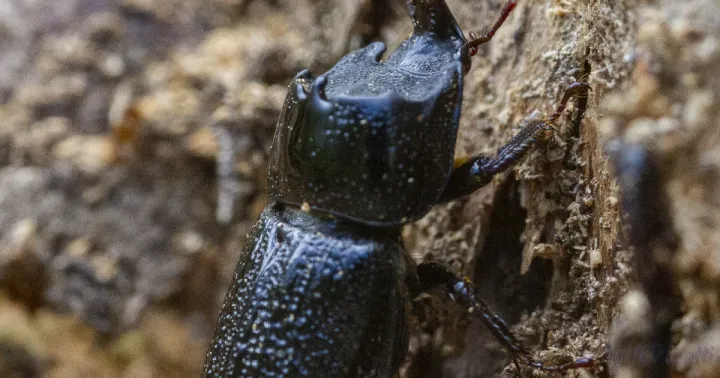
The lesser stag beetle (Sinodendron cylindricum) is a member of the Lucanidae family and the Coleoptera order. Adult beetles have a distinct cylindrical body shape, reaching 10 to 16 millimeters in length.
The coloration ranges from dark brown to coal black, with a noticeable glossy sheen. The body is covered with sparse hairs, and the surface of the elytra features coarse punctation in longitudinal rows.
Males of this species are distinguished by a characteristic horn-like projection on the head, directed forward and upward. Females have a much less pronounced horn or may lack it entirely, appearing as a small tubercle.
The larva of the lesser stag beetle has a typical C-shape, characteristic of scarabaeoid beetles, with a whitish body and a well-developed, hard head capsule featuring strong chewing mouthparts.
This species is the only member of the Sinodendrinae subfamily in Europe, which makes it relatively easy to identify during inspections of damaged woody material.
What it damages
The lesser stag beetle is a xylophagous insect that prefers to infest weakened or decaying deciduous tree species, including beech, oak, hornbeam, birch, and alder.
In gardening and forestry, the beetle primarily attacks old stumps, fallen logs, and deadwood, although it can occasionally colonize stressed fruit or ornamental trees.
The primary damage is caused by the larvae, which bore extensive tunnels through the wood, feeding on its tissues and gradually compromising the structural integrity of the timber.
Adult beetles also participate in the infestation process, boring tunnels into the wood for egg-laying, which facilitates the entry of secondary fungal infections into the tree.
The importance of this pest increases in nurseries and managed forests, where damage to young saplings or high-value decorative trees can lead to significant aesthetic and biological losses.
When it appears
The flight period for adult beetles typically occurs in late spring and summer, mostly from May to July, when adults search for mates and suitable wood for oviposition.
After mating, females search for decaying wood substrates and create boreholes where they deposit their eggs, starting the life cycle.
The life cycle of this species is relatively long and, depending on environmental and temperature conditions, can take between two and three years to complete.
Insects predominantly overwinter at the larval stage within the wood substrate, where they are protected from low temperatures by the bark and dense wood fibers.
Pupation occurs in the spring or early summer inside specialized chambers excavated within the wood, followed by the emergence of new adult beetles.
Signs of infestation
The first sign of infestation is the presence of small, circular exit or entrance holes in the bark and outer wood surface, consistent with the beetle's body width.
Near infestation sites, on the ground or at the base of the trunk, one can often observe accumulations of frass—fine wood dust and excrement pushed out by the larvae.
Removing a section of the bark on affected trees reveals longitudinal and transverse tunnels, which are often tightly packed with larval excrement and wood particles.
A generally weakened state of the tree, localized necrotic bark areas, and premature yellowing of leaves can also serve as indirect indicators of wood-boring beetle activity.
Tapping the trunks of infested trees may reveal a dull, hollow sound, which indicates the internal structural damage caused by extensive larval burrowing.
Control measures
The primary management strategy is the timely removal of deadwood, old stumps, and fallen branches from the garden or forest, as these serve as breeding grounds.
To prevent infestation of healthy trees, it is crucial to maintain their vigor through adequate watering, balanced fertilization, and protection from mechanical injuries.
Using trap logs, placed in affected areas during spring, can help capture and destroy beetles before they have a chance to lay eggs in living or healthy wood.
In garden settings, it is recommended to prune damaged bark areas and apply protective sealants or tree dressings to disinfect the area and prevent reinfection.
In cases of significant infestation, authorized systemic insecticides can be applied directly into the boreholes to target and eliminate the larvae or adults inside the wood.
Taxonomy
- Latin name
- Sinodendron cylindricum
- Order
- Coleoptera (beetles)
- Family
- Lucanidae
- EPPO code
- SINDCY
Discussion
No discussions yet — be the first.