
Lesser stag beetle
Dorcus parallelopipedus
Description
How to identify
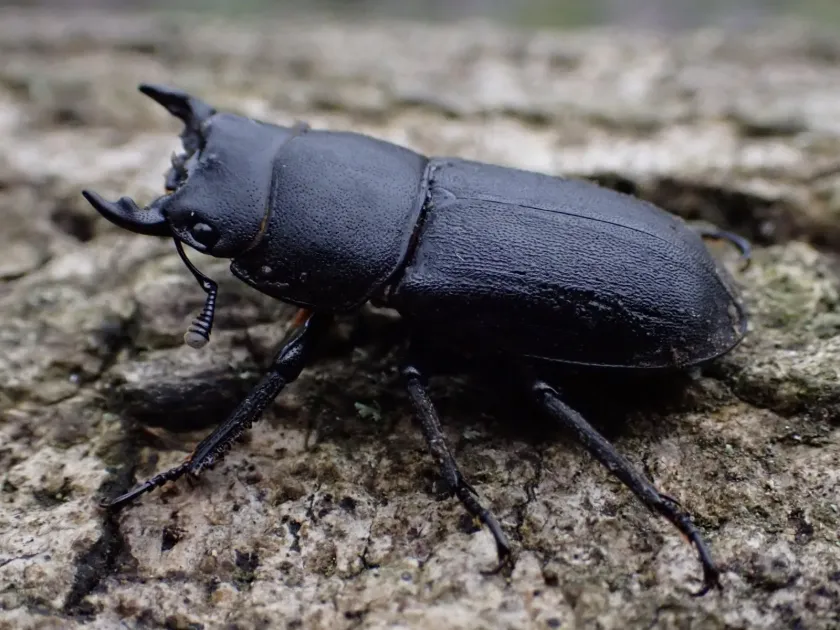
The Lesser stag beetle (Dorcus parallelopipedus) is a member of the Lucanidae family (stag beetles). Adult beetles have an elongated, flattened body that is typically matte black or dark brown in color.
Adult specimens measure between 20 and 32 millimeters in length. Unlike other species in the stag beetle family, the mandibles in males are relatively small, which gives the species its specific name and distinguishes it from the larger European stag beetle.
The larvae are white, C-shaped, and possess a well-defined head with strong mandibles. They have three pairs of thoracic legs and a body texture that is typical of other scarabaeoid beetles.
The development of this insect is strictly tied to decaying wood. The life cycle from egg to adult can take up to three years, during which the larvae feed exclusively on dead or rotting timber.
These insects are primarily associated with old-growth forests and neglected orchards, where large amounts of rotting deciduous wood are available for larval development.
What it damages
The Lesser stag beetle targets various deciduous tree species, including apple, pear, cherry, and plum trees. They are particularly drawn to weakened, dying, or already decaying wood.
While they rarely attack healthy, vigorous trees, their presence in an orchard indicates a buildup of decaying wood. Larvae tunnel through the timber, causing it to become brittle and eventually turn into frass.
The structural damage caused by larval tunneling disrupts the tree's internal transport system, making it less resilient to environmental stresses like strong winds or drought.
Furthermore, the tunnels created by the larvae provide entry points for wood-rotting fungi and other secondary pathogens, accelerating the decay process of the affected host tree.
In mature orchards, significant infestations can compromise the longevity of trees, leading to the premature loss of fruit-bearing branches or entire stems.
When it appears
Adult Lesser stag beetles are primarily active during the summer months, typically from June through August. This is the period when they emerge to find mates and suitable egg-laying sites.
Females seek out cracks in bark or exposed areas of rotting wood to deposit their eggs. Once the larvae hatch, they begin their long developmental phase within the woody substrate.
The larval stage remains hidden within the wood throughout the year. They spend the winter deep inside the timber, which provides thermal insulation against freezing temperatures.
Pupation occurs in the spring or early summer inside the wood. After a brief pupal stage, the adults emerge to complete their lifecycle and begin the process again.
Monitoring the adult population is most effective during the warm summer evenings, when beetles are most active and visible on tree trunks or foliage.
Signs of infestation
The most reliable sign of an infestation is the presence of small, round exit holes on the bark of the trunk or branches, typically measuring 5 to 8 millimeters in diameter.
The accumulation of wood dust or "frass" near the base of the tree or within tree hollows is a strong indicator of active larval tunneling inside the timber.
Affected trees may show signs of general decline, such as yellowing leaves, sparse canopy, or stunted shoot growth, reflecting the damage to the internal vascular system.
Bark that feels soft, spongy, or crumbles easily under light pressure often indicates that the wood underneath has been heavily infested and degraded by larvae.
In cases of severe damage, the structural integrity of the tree is compromised, sometimes resulting in sudden breakage during storms due to the extensive internal hollowing.
Control measures
The primary control strategy is garden sanitation. Removing and disposing of rotting stumps, deadwood, and severely infested trees is crucial to eliminate the breeding grounds for the beetles.
Regular maintenance of the orchard, including pruning dead branches and sealing wounds with high-quality wound paint, prevents the beetles from accessing the heartwood of the trees.
For high-value trees, if tunnels are identified, injecting systemic insecticides into the entry holes can kill the larvae, though this is a surgical approach and not suitable for large-scale treatment.
Boosting tree health through appropriate fertilization and consistent irrigation is the best preventative measure, as healthy trees are less likely to be targeted for infestation.
Routine inspections of the orchard during the summer months are recommended to detect any new exit holes or activity, allowing for quick action before the infestation spreads.
Taxonomy
- Latin name
- Dorcus parallelopipedus
- Order
- Coleoptera (beetles)
- Family
- Lucanidae
- EPPO code
- DORUPA
Discussion
No discussions yet — be the first.