
Lesser stag beetle
Platycerus caraboides
Description
How to identify
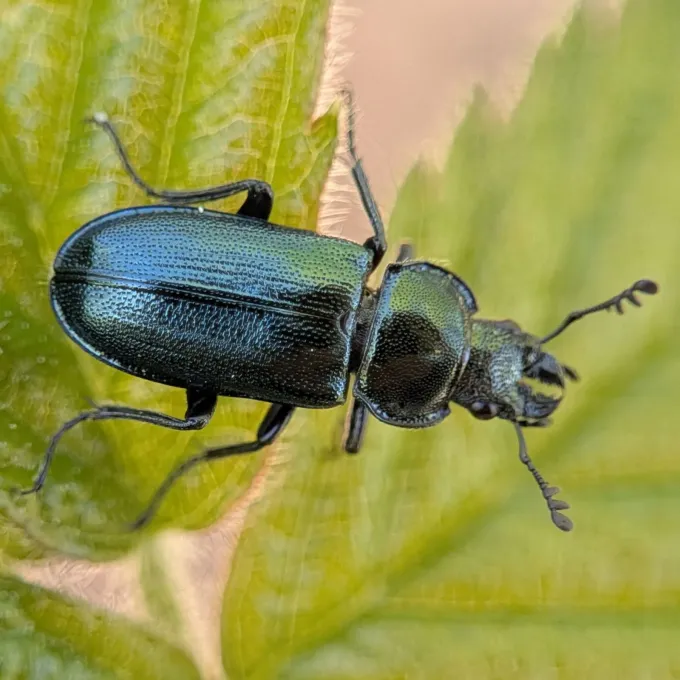
The Lesser stag beetle (Platycerus caraboides) is a small member of the Lucanidae family, typically measuring between 9 and 14 mm in length. Adult beetles exhibit a distinct metallic sheen with blue, green, or black coloration.
Males of the species are characterized by enlarged mandibles that resemble small antlers, giving them their common name. The body is dorsoventrally flattened, and the elytra are marked with fine longitudinal striae.
The larval stage is spent inside wood, where the grub grows into a C-shaped, cream-colored larva with a robust head capsule capable of consuming lignified tissues.
The lifecycle is entirely dependent on the presence of decaying or stressed hardwood trees. The beetle completes its development within the timber, remaining hidden for most of its life.
While often found in forests, these beetles can become opportunistic pests in neglected orchards where trees are not properly maintained or are already suffering from underlying health issues.
What it damages
The primary damage is caused by larvae that bore galleries through the sapwood of deciduous trees, including apple, pear, cherry, plum, oak, and beech. This disrupts the tree's vascular system.
Adult beetles may also cause injury by gnawing on the bark of young shoots and buds, which can lead to localized wilting and a reduction in the vigor of young saplings.
Wood boring activities create entry points for secondary infections, such as pathogenic fungi and bacteria, which can accelerate the decline and death of the host tree.
In cases of heavy infestation, the structural integrity of branches is compromised, leading to limb failure during heavy winds or crop loads.
Persistent infestations cause general tree decline, which manifests as reduced leaf canopy, stunted fruit size, and a significant decrease in overall orchard productivity.
When it appears
Adult activity typically begins in late spring and continues through mid-summer, specifically from May to July, when mating and oviposition occur.
The larval phase is long, often spanning several years depending on the wood quality and climatic conditions, with the larvae overwintering deep within the tree host.
Warmer seasons tend to accelerate the developmental rate of the larvae, potentially leading to faster population growth and more frequent emergence cycles.
Monitoring for adults is most effective during the late spring months when they emerge from the wood and may be seen on trunks or feeding on the bark of younger branches.
The emergence of a new generation is often signaled by small exit holes, which are most visible on the bark of skeletal branches or the main trunk after the adults have exited.
Signs of infestation
The most prominent sign of an infestation is the presence of small, round exit holes on the surface of the bark, indicating where adults have bored their way out.
Localized yellowing or premature dropping of leaves on specific branches indicates that the vascular supply to those parts of the tree has been severed by internal larval galleries.
The accumulation of fine wood shavings or "frass" at the base of the tree or in branch forks is a clear indicator of active feeding occurring within the woody tissues.
Bark splitting or peeling can reveal the underlying damage, where galleries have weakened the cambium and sapwood layers of the tree.
General tree stress, such as a lack of shoot growth and increased vulnerability to other orchard pests, often accompanies a chronic Lesser stag beetle infestation.
Control measures
The primary control strategy involves strict sanitation practices, including the regular removal and destruction of dead, diseased, or infested branches by burning them.
Maintaining high horticultural standards, such as appropriate watering and fertilization, ensures trees remain robust enough to resist or recover from minor pest incursions.
Sealing any mechanical wounds or pruning cuts with specialized wound dressings prevents adult beetles from accessing the bark to lay their eggs.
In orchards experiencing significant pressure, systemic insecticides applied during the peak flight period can help manage the population and disrupt the breeding cycle.
Biological control via the preservation of natural predators, particularly woodpeckers, is highly effective in maintaining low population densities within the orchard ecosystem.
Taxonomy
- Latin name
- Platycerus caraboides
- Order
- Coleoptera (beetles)
- Family
- Lucanidae
- EPPO code
- PLTECR
Discussion
No discussions yet — be the first.