
Blue stag beetle
Platycerus caprea
Description
How to identify
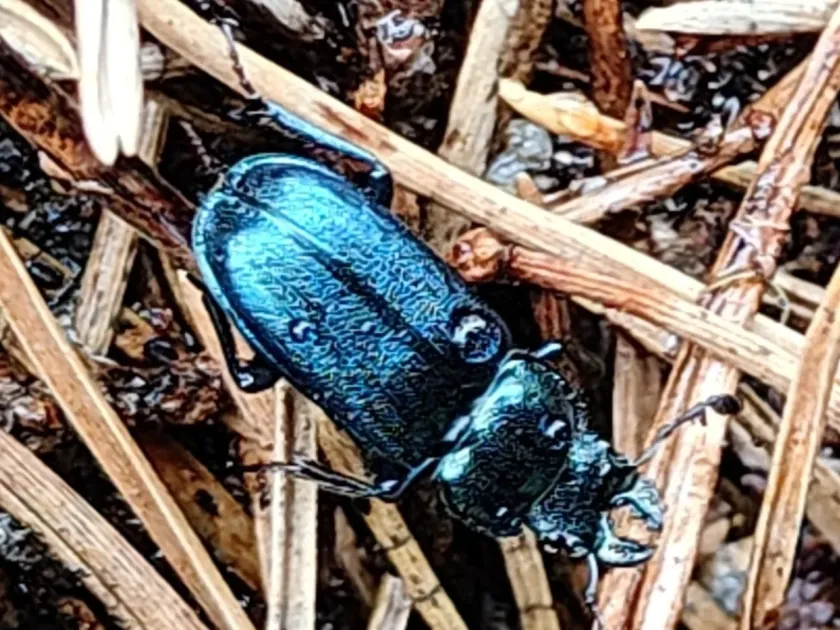
The blue stag beetle (Platycerus caprea) is a member of the Lucanidae family. Adult beetles have a distinct metallic sheen, typically ranging from dark blue to greenish-black.
Adults measure approximately 10 to 15 millimeters in length. Males possess small but distinct mandibles, which are much smaller than those of the well-known European stag beetle.
The larvae are typical of the scarab family: white, C-shaped, with a hard brown head and three pairs of thoracic legs. They are exclusively wood-dwellers, feeding on decaying or weakened trees.
While often found in forests, they can occasionally become a nuisance in old, poorly maintained orchards where decaying wood is available.
Their life cycle is extensive, often taking several years to complete, making them a long-term inhabitant of their host tree.
What it damages
The primary damage is caused by the larvae, which bore galleries through the heartwood and sapwood of deciduous trees. This internal feeding weakens the structural integrity of the tree.
Targeted hosts include apple, pear, cherry, and plum trees, particularly those suffering from rot, fungal infections, or previous mechanical damage to the bark.
Infested trees experience reduced nutrient transport, leading to stunted growth, wilting of branches, and in extreme cases, the death of the tree.
The galleries created by the larvae also serve as entry points for rot-inducing fungi and other secondary pests, accelerating the decay process.
Healthy, vigorous trees with intact bark are rarely attractive to these beetles, as they require wood that is already in the early stages of decomposition.
When it appears
The flight period of adult blue stag beetles occurs during late spring and early summer, typically between May and July, when they emerge to mate and find suitable sites for egg-laying.
Beetles are primarily nocturnal and crepuscular, often remaining hidden in bark crevices or under forest litter during the daylight hours.
Larvae remain active throughout the warmer months, slowly consuming the internal wood of the host tree. Their growth rate is highly dependent on ambient humidity.
Pupation occurs within specially prepared chambers deep inside the wood. After metamorphosis, the young adult may stay inside the tree for a period to harden its cuticle.
Because the life cycle spans several years, the presence of these insects is often not noticed until damage becomes significant.
Signs of infestation
Small, circular exit holes on the trunks and major limbs are the most visible sign that adult beetles have successfully completed their development.
Accumulations of wood frass (a mixture of fine sawdust and larval excrement) at the base of the tree are clear indicators of larval activity inside the wood.
Foliage thinning, premature leaf drop, or localized dieback of branches often point to internal structural damage caused by boring larvae.
The presence of adult beetles crawling on tree trunks in the evening is a direct indicator of a potential infestation in the vicinity.
Dark, oozing patches on the bark or sunken areas may suggest deeper internal decay caused by larval tunneling and secondary infections.
Control measures
The most effective management strategy is strictly sanitary: remove deadwood, dying branches, and stumps to eliminate breeding habitats.
Carefully clean and seal any tree hollows or mechanical wounds with appropriate pruning sealers to prevent the beetles from finding entry points for egg-laying.
Maintaining high horticultural standards, including proper fertilization and irrigation, ensures that trees remain healthy and less prone to wood-boring attacks.
- White-washing trunks to deter beetles from landing and depositing eggs.
- Manual removal of adults during the flight period if numbers are high.
- Destroying heavily infested timber through burning to prevent further spread.
Monitoring the orchard for early signs of decay is crucial, as chemical control of larvae deep within the wood is rarely practical or effective.
Taxonomy
- Latin name
- Platycerus caprea
- Order
- Coleoptera (beetles)
- Family
- Lucanidae
- EPPO code
- PLTECP
Discussion
No discussions yet — be the first.