
Lesser stag beetle
Dorcus
Description
How to identify
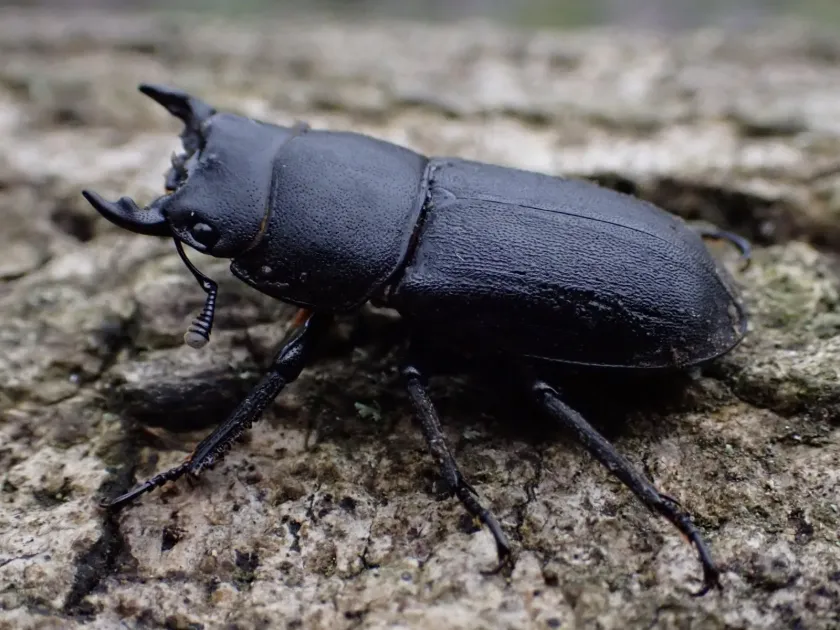
The Lesser stag beetle (Dorcus parallelepipedus) belongs to the order Coleoptera and the Lucanidae family. The adult has an elongated, flattened body of black color with a matte finish, ranging from 20 to 32 millimeters in length.
The larvae are large, C-shaped, typical of scarab-related beetles, creamy-white in color with a distinctive brown head. They possess powerful chewing mouthparts adapted for breaking down tough wood fibers.
These beetles are primarily nocturnal, hiding during the day in bark crevices, leaf litter, or tree hollows. Males can be distinguished from females by their larger, although relatively modest, mandible development compared to other stag beetle species.
The biology of this species is closely linked to decaying deciduous wood. Unlike some relatives, the Lesser stag beetle prefers weakened or rot-affected tree trunks, posing a specific risk to older orchards and declining stands.
The pest's life cycle spans several years. The entire development from egg to adult occurs within the wood, where the larvae spend most of their life tunneling through the internal structure.
What it damages
The primary food source for the Lesser stag beetle is deciduous wood. It is most commonly found on apple, pear, beech, oak, and other fruit or forest tree species.
The pest primarily targets weakened, over-mature, or disease-stricken trees. In cases of high population density, beetles may colonize relatively healthy specimens, effectively accelerating their decline.
Larvae actively feed on decaying wood, excavating deep, winding tunnels. This feeding behavior progressively destroys the structural integrity of the trunk and primary skeletal branches.
The larval activity disrupts the transport of nutrients and water within the tree. As a result, infested trees lose productivity, begin to wither, and become increasingly susceptible to secondary fungal pathogens.
In commercial orchards, the presence of this pest can lead to significant economic losses due to the necessity of premature tree removal and site management.
When it appears
Adult activity is observed during the summer months, typically from June through August. During this period, beetles mate and lay eggs in bark cracks or wood debris.
The larval stage is the most prolonged phase, lasting between two to four years depending on temperature conditions and the quality of the nutrient substrate.
Pupation usually occurs in spring or early summer inside the wood, within specialized chambers. Young beetles emerge after the metamorphosis is complete.
The period of highest risk for the orchard coincides with active growth phases, when weakened trees offer the most attractive conditions for egg-laying.
Temperature significantly impacts the rate of generation development. In warmer seasons, the life cycle may shorten, leading to an accelerated accumulation of the pest population in infested areas.
Signs of infestation
The presence of the Lesser stag beetle can be identified by the characteristic round or oval exit holes found on trunks and thick tree branches.
- Presence of fine frass or sawdust at the base of the tree.
- Reduction in crown turgor and premature yellowing of leaves.
- Visible hollows and areas of rotten wood on the tree surface.
- Audible chewing sounds (in complete garden silence, one may detect a soft rustling from within the bark).
During visual inspections, adult beetles can occasionally be spotted on tree trunks during evening hours, especially after warm rain.
Control measures
The primary method of control is the maintenance of high-quality orchard management. Timely sanitary pruning and removal of affected or dying tree sections eliminate the pest's food supply.
It is essential to avoid mechanical damage to the bark during soil cultivation, as wounds act as entry points for egg-laying females.
In cases where active tunnels are detected, systemic injection methods applying insecticides directly into the larval holes can be utilized.
To prevent colonization, whitening the trunks with a lime wash mixed with fungicides is recommended, as it discourages adults from depositing eggs.
In cases of severe infestation, culling and removing heavily infested trees with mandatory destruction of debris via burning is the most effective eradication measure.
Taxonomy
- Latin name
- Dorcus
- Order
- Coleoptera (beetles)
- Family
- Lucanidae
- EPPO code
- DORUSP
Discussion
No discussions yet — be the first.