
Red-humped caterpillar
Schizura concinna
Description
How to identify
The red-humped caterpillar (Schizura concinna) is a moth species belonging to the Notodontidae family. The adult moth is relatively inconspicuous, with a wingspan of approximately 30–40 mm, featuring mottled gray and brown coloration that provides excellent camouflage against tree bark.
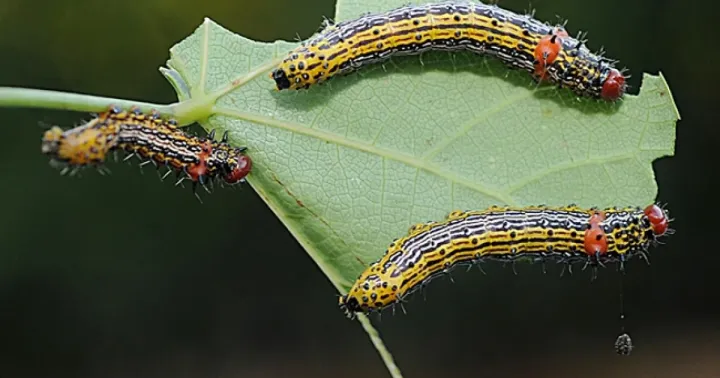
The larvae are highly distinctive, characterized by their brightly colored bodies with longitudinal yellow, white, and black stripes. They feature a prominent red "hump" on the fourth segment and long, black, spine-like structures along their backs.
This pest overwinter as pupae in cocoons located in the soil or under surface debris. This biological trait makes soil management and orchard floor maintenance essential components for disrupting their life cycle.
Development typically includes one or more generations per year depending on the climate. The life cycle involves egg-laying on the undersides of leaves, followed by larval development that peaks during the summer months.
Young larvae exhibit strong gregarious behavior, feeding in groups on the same foliage. As they grow and reach their final instars, they disperse throughout the tree canopy, often feeding individually or in smaller groups.
What it damages
The red-humped caterpillar is a generalist feeder that attacks a wide variety of fruit trees, including apple, pear, cherry, plum, and walnut. It also feeds on various forest and ornamental trees like willow and birch.
Larvae consume leaf tissue starting from the leaf edges, often leaving only the main veins behind. In cases of high infestation, they can quickly defoliate entire branches, leading to severe skeletal damage to the canopy.
The loss of foliage reduces the tree's photosynthetic capacity, which weakens the plant and limits its ability to store nutrients for the following season. This is particularly harmful to younger, developing trees.
Defoliated trees may suffer from reduced fruit quality and yield. Furthermore, weakened trees are more susceptible to secondary stressors, such as diseases, drought, and winter cold injury.
Severe infestations on young nursery stock or newly planted trees can result in stunted growth, dieback, or even tree death if the defoliation occurs early and repeatedly during the growing season.
Signs of infestation
The most visible sign of an infestation is the presence of skeletonized leaves on the periphery of the canopy. Since the larvae are often initially concentrated, the damage may appear in localized patches.
Large quantities of larval frass (droppings) accumulate on the leaves below the feeding sites or on the ground beneath the tree canopy, serving as a clear indicator of active larval presence.
Direct observation of the foliage, particularly the undersides of leaves, reveals the caterpillars. Their vibrant red, yellow, and black colors make them relatively easy to identify once they are located.
Some larvae may use silken threads to tie leaves together or create protective shelters. Detecting these clustered, damaged leaves provides an early warning for orchardists to intervene before damage becomes widespread.
Sudden thinning of the tree foliage in mid-to-late summer is a typical sign of red-humped caterpillar activity, indicating that the larvae have reached a stage where they consume large amounts of leaf tissue.
Control measures
Mechanical control is highly effective for small-scale infestations. If only a few clusters are found, they can be pruned off and destroyed manually, which effectively stops the localized spread of the population.
Biological insecticides containing Bacillus thuringiensis (Bt) are very effective against young larvae while posing minimal risk to beneficial insects and the environment, making them a preferred choice for integrated management.
Chemical control using registered insecticides may be necessary during severe outbreaks. Treatments should be timed to target young larvae, which are significantly more susceptible to pesticides than mature caterpillars.
Cultural practices, such as cultivating the soil beneath the trees in late autumn or early spring, can help destroy the overwintering pupae, thereby reducing the number of adult moths that emerge the following year.
Maintaining a healthy orchard ecosystem by encouraging natural predators, including parasitic wasps and various insect-eating birds, helps provide long-term biological suppression of this caterpillar species.
Taxonomy
- Latin name
- Schizura concinna
- Order
- Lepidoptera (butterflies)
- Family
- Notodontidae
- EPPO code
- SCHUCO
Discussion
No discussions yet — be the first.