
Eastern mole
Scalopus aquaticus
Description
How to identify
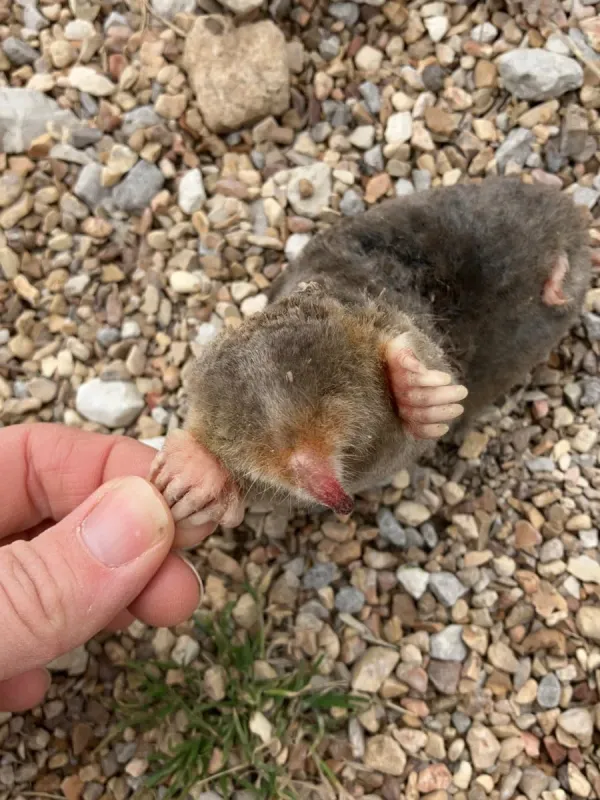
The Eastern mole (Scalopus aquaticus) is a subterranean mammal belonging to the family Talpidae. It is highly specialized for life underground, featuring powerful, spade-like forelimbs equipped with long, sturdy claws.
The body is cylindrical and covered in dense, velvety fur that can brush in any direction, allowing the mole to move forward or backward through narrow tunnels with minimal resistance.
These animals possess virtually no external ears and their eyes are vestigial, often covered by skin. Their primary sensory organ is their highly sensitive, hairless snout, which helps them navigate the dark environment.
An adult Eastern mole typically measures between 15 and 20 centimeters in length. They are strictly territorial and maintain extensive tunnel systems that they constantly patrol for food.
Unlike other small mammals, they are rarely seen on the surface. Their entire physiological structure is an evolutionary marvel designed specifically for energy-efficient excavation in various soil types.
What it damages
Although the Eastern mole is primarily insectivorous, feeding on earthworms, grubs, and insects, its digging activities cause significant damage to agricultural lands and residential gardens.
The primary damage occurs when moles tunnel through root zones of plants. This causes the soil to heave and air pockets to form, which leads to the roots drying out and the plants dying.
On manicured lawns and golf courses, mole activity creates unsightly mounds and raised ridges, which disrupt the surface quality and hinder the operation of mowing equipment.
In vegetable gardens and flower beds, the disturbance of the soil and root systems can severely stress young seedlings and transplant crops, frequently resulting in crop loss.
Mole tunnels also provide pathways for rodents, such as voles and mice, which use the existing passages to reach and consume plant roots, thereby compounding the original damage.
When it appears
The Eastern mole is active throughout the entire year and does not hibernate. They maintain their tunnel networks regardless of the season, although their activity levels fluctuate.
Peak activity is usually observed during spring and autumn when the soil is moist and friable, making digging easier and the concentration of earthworms near the surface at its highest.
During the heat of the summer, when the topsoil becomes dry and hard, moles retreat to deeper, cooler strata where moisture levels are maintained, making them less visible on the surface.
In winter, provided the ground does not freeze to extreme depths, the moles remain active, though their surface-level digging is reduced compared to the more favorable shoulder seasons.
The breeding season takes place in early spring, which can lead to localized increases in tunnel activity as juvenile moles establish their own territories.
Signs of infestation
The most distinctive signs of mole presence are the volcano-shaped dirt mounds, known as molehills, which are pushed to the surface during the excavation of deep tunnels.
Raised ridges or "tunnels" visible on the surface of the lawn are classic signs of foraging activity, where the mole has pushed up the soil just below the grass roots.
Plants that suddenly begin to wilt or lean in established rows may indicate that a tunnel has compromised their contact with the underlying soil moisture.
The sudden appearance of small, round holes leading into the ground, often paired with spongy or collapsing soil areas, signals a high level of subterranean activity.
A noticeable decrease in the population of beneficial earthworms or a sudden increase in soil disturbance are strong indicators that a mole has colonized the area.
Control measures
Controlling the Eastern mole requires a persistent and multi-faceted approach, as they are notoriously difficult to eliminate once they have established a stable habitat.
- Utilizing specialized harpoon or scissor-type traps placed correctly in active runways.
- Applying castor oil-based repellents to the soil, which create an unpleasant environment for the mole to inhabit.
- Installing sonic or vibration-based devices that discourage moles by emitting sounds they find irritating.
- Reducing the availability of food sources by managing lawn pests like grubs and other soil-dwelling insects.
- Installing underground wire mesh barriers around gardens and flower beds to physically block their movement.
Taxonomy
- Latin name
- Scalopus aquaticus
- Family
- Talpidae
- EPPO code
- SKALAQ
Discussion
No discussions yet — be the first.