
Emperor moth
Saturnia spini
Description
How to identify
Saturnia spini, commonly known as the southern emperor moth, is a large moth species belonging to the family Saturniidae (giant silk moths).
Adult moths are characterized by a large wingspan, typically reaching 80–90 mm, with prominent eye-spots on all four wings surrounded by dark and light rings.
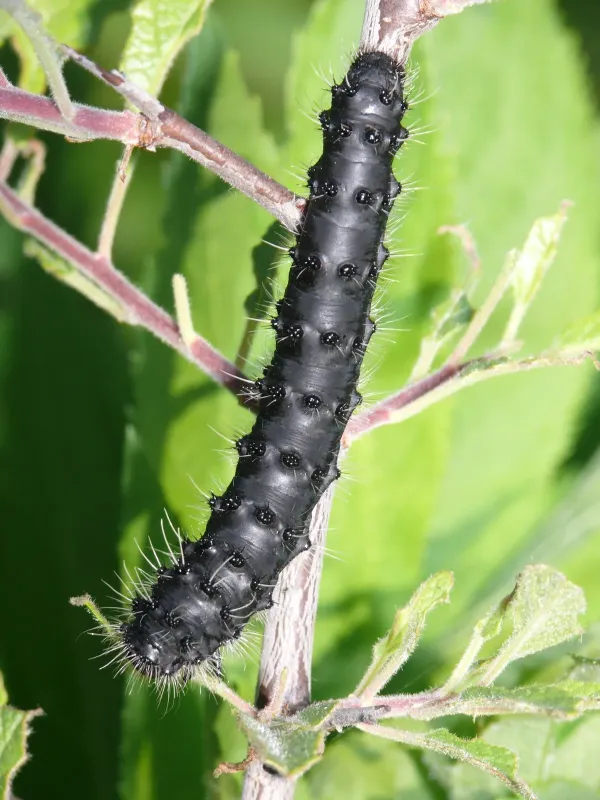
The larvae are striking in appearance, growing up to 80 mm in length, and are usually bright green with orange or yellow wart-like projections.
Pupation occurs within a tough, pear-shaped, brownish cocoon, which is firmly attached to the twigs or branches of the host plant throughout the winter.
This species is primarily found in warmer regions and deciduous forests, where it utilizes various woody plants for its development and life cycle.
What it damages
This moth is a polyphagous pest, meaning the larvae feed on the foliage of a wide range of different tree and shrub species across multiple families.
It shows a strong preference for fruit-bearing trees belonging to the Rosaceae family, specifically plum, sloe, cherry, apricot, and apple trees.
The larvae feed voraciously on leaves, beginning with the edges and eventually consuming the entire leaf blade, leaving only the primary veins behind.
Defoliation caused by a high density of larvae can significantly reduce the vitality of trees, impacting their ability to store energy for the next growing season.
While an isolated occurrence may not kill a tree, repeated infestations can lead to stunted growth, reduced fruit production, and overall tree weakening.
When it appears
Adult moths typically emerge in the spring, generally between April and May, when temperatures become favorable for mating and egg deposition.
Adults do not feed as they lack functional mouthparts, focusing entirely on reproduction before completing their short life cycle within a few weeks.
Eggs are laid in clusters on the stems and branches of host plants, hatching about two weeks later into small, hungry larvae ready to consume foliage.
The larvae progress through several developmental stages (instars) throughout the summer months, reaching their maximum size by mid-summer.
By late summer, the fully grown larvae construct their characteristic cocoons, where they remain in the pupal stage until the following spring season.
Signs of infestation
The most obvious sign of infestation is the visual presence of large, colorful, and conspicuous caterpillars feeding on the canopy of fruit trees.
Evidence of foliage loss is clear, with leaves showing ragged edges or complete stripping of the leaf blade, resulting in visible gaps in the foliage.
During the dormant season, the durable cocoons can be easily identified as hard, oval-shaped brown objects attached securely to the woody branches.
Droppings (frass) from the larvae are often found on lower leaves or on the ground beneath the tree canopy during the active feeding months.
A general decline in the tree's vigor, coupled with thinning foliage during the peak of summer, often indicates an active and significant larval population.
Control measures
Manual removal of cocoons during winter pruning is the most effective and eco-friendly method for managing this pest in home orchards.
If larvae are observed during the summer, targetted application of biological insecticides, such as Bacillus thuringiensis, can minimize damage.
Encouraging natural predators, including insectivorous birds and parasitic wasps, helps keep the population levels of this moth under natural control.
Maintaining healthy orchard conditions through proper fertilization and irrigation helps trees recover from minor defoliation events quickly.
Regular scouting of branches for eggs or early-stage larvae allows for prompt interventions before the infestation reaches a level that causes economic loss.
Taxonomy
- Latin name
- Saturnia spini
- Order
- Lepidoptera (butterflies)
- Family
- Saturniidae
- EPPO code
- EUDISI
Discussion
No discussions yet — be the first.