
Moon moth
Actias
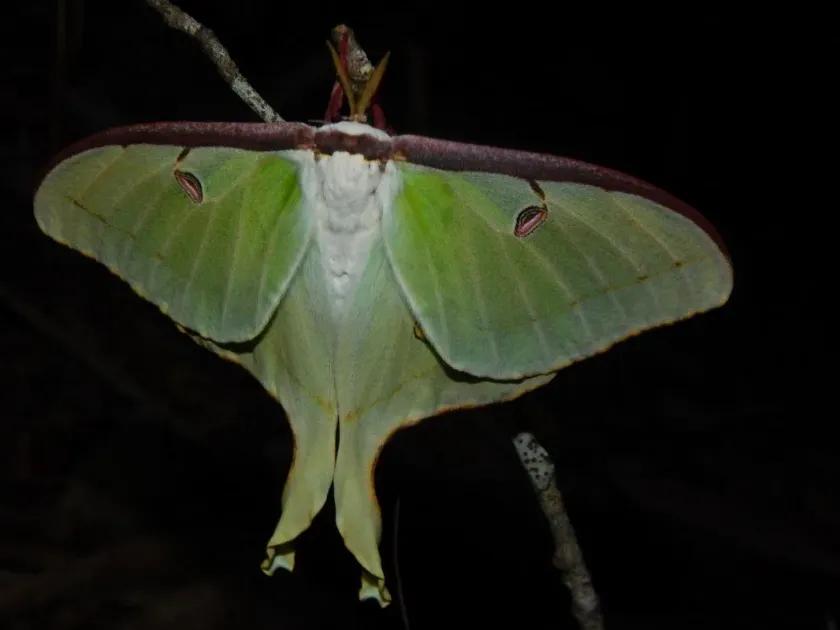
Description
How to identify
The genus Actias belongs to the Saturniidae family, order Lepidoptera. These are large nocturnal moths characterized by long, elegant tails on their hindwings and a wingspan reaching 10–12 cm.
Adult moths do not feed, as their mouthparts are vestigial. Their primary objective is reproduction, resulting in a very short lifespan, usually lasting only a few days.
The caterpillars undergo several instars, changing color and size as they grow. They possess powerful mandibles and consume foliage at a rapid rate during their development.
Eggs are deposited by females on the surface of host plant leaves. The clusters are typically small, tightly secured to the leaf surface with a specialized secretion.
For accurate identification, experts examine specific tubercles or setae on the caterpillar, which vary depending on the specific Actias species present in the orchard.
What it damages
Caterpillars of this genus are polyphagous, although they exhibit specific preferences for certain host plants. They primarily damage deciduous trees and shrub species.
Commonly affected crops include nut-bearing trees like walnuts, as well as fruit trees such as apples, pears, cherries, and plums. They are also frequently observed on birch and willow.
Damage is caused exclusively by the larval stage. Caterpillars consume leaf blades starting from the edges, eventually leading to full defoliation, leaving only the primary veins.
In cases of high infestation, the pest can cause significant defoliation of branches or young trees, which severely weakens the plant's immune system and reduces fruit production.
Stressed trees become more susceptible to secondary infections and opportunistic pests, which collectively impede annual shoot growth and overall tree health.
When it appears
The life cycle of Actias is closely linked to regional climate conditions. In temperate climates, there is usually one, rarely two, generations per year.
Moth activity begins in late spring or early summer once nighttime temperatures stabilize. This is the optimal window for mating and oviposition.
The active feeding stage of the caterpillars occurs during the summer months. Depending on the ambient temperature, larval development takes between 4 and 8 weeks before pupation.
Pupation takes place within a dense, silken cocoon, which the caterpillar secures in protected locations such as foliage or bark crevices, where the insect hibernates.
The emergence of adults in spring is synchronized with bud break and early leaf growth, ensuring that young caterpillars have access to abundant food resources.
Signs of infestation
The most prominent sign of infestation is significant loss of leaf area. Leaves often appear bitten at the edges or skeletonized, leaving only hard veins behind.
The presence of frass (caterpillar excrement) on lower foliage or on the ground beneath the canopy indicates active feeding by larvae in the higher branches.
Discovering dense, brown cocoons attached to branches is a clear indicator that the larvae have completed their feeding cycle and are transitioning to the pupal stage.
Slow growth of shoots and premature yellowing of foliage combined with irregular leaf margins are indirect markers of high population density.
Field scouting for egg clusters on the underside of leaves at the beginning of the season is highly recommended to detect early signs of infestation.
Control measures
Manual removal of caterpillars and cocoons is effective in small gardens or orchards where the population density remains relatively low.
Biological control using bacteria-based products (e.g., Bacillus thuringiensis) is highly effective, as it targets the larvae specifically without harming beneficial pollinators or predatory insects.
Chemical insecticides should be used only as a last resort during mass outbreaks, following strict regional safety protocols and application guidelines.
Agronomic management practices focus on maintaining tree vigor through proper pruning, cleaning trunks, and monitoring health, which minimizes the attractiveness of the site to ovipositing moths.
- Monitor moth presence using light traps at night.
- Remove fallen leaf debris, as cocoons may overwinter in the litter.
- Enhance biodiversity to attract birds and parasitic wasps that predate on larvae.
Taxonomy
- Latin name
- Actias
- Order
- Lepidoptera (butterflies)
- Family
- Saturniidae
- EPPO code
- ACTISP
Discussion
No discussions yet — be the first.