
Isabella Moth
Actias isabellae
Description
How to identify
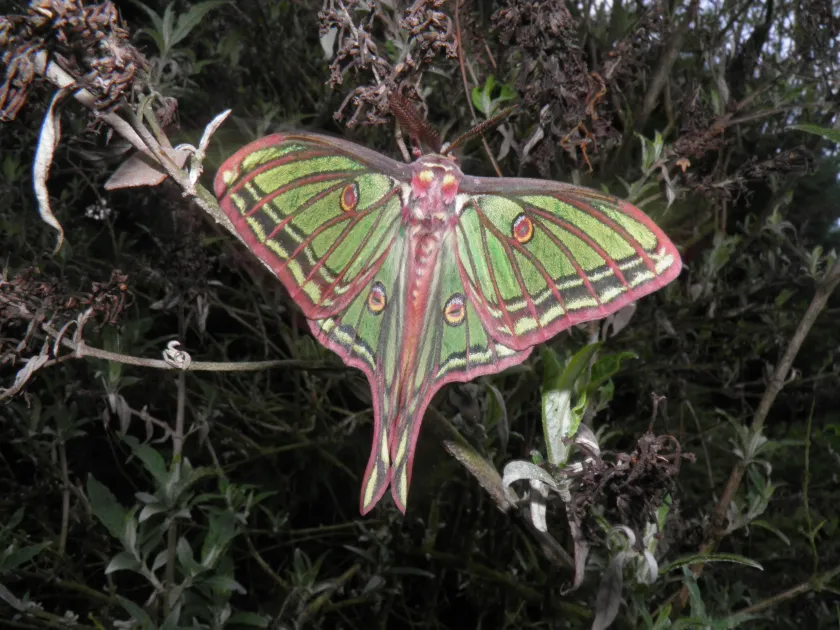
The Isabella moth (Actias isabellae), also known as the Spanish moon moth, belongs to the Saturniidae family, which is famous for its large and visually striking members.
Adult moths are characterized by their greenish, vein-patterned wings and distinctive long "tails" on the hindwings, reaching a wingspan of 70 to 90 mm.
The larvae progress through five stages, transforming from small, dark-haired caterpillars into large, vibrant green individuals that can grow up to 80 mm in length.
Eggs are typically laid on pine needles, appearing as small, oval-shaped structures that blend in well with the texture of the host plant.
The pupa is safely enclosed within a tough, brownish silk cocoon, often camouflaged with pine needles to avoid detection by predators in the forest floor litter.
What it damages
The primary food source for this species is limited to the genus Pinus, specifically favoring Scots pine, mountain pine, and black pine trees.
The Isabella moth is not classified as a destructive agricultural pest because its natural population density is consistently low throughout its limited European range.
Caterpillars consume young pine needles, yet the impact on tree health is negligible and does not cause significant defoliation or economic loss to timber production.
Given its status as a protected species in many regions, any feeding activity is considered a minor ecological factor rather than a cause for concern for foresters.
Natural biological controls, including parasitoid wasps and various pathogens, keep the moth population within sustainable limits naturally.
When it appears
This species typically undergoes one generation per year, with the adult flight period occurring in the spring, generally between April and June.
Adult moths are short-lived, surviving only for a few days to a week, as they lack functional mouthparts and do not feed, relying entirely on stored energy.
Following mating and egg-laying, larvae hatch and spend the summer months feeding on pine needles to accumulate the necessary resources for pupation.
Pupation occurs in late summer, where the insect enters a diapause state to withstand cold winter temperatures, eventually emerging as an adult the following spring.
This synchronized life cycle is perfectly adapted to the seasonal growth patterns of its host pine trees, ensuring optimal survival for the offspring.
Signs of infestation
Evidence of larval activity includes small, irregular edges on pine needles, which are often extremely difficult to detect without careful inspection.
Finding cocoons is equally challenging due to their protective coloration and the habit of incorporating forest debris into their outer layers.
Small, pellet-like frass on the forest floor beneath a canopy may indicate the presence of caterpillars, though this is rarely noticeable in forest environments.
Adults are rarely seen due to their nocturnal habits and camouflage, though researchers may use pheromone or light traps to monitor local populations.
Since the species is not a major pest, the absence of widespread damage to needles is the most common observation in its natural habitats.
Control measures
Because Actias isabellae is protected by law in many countries, no control measures are permitted, and they would be ecologically counterproductive.
Forest management strategies should focus on maintaining natural biodiversity to ensure that the moth's natural predators can keep its population balanced.
Research and observation remain the primary methods for interacting with this species, aimed at habitat preservation rather than eradication or suppression.
There is no necessity for chemical intervention, as the Isabella moth does not pose any risk to the productivity or survival of pine forest plantations.
Practicing sustainable forestry and protecting native pine ecosystems are the best ways to ensure the continued survival of this unique and beautiful moth.
Taxonomy
- Latin name
- Actias isabellae
- Order
- Lepidoptera (butterflies)
- Family
- Saturniidae
- EPPO code
- ACTIIS
Discussion
No discussions yet — be the first.