
Green-striped mapleworm
Anisota rubicunda
Description
How to identify
The green-striped mapleworm, Anisota rubicunda, is a moth species belonging to the family Saturniidae. It is well-known for its role as a significant defoliator of various maple species.
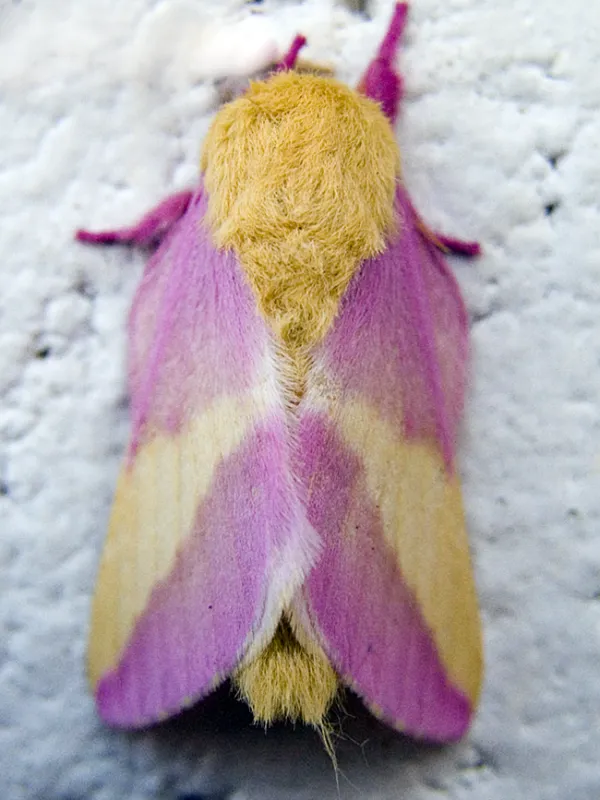
Adult moths are relatively small with wings that display distinctive rose and yellow coloration. They are primarily nocturnal and attracted to artificial light sources.
The larvae, or caterpillars, are the stage that causes the most damage. They typically feature a pale green body with dark green stripes and two prominent horn-like structures near the head.
The life cycle involves a complete metamorphosis: egg, larva, pupa, and adult. Most populations produce one generation per year, though warmer climates may support two.
The eggs are laid in clusters on the underside of leaves, and the resulting larvae feed gregariously in their early stages before dispersing as they mature.
What it damages
This pest primarily targets maple trees, with red maples Acer rubrum and silver maples Acer saccharinum being the most preferred hosts for larval development.
While maples are the main food source, high-density infestations may occasionally cause larvae to feed on oak species, though this is not their primary behavioral pattern.
Young larvae feed by skeletonizing the leaf surface, while later stages consume the entire leaf blade, leaving only the tougher veins and the petiole attached to the twig.
Significant defoliation can stress the tree, forcing it to use stored energy reserves to produce new leaves, which in turn reduces its overall vigor and health.
Repeated annual defoliation by this pest can lead to branch dieback and leave the tree highly susceptible to other secondary pests, diseases, and environmental stressors.
When it appears
Adult moths typically emerge in late spring or early summer, coinciding with the period of peak foliage development in their host trees for optimal egg deposition.
Larval activity is most intense during mid-summer, specifically July and August, when the caterpillars are growing rapidly and consuming large amounts of leaf tissue.
By late summer or early autumn, the mature larvae crawl down to the soil to pupate. They remain in the soil through the winter months to survive cold temperatures.
Environmental factors like summer rainfall patterns and local temperatures can significantly dictate the success rate of larval development and adult emergence timing.
In regions where two generations occur, the second cycle of larvae appears later in the season, which can cause extended damage to maple foliage late in the summer.
Signs of infestation
The most visible sign of an infestation is the presence of large quantities of frass (caterpillar excrement) accumulating on the ground or on sidewalks beneath the tree.
Leaves often show irregular feeding patterns, progressing from partial skeletonization to complete stripping of the green tissue from the primary leaf veins.
Colonies of larvae can often be spotted by inspecting the underside of leaves, especially in the lower or middle sections of the tree canopy during the early larval stages.
A thinning crown or visible sparse patches of foliage are clear indications that a population of green-striped mapleworms is active and feeding on the tree.
- Clusters of caterpillars on the undersides of leaves.
- Severe skeletonization or total leaf defoliation.
- Abundant dark-colored droppings on the ground under the canopy.
Control measures
For smaller landscape trees, manual removal of the larval clusters is a highly effective and environmentally friendly method for controlling the local population.
Biological insecticides, specifically those containing Bacillus thuringiensis, are very effective against young larvae and have minimal impact on beneficial insects.
In cases of severe infestation in forests or large landscapes, contact insecticides may be applied, though this should be timed to hit the larvae during their feeding phase.
Soil cultivation in the autumn around the base of the tree can help disturb or destroy overwintering pupae, thereby reducing the number of adults in the next season.
Maintaining proper tree health through adequate irrigation and fertilization helps maples recover more effectively from defoliation events throughout the growing season.
Taxonomy
- Latin name
- Anisota rubicunda
- Order
- Lepidoptera (butterflies)
- Family
- Saturniidae
- EPPO code
- ANITRU
Discussion
No discussions yet — be the first.