
Tau Emperor
Aglia tau
Description
How to identify
The Tau Emperor (Aglia tau) is a moth belonging to the family Saturniidae. It is a robust species, widely distributed across the temperate forests of Europe and parts of Asia.
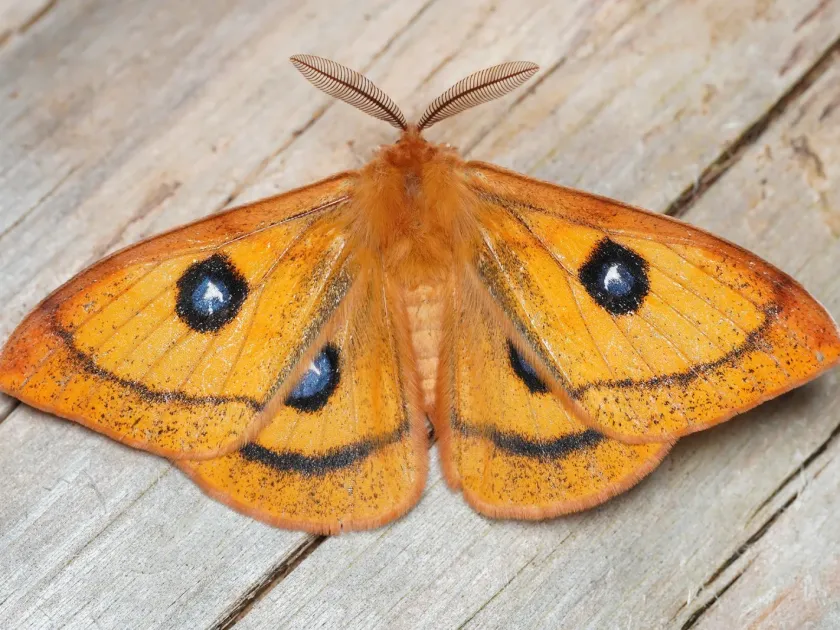
Adult moths are characterized by a yellowish-brown to dark brown wingspan of approximately 60–80 mm. Each wing features a distinct, prominent eye-spot resembling the Greek letter 'tau'.
The larvae are distinct in their developmental stages, transitioning from brown at birth to a vibrant green color as they mature, featuring spiky, branched protrusions along their bodies.
Males are easily identified by their large, feathery antennae used to detect female pheromones from significant distances within the dense forest canopy.
While not a major agricultural pest, it is a significant defoliator of various broad-leaved deciduous trees, often going unnoticed due to its cryptic behavior.
What it damages
The larvae of the Tau Emperor primarily feed on the foliage of Fagus sylvatica (European beech), which is their preferred host plant.
Secondary host plants include oak, birch, alder, lime, and willow trees, making the moth a versatile pest in diverse deciduous woodland ecosystems.
Severe infestations can lead to significant defoliation, where the larvae consume large portions of the leaf blades, often leaving only the tough midribs behind.
Repeated or intense feeding reduces the tree's photosynthetic capacity, resulting in weakened growth, reduced timber quality, and higher vulnerability to drought.
In ornamental and park settings, the aesthetic damage caused by leaf stripping can necessitate active control measures to preserve the health and appearance of the trees.
When it appears
The Tau Emperor moth has a univoltine lifecycle, meaning it completes only one generation per year, with adults emerging in the spring.
Emergence typically coincides with the bud break of host trees in April or early May, ensuring that immediate food sources are available for the hatching larvae.
The egg stage lasts about two weeks, followed by a period of intensive larval feeding that spans from late spring through to the early summer months.
By mid-summer, fully grown caterpillars descend from the canopy to the leaf litter to pupate, constructing a tough, papery cocoon in which they hibernate.
The pupal stage is the longest part of the lifecycle, remaining dormant throughout the autumn and winter until the following spring arrival.
Signs of infestation
Evidence of an infestation begins with the appearance of notched or completely consumed leaf margins, particularly in the outer crown of deciduous trees.
Accumulation of larval frass (droppings) on the forest floor or on the foliage below the feeding site is a reliable indicator of the moth's presence.
Searching the undersides of leaves during the peak feeding season can reveal egg clusters or young larvae clustered together before they disperse.
In areas of high density, the sound of rhythmic crunching from thousands of caterpillars eating can be heard, serving as a distinct auditory sign of a heavy infestation.
During winter, the detection of cocoons attached to leaves in the debris or buried in the soil can help foresters predict potential outbreaks for the coming year.
Control measures
Biological control is the preferred method for managing the Tau Emperor, specifically using sprays containing Bacillus thuringiensis to target the larval stage.
In smaller managed areas, manual removal of larvae from young trees or saplings can be an effective and environmentally friendly intervention.
Enhancing natural biodiversity, such as installing nesting boxes for insectivorous birds, provides a sustainable way to keep moth populations below economic thresholds.
Chemical intervention with synthetic insecticides should be reserved for severe outbreaks only, adhering strictly to environmental regulations to protect non-target species.
Long-term management focuses on maintaining a healthy forest stand, which increases the natural resilience of the trees against occasional defoliation events.
Taxonomy
- Latin name
- Aglia tau
- Order
- Lepidoptera (butterflies)
- Family
- Saturniidae
- EPPO code
- AGLITA
Discussion
No discussions yet — be the first.