
Giant Peacock Moth
Saturnia pyri
Description
How to identify
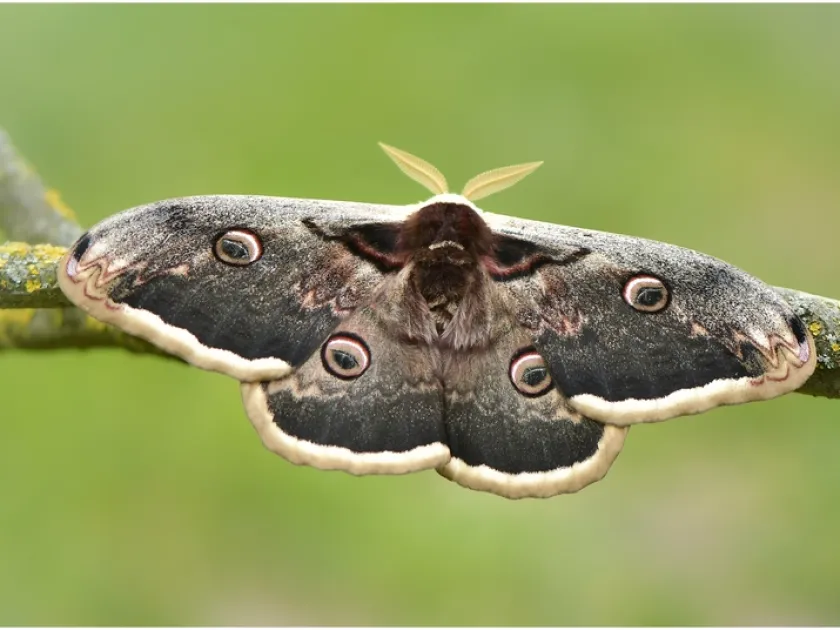
The Giant Peacock Moth, scientifically known as Saturnia pyri, is the largest moth found in Europe. Adults are impressive insects with a wingspan that can reach up to 16 centimeters, featuring distinctive eyespots on each wing used for defense.
This species belongs to the order Lepidoptera and the family Saturniidae. It is well-known for its size and its status as one of the most recognizable insects in European deciduous forests and orchards.
The larvae, or caterpillars, are equally large, growing up to 10 centimeters in length. They progress through several instars, changing from dark brown to a vibrant green color, often decorated with prominent yellow tubercles.
The lifecycle is strictly univoltine, meaning there is only one generation per year. The insect overwinters as a pupa encased in a very tough, dark-brown cocoon attached firmly to tree branches.
Adult moths emerge in spring, typically in April or May. Since they possess non-functional mouthparts, they do not feed as adults and rely entirely on the energy reserves they stored during their larval stage.
What it damages
The Giant Peacock Moth is a polyphagous pest that targets a wide variety of fruit trees. Primary hosts include pear, apple, plum, cherry, and walnut trees, though it can also feed on various wild species.
The damage is caused exclusively by the caterpillars. Due to their large size and high metabolic rate, they are capable of consuming a significant amount of leaf tissue in a very short period.
Severe infestations can lead to the defoliation of entire tree limbs. This widespread loss of leaf surface area disrupts photosynthesis, which is essential for the tree's health and fruit development.
Trees that suffer from heavy defoliation often exhibit reduced vigor in subsequent years. This makes them more susceptible to environmental stressors, such as cold winters and secondary diseases.
While a single tree can usually survive a limited attack, nursery stock and young saplings are at high risk, as total defoliation at a young age can severely stunt their growth or kill them.
When it appears
The emergence of adult moths occurs in the late spring, coinciding with the warming temperatures of May. After mating, females lay eggs on the leaves or young stems of host plants.
Larval activity begins in early summer. From June through August, the caterpillars feed voraciously, rapidly increasing in size as they prepare to pupate.
By late summer, the caterpillars finalize their development and construct their overwintering cocoons. This stage is crucial, as the cocoon provides protection against both predators and climate elements.
The pupae remain in their cocoons on the host trees throughout the autumn and winter months, effectively surviving until the return of favorable spring conditions.
Thus, the main period to watch for this pest is during the summer months, when caterpillars are visible and actively feeding in the canopy of fruit trees.
Signs of infestation
The most obvious sign of an infestation is the rapid disappearance of foliage. Caterpillars often consume entire leaves, leaving only the main veins behind, resulting in sparse or bare branches.
In winter, when the trees are dormant, the large, firm cocoons attached to the branches are the primary sign that the pest is present in your orchard.
Large amounts of frass, or caterpillar droppings, on the ground beneath the canopy are another indicator of active feeding by large larvae in the upper branches.
Because the larvae are quite large and brightly colored during their later stages, they can often be spotted directly on the foliage during a simple walk through the orchard in mid-summer.
While they do not spin large communal silk webs like some other orchard pests, their size makes them relatively easy to identify for any observant gardener or professional agronomist.
Control measures
Manual removal of cocoons during the winter dormancy period is the most effective and eco-friendly control method for small-scale gardens. Check branches carefully and remove any detected cocoons.
During the summer, hand-picking the large caterpillars is practical if the infestation level is low. Because they are slow-moving and conspicuous, they are easily collected and destroyed.
Biological control using formulations of Bacillus thuringiensis is highly effective against young larvae, providing a targeted approach that protects beneficial insects in the orchard ecosystem.
In cases of massive infestations, registered insecticides for fruit trees can be used, provided that safety guidelines and pre-harvest intervals are strictly followed to ensure food safety.
Maintaining orchard health through proper pruning and canopy management helps keep trees resilient, making them less attractive and better equipped to withstand minor pest pressures.
Taxonomy
- Latin name
- Saturnia pyri
- Order
- Lepidoptera (butterflies)
- Family
- Saturniidae
- EPPO code
- SATUPY
Discussion
No discussions yet — be the first.