
Saturnia
Saturnia
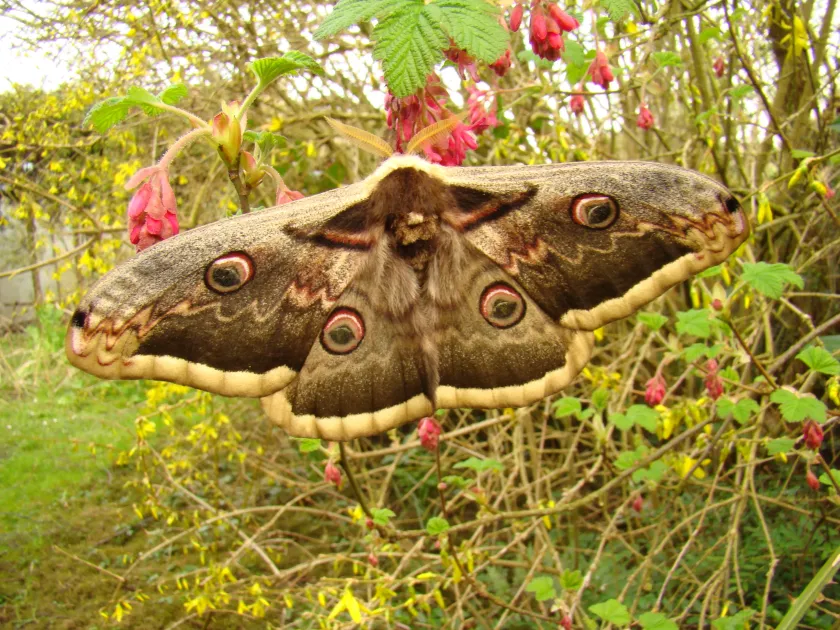
Description
How to identify
The genus Saturnia belongs to the family Saturniidae, also known as giant silkworm moths. These are large nocturnal moths characterized by their striking wing patterns, which often resemble eyes to deter predators.
Adult moths have a robust body covered with dense hair and feathery antennae. The wingspan of large species can reach up to 15 centimeters.
Saturnia caterpillars are distinct for their impressive size and the presence of colorful tubercles or spines on their bodies. During their development, they undergo several molts, shifting from darker shades to vibrant green.
Pupae develop inside tough, silken cocoons attached to the branches of host plants or hidden among fallen leaves.
The adult life cycle is very short; the moths do not feed and live solely on the energy reserves accumulated during their larval stage.
What it damages
The primary damage is caused by the caterpillars, which are highly voracious and capable of skeletonizing or completely stripping the foliage of a tree in a short period.
The host plant range is quite diverse, consisting mainly of woody trees and shrubs, including fruit-bearing species like apple, pear, plum, and walnut trees.
Under heavy infestation, the pest causes significant stress to the host, lowering its immune response and triggering premature leaf drop.
Damage to young shoots and buds during the active growing season negatively impacts fruit yields for both the current and following years.
In natural habitats, these insects also inhabit woodlands, feeding on the leaves of oak, alder, birch, and blackthorn.
When it appears
The flight period of adult moths usually occurs in spring and summer, depending on the climatic region, typically spanning from May to June.
After mating, females lay eggs in small clusters on the undersides of leaves or on the bark of thin twigs.
The period of active caterpillar feeding encompasses the summer months, when foliage is most succulent and nutrient-rich for larval development.
By late summer, the caterpillars pupate by forming cocoons, in which they overwinter until the next season, surviving harsh conditions.
Consequently, monitoring for this pest is most effective during the period from May to August.
Signs of infestation
The first sign of presence is the appearance of large eaten areas on leaf blades, often leaving only the coarse veins behind.
Spotting the caterpillars themselves, which are quite noticeable due to their large size and bright colors, is a clear signal to begin control measures.
Droppings on the ground or under the tree branches can indicate their location within the tree canopy.
Finding firm, brown or grey cocoons on tree branches during the winter allows for proactive removal before spring hatching.
In the evening, adult moths are often attracted to artificial light sources, which can serve as an indicator of the start of their flight season.
Control measures
Manual removal of caterpillars and destruction of nests or cocoons remains the most effective and eco-friendly method of management.
In cases of high infestation, biological insecticides based on bacteria are used, as they are safe for beneficial pollinators but highly effective against caterpillars.
Broad-spectrum insecticide use should be limited to extreme cases and requires strict adherence to safety protocols for non-target species.
Proper orchard management, including regular pruning and the removal of fallen leaves where cocoons may hibernate, plays a vital role in prevention.
Encouraging natural predators such as birds and beneficial insects helps maintain the Saturnia population at manageable levels.
Taxonomy
- Latin name
- Saturnia
- Order
- Lepidoptera (butterflies)
- Family
- Saturniidae
- EPPO code
- SATUSP
Discussion
No discussions yet — be the first.