
Eri silkmoth
Samia ricini
Description
How to identify
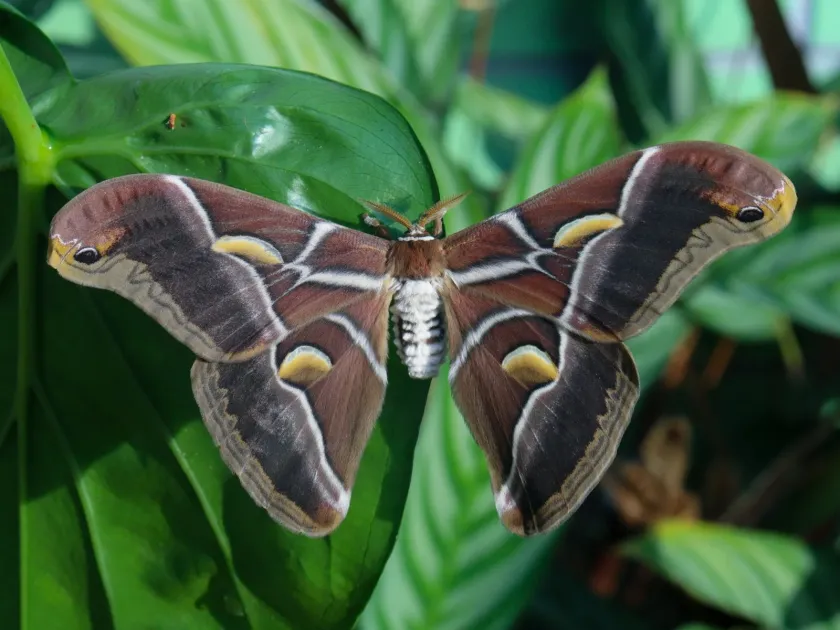
The Eri silkmoth (Latin Samia ricini) belongs to the order Lepidoptera and the family Saturniidae. It is a large nocturnal moth with a wingspan that can reach 12 to 15 centimeters.
The coloration of the adult moth ranges from reddish-brown to ochre, featuring distinct transparent "eyespots" on the wings, bordered by white and black rings. Adults do not feed, as they survive on energy reserves accumulated during the larval stage.
The larvae (caterpillars) go through five instars, growing significantly in size. In the final stage, they reach 7–9 centimeters in length and are covered with a whitish, waxy bloom, which gives them a unique appearance compared to other silkworm species.
The life cycle consists of the egg, larva (caterpillar), pupa (inside a dense cocoon), and adult moth. Under favorable conditions, the development from egg to adult takes approximately 45–60 days.
In its native environment, the species can have multiple generations per year, and pupae within cocoons are capable of entering diapause to survive unfavorable environmental conditions.
What it damages
The primary host plant for the larvae is the castor bean plant (Ricinus communis), which is the source of the species' name. However, the larvae can also feed on the leaves of several other plants, including Ailanthus and Privet.
This pest is most significant in regions where castor beans are grown commercially, as the caterpillars have a voracious appetite and can rapidly defoliate large areas of vegetation.
Mass infestations of the Eri silkmoth lead to severe leaf loss, which drastically reduces the photosynthetic capacity of the plants and hinders their overall growth and productivity.
Feeding damage manifests as skeletonization or complete destruction of leaf blades, causing physiological stress to the crop and potentially leading to significant yield losses in seed production.
Although the species is cultivated for silk production, in uncontrolled environments, it is considered a potential agricultural pest capable of causing substantial damage to industrial crops.
Control measures
The primary method of pest control involves rigorous agricultural monitoring of plantations during the period of moth flight and oviposition on the undersides of leaves.
When infestation foci are detected at early stages, manual removal of caterpillars is highly effective and practical for small-scale or experimental cultivation areas.
The application of biological insecticides based on bacteria, specifically Bacillus thuringiensis, remains the most sustainable and efficient strategy for controlling young larval instars.
In cases of high pest density, contact-stomach chemical insecticides may be used, though their application must be strictly regulated according to pre-harvest intervals to ensure safety.
Preventive measures include the systematic removal of wild host plants from the Euphorbiaceae family, which can act as reservoirs for the pest near the main cultivated fields.
Taxonomy
- Latin name
- Samia ricini
- Order
- Lepidoptera (butterflies)
- Family
- Saturniidae
- EPPO code
- ATTCRI
Discussion
No discussions yet — be the first.