
Rice delphacid
Saccharosydne procerus
Description
How to identify
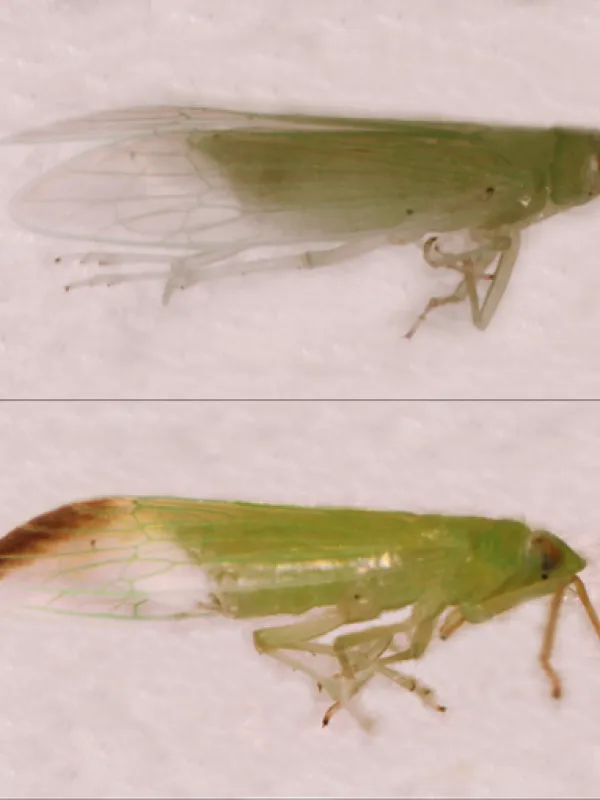
The rice delphacid (Saccharosydne procerus) belongs to the order Hemiptera and the family Delphacidae. It is a small insect commonly found in rice-growing agroecosystems.
Adults typically exhibit a yellowish-green coloration, providing effective camouflage among rice stems. They are small in size, usually measuring between 4 and 6 mm.
A distinctive feature of these insects is their well-developed hind legs, which enable them to jump rapidly when disturbed or threatened.
The life cycle involves egg, five nymphal instars, and the adult stage. The reproduction rate is highly sensitive to environmental factors like humidity and temperature.
Multiple generations can occur throughout the growing season, often leading to rapid population surges if environmental conditions are favorable.
What it damages
The primary host for this pest is cultivated rice (Oryza sativa). These insects feed by sucking sap from the plant's vegetative tissues, leading to nutrient loss.
Beyond direct feeding damage, these delphacids act as critical vectors for various rice viruses, which can cause severe and widespread damage across fields.
In regions with intensive rice cultivation, heavy infestations of Saccharosydne procerus result in widespread yellowing and wilting of the leaf canopy.
Stunted growth, poor tillering, and blank grains (empty panicles) are common manifestations of high pest density, severely impacting harvest yields.
Economic damage is most pronounced during periods of high humidity and heat, which facilitate optimal conditions for the pest's rapid reproduction.
Signs of infestation
One of the first signs is the congregation of insects on the underside of rice leaves and at the base of the plant stems.
Visual identification includes observing patches of scorched or yellowed leaves, which might sometimes be misidentified as nutrient deficiencies.
The presence of honeydew secretions on the leaves creates a substrate for sooty mold, leading to blackened and discolored foliage in the infested areas.
When walking through the field, a noticeable flight of insects occurs, which serves as a standard indicator for field scouting and monitoring.
Severe infestations during critical growth stages can lead to stem deformation and premature plant death in heavily populated spots.
Control measures
Agricultural practices, including crop rotation and strict weed control in surrounding irrigation canals, are essential for limiting the pest's spread.
Water management techniques, such as adjusting water levels within the rice paddies, can help disrupt the nymphal stages of the life cycle.
Chemical control should be implemented only after reaching the economic threshold to ensure that pest management remains cost-effective and sustainable.
Systemic insecticides are generally the most effective, as they are absorbed by the plant and provide residual protection against sap-sucking pests.
It is vital to rotate chemical classes used for treatment to manage and prevent the development of insecticide resistance within the local population.
Taxonomy
- Latin name
- Saccharosydne procerus
- Order
- Hemiptera (bugs, aphids, leafhoppers)
- Family
- Delphacidae
- EPPO code
- SACDPR
Discussion
No discussions yet — be the first.