
Rothschildia jorulla
Rothschildia jorulla
Description
How to identify
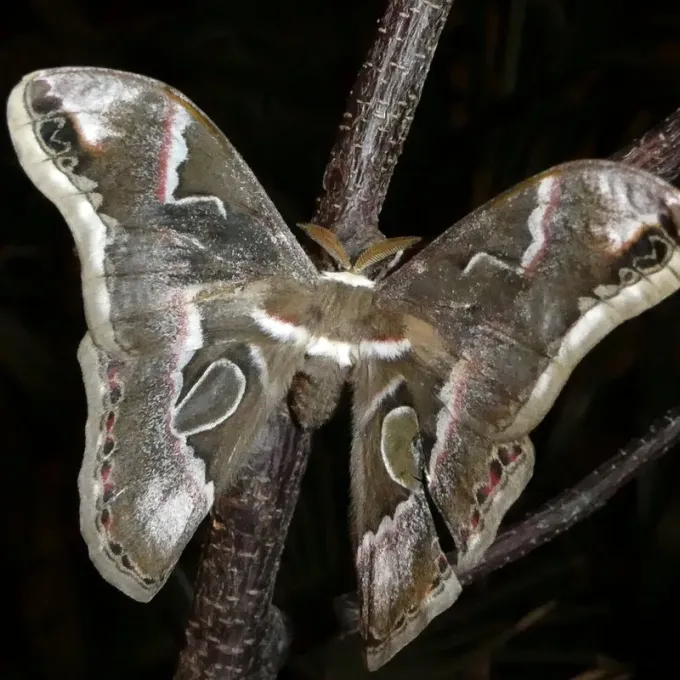
Rothschildia jorulla belongs to the Saturniidae family (giant silkworm moths) of the order Lepidoptera. This is a large moth that does not feed as an adult, but its larvae have a voracious appetite.
The adult moth has a wingspan of about 10–12 cm, with a distinctive pattern featuring translucent "windows" on the wings, surrounded by dark borders. The caterpillars undergo several developmental stages (instars), growing significantly in size.
The caterpillar's body is usually brightly colored, often covered with tubercles or spines, which serve as a defensive mechanism against predators. Pupation occurs within a dense cocoon attached to branches or tree trunks.
The life cycle includes complete metamorphosis: egg, larva, pupa, and adult. The duration of each stage strongly depends on local temperature and humidity levels.
Identification of the species at early stages is challenging because the larvae can camouflage themselves with the environment, which often leads to late detection of infestation centers.
What it damages
The primary food sources are members of the Rosaceae and Fabaceae families. The pest is frequently found on fruit crops, including apples, pears, and plums grown within its range.
The caterpillars are active during the warmer months, consuming the leaf blades of the plant. At high population densities, they can completely defoliate a tree in a short period.
Damage to the leaf apparatus leads to impaired photosynthesis, which weakens the plant's immune system and reduces yield in both the current and subsequent seasons.
In addition to fruit trees, the species can affect ornamental shrubs and trees used in landscaping, making it a threat not only to agriculture but also to urban parks.
Heavy defoliation during the active sap flow period leads to premature fruit drop, which is critical for commercial horticulture.
Signs of infestation
The first sign of infestation is the appearance of large holes in the leaf blades, which gradually evolve into full skeletonization of the leaves.
The presence of caterpillar frass (excrement) under the tree canopy is an indirect but reliable indicator of active pest feeding in the upper tiers of the plant.
Discovery of dense, oval-shaped cocoons fixed to leaf stems or branches indicates the completion of the larval development cycle and the need for sanitary measures.
Uneven canopy development is often observed, where damaged branches exhibit stunted growth compared to healthy parts of the plant.
When inspecting the underside of leaves, one can often find egg clutches that look like small pearly spheres grouped together.
Control measures
An effective control method is the manual collection of caterpillars and removal of cocoons during the winter-spring period, which significantly reduces the pest population.
The use of biological products based on Bacillus thuringiensis allows for the selective elimination of young instar larvae without harming beneficial entomophagous insects.
Chemical treatment with systemic insecticides is recommended during periods of mass hatching when the level of infestation exceeds the economic threshold of damage.
An important element of protection is encouraging natural enemies in the garden, such as birds and predatory insects, which effectively control Saturniid populations.
Following good agricultural practices, including proper pruning and timely fertilization, strengthens the plant's defense mechanisms, helping them recover from damage.
Taxonomy
- Latin name
- Rothschildia jorulla
- Order
- Lepidoptera (butterflies)
- Family
- Saturniidae
- EPPO code
- ROTHJO
Discussion
No discussions yet — be the first.