
Rothschildia
Rothschildia
Description
How to identify
The genus Rothschildia belongs to the Saturniidae family, commonly known as giant silkmoth or emperor moths. These are large nocturnal insects known for the characteristic transparent "windows" on their wings, which serve as a defensive mechanism against predators.
Adult moths have a wingspan ranging from 10 to 15 centimeters. Their coloration is predominantly earthy, featuring brown, orange, or reddish tones with distinctive white bands and wedge-shaped transparent spots.
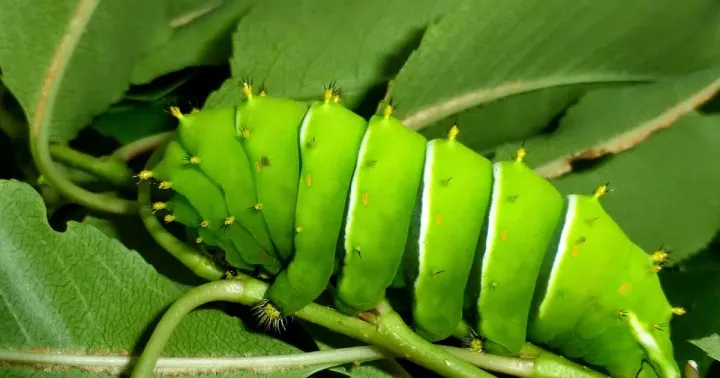
Rothschildia larvae undergo several developmental stages (instars). In their final stages, they grow quite large, displaying bright green colors often adorned with contrasting tubercles or spines, making them conspicuous on host plants.
The pupae develop inside dense cocoons attached to branches with a sturdy silken stem. This specialized attachment provides the pupa with necessary protection from environmental stress and natural enemies throughout its transition phase.
The primary range of these moths is concentrated in the tropical and subtropical regions of the Americas. While they are a natural part of these ecosystems, their high-density outbreaks can pose significant risks to agriculture.
What it damages
Rothschildia larvae are polyphagous, meaning they feed on the leaves of a wide range of woody plants and shrubs. Their host list includes both native wild species and valuable commercial crops.
Commonly targeted plants include members of the Rosaceae and Lauraceae families, among other tropical fruit-bearing trees. These plants are susceptible to heavy foliage loss during outbreaks.
Young plantations and tree nurseries are at the highest risk, where a dense infestation of caterpillars can lead to complete defoliation, severely stunting the development of young plants.
Continuous feeding by the larvae weakens the host plant, leaving it susceptible to secondary infestations of fungal or bacterial diseases that enter through damaged plant tissues.
In regions with intensive fruit production, Rothschildia can cause significant economic losses by reducing overall tree vigor, limiting fruit yield, and decreasing the photosynthetic capacity of the canopy.
Signs of infestation
The primary sign of infestation is skeletonized or entirely consumed foliage, where only the major leaf veins remain visible on the branches.
Frass (larval excrement) appearing as dark, granular droppings on the soil surface beneath the canopy is a clear indicator that caterpillars are actively feeding above.
Upon close inspection, large larvae can be found on stems and branches. Despite their camouflage, they are often visible due to their size and movement, especially when disturbed by vibrations.
The presence of abandoned, papery cocoons anchored to small twigs indicates that a population has previously completed its life cycle on the host plant, suggesting a high likelihood of recurrence.
Wilting of shoot tips or premature leaf drop across sections of the canopy often points to local clusters of caterpillars disrupting the plant's nutrient and water transport systems.
Control measures
Hand-picking larvae and physically removing cocoons from branches are the most effective control measures for smaller gardens, providing an immediate reduction in the pest population.
Biological control agents, particularly those containing Bacillus thuringiensis (Bt), are highly effective against lepidopteran larvae while remaining safe for non-target beneficial insects and pollinators.
Proper canopy management, including regular pruning and thinning, improves airflow and light penetration, which discourages female moths from laying eggs and makes the habitat less suitable for survival.
Implementing pheromone traps allows growers to monitor adult moth activity. This data helps predict the timing of egg-laying, enabling more precise timing for intervention strategies.
In cases where infestation levels exceed economic thresholds, targeted systemic insecticides may be used; however, their application must strictly adhere to environmental guidelines to minimize ecological impact.
Taxonomy
- Latin name
- Rothschildia
- Order
- Lepidoptera (butterflies)
- Family
- Saturniidae
- EPPO code
- ROTHSP
Discussion
No discussions yet — be the first.