
Red-legged assassin bug
Rhynocoris erythropus
Description
How to identify
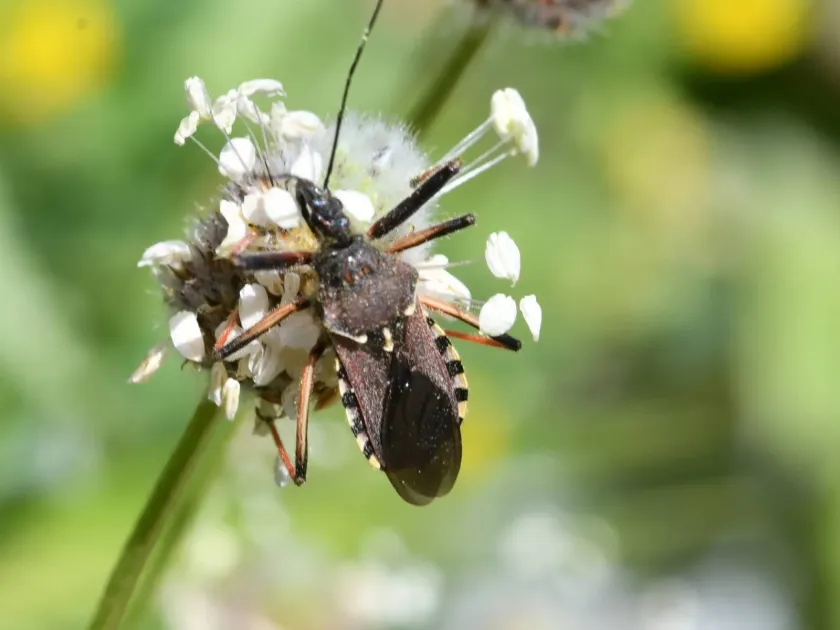
The red-legged assassin bug (Rhynocoris erythropus) is a member of the Reduviidae family, easily recognized by its distinctive dark body and contrasting reddish-orange legs.
Adult insects typically measure between 12 and 15 mm in length, characterized by a slender body shape covered with fine, short, and dense hairs that provide a unique texture.
Their head features a prominent, robust, and curved rostrum (beak), which is a characteristic feature of all assassin bugs, used for piercing and feeding.
Nymphs resemble smaller, wingless versions of the adults, developing through several molts before reaching maturity, with their color becoming more intense over time.
The antennae are long and thread-like, enabling these bugs to navigate efficiently through dense vegetation while hunting or searching for moisture.
What it damages
Although primarily predaceous, Rhynocoris erythropus can behave as a pest when prey availability is low, causing incidental damage to various cultivated plants.
By piercing delicate stems, leaves, and buds to extract plant sap, these bugs cause localized necrotic spots, tissue discoloration, and overall plant weakness.
When mass occurrences happen, their feeding activity can lead to the deformation of new growth and a significant reduction in the aesthetic or commercial value of produce.
Open wounds left by the bug's rostrum are susceptible to colonization by opportunistic fungi and bacteria, leading to secondary infections that may kill tender sprouts.
Damage is most prevalent on young, succulent plant parts, which are easier for the insects to penetrate during hot and dry periods when they seek extra hydration.
When it appears
These bugs overwinter as adults, finding refuge in crevices of bark, leaf litter, or dry plant stalks, where they remain in a state of diapause until spring.
Activity begins as temperatures rise in the spring, with adults emerging to find mates and establish breeding populations on newly emerged vegetation.
Summer is the peak period for their life cycle, involving mating, egg-laying, and the rapid development of nymphal stages supported by an abundance of prey.
Depending on the climatic zone, one or two generations per year are possible, driven by favorable weather conditions and the presence of suitable host plants.
As autumn approaches and day length shortens, the population density gradually declines as the insects move towards their chosen hibernation sites to survive winter.
Control measures
Sanitation is key to population management, which includes removing crop debris and overgrown weeds around the garden to eliminate potential overwintering sites.
Encouraging natural predators such as birds and larger predatory insects can assist in maintaining a natural balance, keeping the bug population at manageable levels.
Chemical intervention should be considered a last resort, applied only when monitoring indicates that the bug population has crossed the threshold for economic damage.
Using light traps or visual observation in the garden helps growers assess the current population density and prevent the spread of the insect to vulnerable crops.
Cultural practices, including proper crop spacing and irrigation management, can reduce the attractiveness of plants to these bugs, minimizing potential damage throughout the season.
Taxonomy
- Latin name
- Rhynocoris erythropus
- Order
- Hemiptera (bugs, aphids, leafhoppers)
- Family
- Reduviidae
- EPPO code
- RHNCER
Discussion
No discussions yet — be the first.