
Rhynocoris costai
Rhynocoris costai
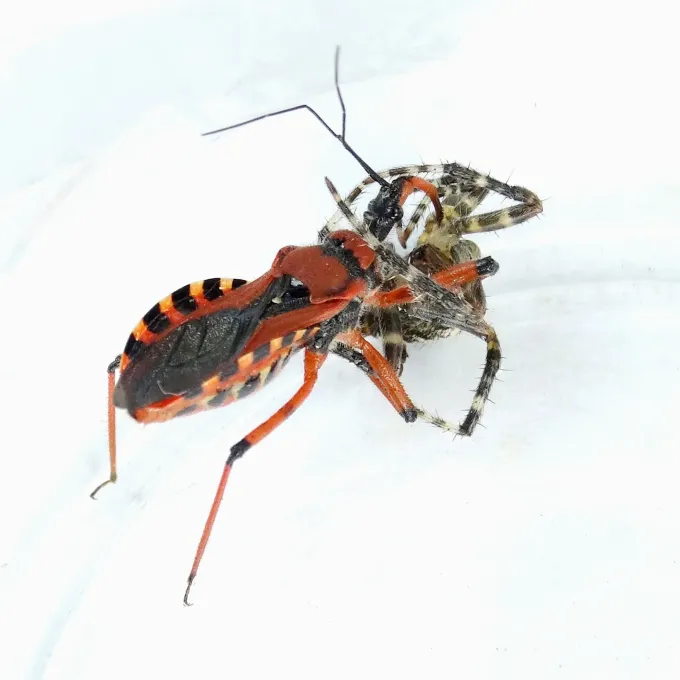
Description
How to identify
Rhynocoris costai belongs to the family Reduviidae (assassin bugs), order Hemiptera. These insects are easily identified by their elongated head and a strong, curved proboscis designed to pierce the cuticle of their prey.
Adult bugs are typically robust with bold, often contrasting colors that serve as warning coloration or camouflage. Their body length ranges generally between 10 to 15 millimeters.
The nymphs undergo several developmental stages, resembling miniature versions of the adults. They are highly mobile and demonstrate predatory behavior from an early developmental stage.
A key physical feature is their long, specialized legs that provide excellent grip and rapid movement across plant surfaces, allowing them to effectively pursue various insect prey.
While categorized primarily as a beneficial entomophage, this species may occasionally damage plant tissues when natural prey populations are low or under specific environmental stress.
What it damages
The primary diet of Rhynocoris costai consists of various insects, including caterpillars, beetle larvae, and smaller sucking pests. When prey is scarce, they may feed on plant sap by piercing stems.
Crops commonly affected include cereals, vegetable crops, and industrial crops. The damage is characterized by mechanical punctures and the injection of digestive enzymes into plant tissues.
The feeding process results in the degradation of plant cell walls, leading to localized necrosis, wilting, and reduced vigor of the affected plant parts.
Young seedlings and actively growing shoots are particularly vulnerable. These puncture sites can also serve as entry points for various fungal and bacterial pathogens, causing secondary infections.
Assessing the level of damage is crucial for agronomists, as the benefit of them preying on other pests often outweighs the minor damage they cause to the crops themselves.
When it appears
Activity of Rhynocoris costai begins in early spring as temperatures rise, signaling the end of their diapause. They emerge from overwintering sites to initiate mating and foraging.
The peak population density typically occurs in mid-summer, coinciding with the flowering and grain-filling stages of many field crops, where prey availability is highest.
The life cycle involves oviposition in protected areas, such as leaf litter, crevices in bark, or soil cracks. Nymphal development is accelerated by higher summer temperatures.
As autumn approaches, adults seek overwintering sites in leaf mulch, weed patches, or field margins. Implementing fall tillage can significantly disrupt their survival during winter months.
Field colonization is usually patchy and depends heavily on the presence of high prey density within the local agroecosystem, making them highly dependent on the broader pest landscape.
Signs of infestation
The most reliable sign of their presence is the visual identification of adults patrolling plant foliage. They are often seen stationary, waiting for potential prey to approach.
Symptoms of feeding activity include tiny, circular puncture marks on stems or leaf stalks, often surrounded by a light-colored or necrotic ring of dying tissue.
- small puncture wounds on stems;
- wilting of young succulent shoots;
- localized tissue necrosis around feeding sites;
- presence of fecal spots on the leaf surface;
- stunted growth in severe, high-density infestations.
Fruit and floral development can also be impaired if feeding occurs on sensitive reproductive structures, leading to reduced overall crop yields.
Control measures
Integrated Pest Management (IPM) is the best approach for this species. Given its role as a predator, the use of broad-spectrum insecticides should be strictly avoided.
Control measures should be selective and targeted. If population levels become critical, narrow-spectrum insecticides applied during low-activity hours are recommended to minimize non-target impact.
Agrotechnical controls include crop rotation and effective removal of crop residues and field weeds, which reduces the availability of overwintering habitats and breeding grounds.
Biological control efforts focus on maintaining natural populations of parasitoids, such as egg-parasitizing wasps, that help regulate the assassin bug population naturally.
Regular field scouting using yellow sticky traps can help monitor population fluctuations, allowing for informed decision-making without disrupting the existing beneficial insect community.
Taxonomy
- Latin name
- Rhynocoris costai
- Order
- Hemiptera (bugs, aphids, leafhoppers)
- Family
- Reduviidae
- EPPO code
- RHNCCO
Discussion
No discussions yet — be the first.