
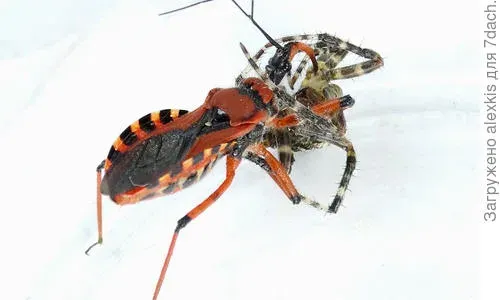
Assassin bug of the genus Rhynocoris
Rhynocoris
Description
How to identify
The Rhynocoris genus belongs to the order Hemiptera and the family Reduviidae, commonly known as assassin bugs. They are medium-sized insects characterized by an elongated head and a robust, curved rostrum used for piercing their prey.
Adult Rhynocoris bugs often display bright, warning coloration patterns, typically combining red, black, or orange. They possess strong, well-developed legs that allow them to move swiftly across plant foliage while hunting.
It is crucial to clarify that Rhynocoris is not a plant pest. In agricultural terms, it is considered a beneficial entomophage, a natural predator that feeds on other insects.
To distinguish them from herbivorous bugs, look at the rostrum: in predatory assassin bugs, it is short, thick, and curved under the body, specifically evolved for injecting venom into prey rather than feeding on plant tissues.
These bugs are active hunters, patrolling plant surfaces with keen eyesight to detect the movement of potential prey, making them highly effective natural controllers of insect populations.
What it damages
The Rhynocoris assassin bug does not cause any damage to crops. They are obligate predators, meaning their survival depends entirely on the consumption of other insects, not plant matter.
Their diet includes a wide range of common garden and field pests, such as aphids, leaf-feeding caterpillars, beetle larvae, and other small insects that typically harm agricultural productivity.
Physiologically, these bugs are unable to damage plants because their mouthparts are designed strictly for liquefying and consuming the hemolymph of their prey rather than feeding on sap or leaves.
Their presence on a farm is a positive sign, indicating a healthy ecosystem where natural predators are keeping potential pest populations below the economic injury level.
Because they do not attack crops, they pose no threat to the harvest and are instead vital components of sustainable and integrated pest management programs.
When it appears
The activity of Rhynocoris species is concentrated in the warmer months, typically beginning in late spring and extending until the onset of autumn frost.
The life cycle usually involves one or two generations per year, with activity levels fluctuating based on local temperature and the abundance of available prey species.
Eggs are typically laid in protected clusters on stems or leaf litter, where nymphs emerge and begin their predatory lifestyle immediately, mimicking the hunting behavior of their parents.
During the summer months, they are most active, aggressively searching for prey in fields, orchards, and gardens where insect activity is at its highest.
Winter survival involves the adults entering diapause, seeking shelter in tree bark, dense vegetation, or debris, effectively waiting out the cold season until the next spring.
Signs of infestation
A primary sign of Rhynocoris presence is the observation of them patrolling plants. Since they are hunters, you will often find them stationary on leaves, waiting for prey.
The reduction in pest populations, such as aphids or small larvae, without the visible impact of chemical pesticides, often indicates the successful work of these predators.
The total absence of characteristic pest-induced leaf damage or fruit blemishes around the bug serves as proof that it is a beneficial visitor rather than a harmful one.
In some cases, you may notice empty, shriveled exoskeletons of pest insects left behind on the foliage, which is a tell-tale sign that a predator has been feeding in the area.
Identifying these bugs correctly allows farmers to avoid unnecessary pest control measures, thereby preserving the beneficial insect community within the field.
Control measures
No control measures are needed for the Rhynocoris assassin bug, as they are valuable allies in sustainable farming. Farmers should actively encourage their presence rather than eliminate them.
Limiting the use of broad-spectrum insecticides is the most effective way to preserve Rhynocoris populations, as these chemicals are equally lethal to natural predators as they are to pests.
Implementing integrated pest management (IPM) practices, such as using selective biological controls, helps maintain high levels of these beneficial insects throughout the growing season.
Providing habitat diversity, including field margins and cover crops, ensures that these predators have shelter and alternative food sources during periods when pest populations are low.
In conclusion, viewing Rhynocoris as a natural biological control agent rather than a pest is essential for reducing chemical dependency and enhancing the overall resilience of the crop ecosystem.
Taxonomy
- Latin name
- Rhynocoris
- Order
- Hemiptera (bugs, aphids, leafhoppers)
- Family
- Reduviidae
- EPPO code
- RHNCSP
Discussion
No discussions yet — be the first.