
Common grackle
Quiscalus quiscula
Description
How to identify
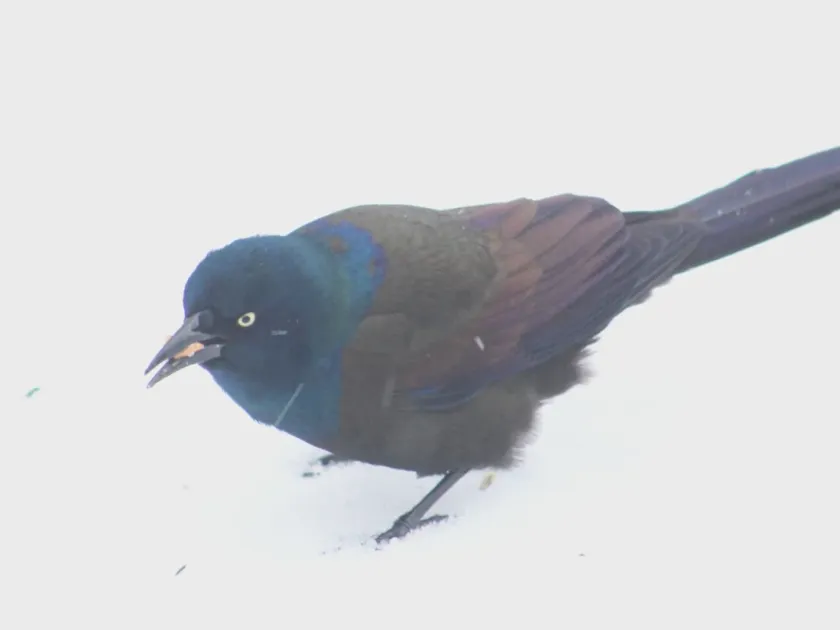
The Common grackle Quiscalus quiscula is a species of the Icteridae family, within the Passeriformes order. These birds are characterized by their long, iridescent tails and distinct, robust beaks.
Males possess a striking black plumage that displays iridescent bronze, green, or purple highlights depending on the light angle. Females typically feature a duller, brown-toned appearance.
Common grackles are highly social and gregarious, often forming large flocks that can congregate in agricultural areas, leading to significant damage.
They are highly adaptable to diverse environments, frequently utilizing both natural habitats and man-made structures for nesting and roosting.
Their life cycle involves breeding in the spring, with nests often built in dense vegetation or trees, allowing them to rapidly colonize areas near food sources.
What it damages
The primary economic impact of the Common grackle is on cereal crops, particularly corn, where they target seeds and developing kernels.
Grackles damage corn by stripping the husks from ears to reach the kernels, which not only causes direct yield loss but also exposes the plant to moisture and rot.
Sunflowers are also frequently targeted, with the birds picking apart the heads to feed on the ripening seeds in the late summer months.
Vegetable crops and orchards may suffer from feeding damage, as grackles will peck at ripe fruits and vegetables, reducing their marketability.
Seedling destruction is another major issue, as grackles pull up freshly sprouted seeds, leading to uneven crop stands and requiring costly replanting efforts.
When it appears
Spring is a critical window for crop protection, as grackles actively search for newly planted seeds in the soil during the germination phase.
Late summer marks the second period of intense pressure when the grain reaches the milk and dough stages, becoming highly attractive to foraging flocks.
Their migratory habits ensure that large populations move through agricultural zones, prolonging the duration of potential risk throughout the growing season.
Peak feeding activity usually occurs during the early morning and late afternoon, when the birds are most motivated to search for nutrient-dense food.
Extended drought periods can force grackles to damage plants for moisture, increasing the frequency and intensity of their attacks during dry years.
Signs of infestation
The presence of pulled-up seedlings with distinctive bill marks on the seed coat is the most common early sign of grackle infestation.
In cornfields, shredded husks on standing ears indicate that birds have accessed the kernels, leaving the ears vulnerable to further environmental damage.
High densities of bird droppings on foliage and in the soil indicate that large flocks are roosting or spending significant time on the property.
Sunflower heads that appear partially stripped or ragged, with seeds missing in irregular patterns, are a clear indication of avian feeding activity.
Observing large flocks moving between nearby tree lines and the field is a reliable indicator that the crop is being utilized as a primary food source.
Control measures
Visual deterrents such as reflective tape, hawk silhouettes, or motion-activated devices can be effective in discouraging birds from landing.
Acoustic deterrents, including broadcasted predator calls or recorded distress calls, are widely used to manage bird populations on larger agricultural tracts.
Seed treatments using taste-aversion repellents can make planted seeds unpalatable, successfully deterring birds during the critical germination period.
Cultural practices, such as minimizing spill during harvest and managing nearby roosting sites, help to reduce the overall attractiveness of the field.
Rapid harvest techniques, when possible, minimize the window of opportunity for grackles to feed on mature crops, effectively reducing potential harvest losses.
Taxonomy
- Latin name
- Quiscalus quiscula
- Family
- Icteridae
- EPPO code
- QUISQU
Discussion
No discussions yet — be the first.