
Bobolink
Dolichonyx oryzivorus
Description
How to identify
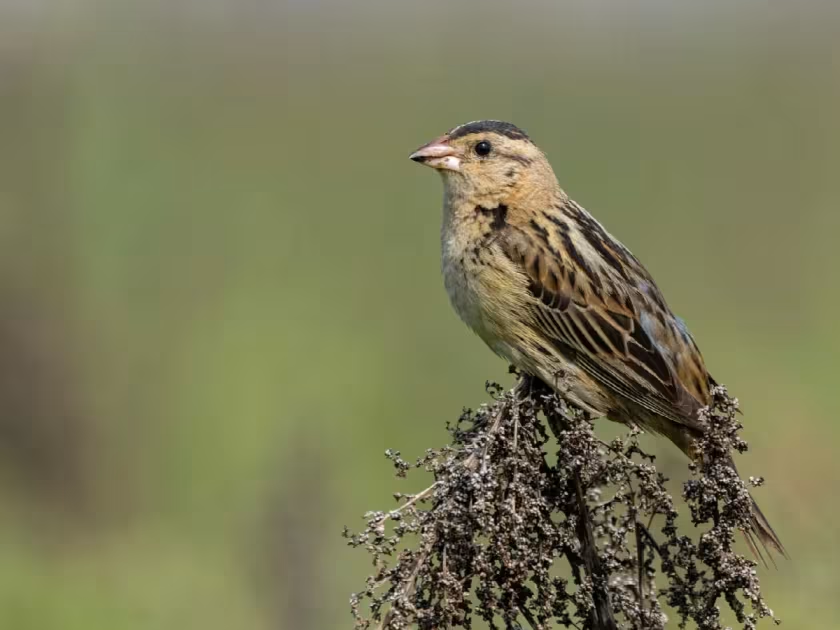
The Bobolink (Dolichonyx oryzivorus) belongs to the order Passeriformes and the family Icteridae. During the breeding season, adult males exhibit a striking, contrasting plumage with black underparts and breast combined with a white rump and a creamy patch on the nape.
Females and young birds have a more modest appearance, resembling large sparrows with buff plumage and dark streaks. This cryptic coloration helps them blend into dense vegetation in fields and meadows.
This species is renowned for its long-distance migration between North American breeding grounds and South American wintering sites. In agricultural regions, they are often known as "rice birds" due to their notorious habit of raiding fields during grain maturation.
Prior to their autumn migration, these birds congregate in massive flocks, which poses a significant threat to farming operations. Their complex social structure enables them to coordinate foraging efforts, complicating the protection of agricultural lands.
A key morphological feature is their powerful, conical bill, adapted for husking tough seed hulls. This anatomical trait allows them to efficiently feed on both wild grasses and cultivated rice crops.
What it damages
Significant damage is inflicted upon rice crops, particularly during the milky-wax maturity stage of the grain. Flocks can destroy a substantial portion of the harvest on a specific field plot within just a few hours.
Beyond rice, the Bobolink damages sorghum, millet, and other grain crops if they lie along their migratory path. The sheer scale of these flocks makes them a major risk factor for producers.
The damage primarily consists of the mass consumption of grain from the panicles. In addition to direct harvest loss, birds break plant stems, leading to lodging, which results in secondary losses due to decay and increased disease susceptibility.
Grain damage also creates entry points for fungal and bacterial pathogens, which lowers the quality of the harvested grain even in unaffected parts of the panicle, leading to downgraded market value.
Damage is especially noticeable near rest areas or along the edges of fields bordering natural meadows or shelterbelts, where the birds find cover before descending on the crops to feed.
When it appears
The peak activity period for this pest occurs in late summer and early autumn, coinciding with flock formation prior to southern migration. This timing aligns precisely with the rice maturation phase.
In northern rice-growing regions, the arrival of these flocks often overlaps with peak harvesting schedules, creating a conflict between crop protection efforts and actual harvesting logistics.
Bird activity is highly dependent on meteorological conditions. During rainy or overcast periods, birds are less active, whereas sunny weather encourages massive raids on fields during early morning and late evening hours.
The seasonal cycle is strictly governed by migration biology, resulting in infestations that are temporary but extremely intense. Outside the grain maturation window, these birds pose virtually no threat to cultivated plantings.
Understanding the exact arrival dates of flocks in a specific locality allows producers to pre-install deterrents to minimize risks during the critical maturation week.
Signs of infestation
The first indicator of a pest presence is a sharp increase in noise levels over the field during dawn or dusk. The collective chattering of the flock can be heard from a significant distance.
On the plants themselves, one can find gnawed panicles with empty grain hulls. Frequently, individual plants show signs of grain processing, accompanied by scattered scales and debris around the base.
Massive gatherings of birds on utility wires or tall trees near fields often serve as a signal that the entire flock is preparing to descend upon the crops.
The appearance of "bald patches" in the field, where damaged plants are bent or broken, indicates prolonged flock presence in that area.
- Presence of excrement on plant leaves.
- Damaged, husked rice panicles.
- Broken stalks of grain crops.
- Massive bird flights from woodlands to fields.
- Characteristic absence of grain in the lower and middle sections of the panicle.
Control measures
The most effective protection methods include visual and auditory deterrents. The use of propane cannons that mimic shotgun blasts creates a zone of discomfort for the flocks.
Applying reflective ribbons, holographic spheres, and scarecrows with moving parts helps in smaller areas, though birds quickly habituate to static threats, necessitating regular relocation of these tools.
Timely harvesting is a crucial agronomic strategy to minimize the duration of time that mature grain remains in the field vulnerable to flock raiding.
In some regions, the use of drones for field patrols has proven successful, as they effectively disperse flocks through their noise and unnatural aerial movement.
For high-value seed production plots, using bird exclusion netting is a radical yet highly effective method to guarantee complete protection against raiding birds.
Taxonomy
- Latin name
- Dolichonyx oryzivorus
- Family
- Icteridae
- EPPO code
- DLNXOR
Discussion
No discussions yet — be the first.